Lyrics
[Intro – Distant Male Choir]
Patroclus has fallen…
His armour is gone…
But no friend of Achilles
Will be abandoned to Troy.
[Verse 1]
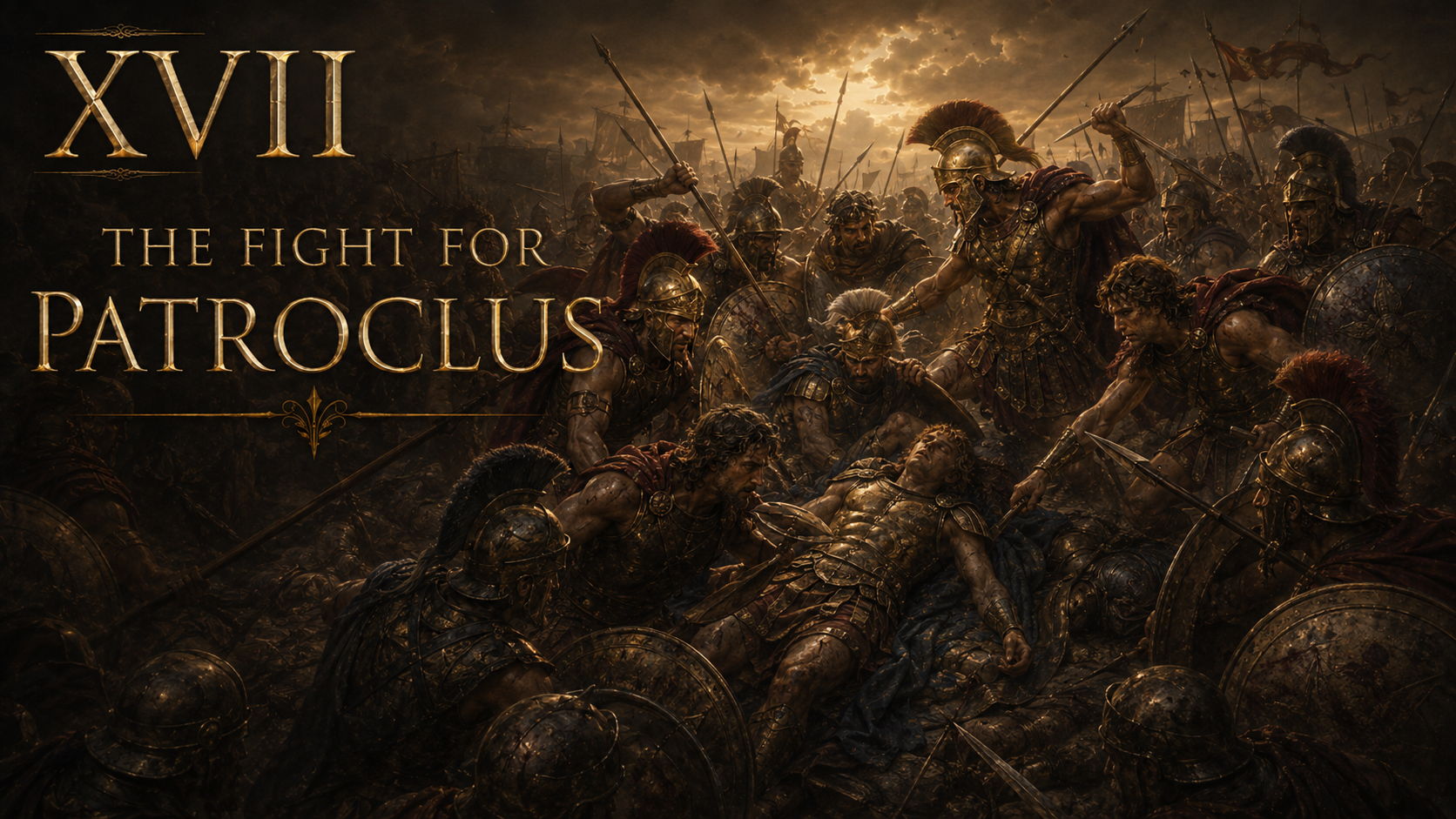
Patroclus lay where spearpoints shone,
His borrowed armour stripped and gone.
Around him rolled the battle’s tide,
As Greece and Troy closed side by side.
Menelaus stood above the dead,
His shield held firm above his head.
Euphorbus came and claimed the slain:
“I struck him first—
Now leave the plain!”
Menelaus answered spear with spear,
And Euphorbus fell beside him there.
[Verse 2]
But Hector’s war cry shook the field,
And Menelaus knew one shield
Could never hold the Trojan flood.
He called both Ajaxes through the blood.
They came with comrades at their side,
A ring of bronze against the tide.
Shield locked to shield, no space remained;
No Trojan hand would touch the slain.
[Chorus – Warrior Choir]
Hold the line!
Let no man yield!
Lock every shield across the field!
Whatever bronze and fury come,
We will bring Patroclus home!
Not for plunder,
Not for fame,
But for the friend who knew our name.
Let Troy hear every Argive cry:
We guard our own until we die!
[Verse 3]
Hector came in god-forged gold,
A borrowed blaze both bright and cold.
He drove the Trojans wave on wave
To seize the body of the brave.
Both armies pulled the fallen man
With all the strength of heart and hand.
Spears broke apart and warriors fell;
The dust became a living hell.
The fight lost every shape and name—
One fallen friend became the flame.
[Chorus – Warrior Choir]
Hold the line!
Let no man yield!
Lock every shield across the field!
Whatever bronze and fury come,
We will bring Patroclus home!
Not for plunder,
Not for fame,
But for the friend who knew our name.
Let Troy hear every Argive cry:
We guard our own until we die!
[Lament – Cello, Lyre and Distant Choir]
Far from the cries, the horses stood,
Still as stone in dust and blood.
Xanthos and Balios, born of air,
Would neither wheel nor leave him there.
They bowed their heads beneath the yoke;
No hoof replied, no harness spoke.
Automedon called with voice and rein,
Yet nothing moved their rooted pain.
Their deathless eyes shed mortal rain
For hands that would not rise again.
Zeus gave their limbs their strength once more,
But not the peace they knew before.
No god who rules the earth or sky
Can teach a grieving heart goodbye.
[Verse 4]
Alcimedon gathered every rein;
Automedon faced the field again.
With shield and spear he turned to stand
And guard the horses of the deathless land.
Hector and Aeneas came
To seize the steeds of ageless fame.
Aretus followed at their side;
Automedon struck—Aretus died.
Then Ajax came with shield held fast,
And Hector’s grasp was broken at last.
[Bridge – Rising Drums]
A darkness smothered friend and foe;
No eye could see where death would go.
Great Ajax raised his face and cried:
“Father Zeus,
Give light,
Though here we die!”
The cloud was torn, the field lay bare,
And Menelaus found the runner there.
“Antilochus, run to the sea!
Carry this grief to Achilles for me.
Patroclus lies behind our wall.
His dearest friend will never call.
Run now—
Before the Trojans come.
We fight to bring his body home!”
[Final Verse]
Menelaus and Meriones
Bent to the burden in the press.
The Ajaxes turned, shield upon shield,
And walked backwards from the field.
Each step was bought,
Each breath was hard;
Two living walls became his guard.
Towards the ships,
Through dust and stone,
They carried Patroclus home.
[Final Chorus – Full Choir]
Hold the line!
Let no man yield!
Lock every shield across the field!
Though bronze and fire and fury come,
We carry Patroclus home!
No Trojan wall shall claim his name,
No enemy shall shame the slain.
Through spear and dust,
Though daylight’s gone,
We carry Patroclus home!
[Outro – Slowing]
The shield wall moved;
The daylight bled,
And grief marched with the honoured dead.
A runner crossed the darkening shore
To wake a wrath unknown before.
And through the dust one promise shone:
No fallen friend
Is left alone.
[Low Choir]
Patroclus…
Home.
[Decisive Final Chord]
Translations
English
The original English lyrics are shown in the Lyrics section above.
Deutsch
Der siebzehnte Gesang wird vollständig von Patroklos’ Tod beherrscht. Menelaos verteidigt den Körper, tötet Euphorbos und ruft die beiden Aias, als Hektor und die Trojaner vordringen.
Hektor legt Achilleus’ göttliche Rüstung an und deutet sie als höchsten Ruhm, während Zeus darin sein nahes Ende erkennt. Um den Leichnam schließt sich ein Wall aus Schilden; die Schlacht wird zu einem kollektiven Ringen ohne klaren Einzelhelden.
Abseits davon weinen Achilleus’ unsterbliche Pferde. Zeus gibt ihnen Kraft, Automedon und Alcimedon kämpfen um den Wagen, und schließlich wird Antilochos zu Achilleus geschickt. Der Körper kehrt heim; die Nachricht und der kommende Zorn folgen ihm.
Español
El canto decimoséptimo está dominado por completo por la muerte de Patroclo. Menelao defiende el cuerpo, mata a Euforbo y llama a los dos Áyax cuando avanzan Héctor y los troyanos.
Héctor se pone la armadura divina de Aquiles y la interpreta como gloria suprema, mientras Zeus ve en ella su próximo final. Un muro de escudos se cierra alrededor del cadáver y la batalla se convierte en una lucha colectiva sin un héroe individual claro.
Lejos de allí lloran los caballos inmortales de Aquiles. Zeus les devuelve la fuerza, Automedonte y Alcimedonte luchan por el carro y, finalmente, Antíloco es enviado a Aquiles. El cuerpo vuelve; detrás vienen la noticia y la ira futura.
Français
Le dix-septième chant est entièrement dominé par la mort de Patrocle. Ménélas défend le corps, tue Euphorbe et appelle les deux Ajax lorsque Hector et les Troyens avancent.
Hector revêt l’armure divine d’Achille et y voit la gloire suprême, tandis que Zeus y reconnaît sa fin prochaine. Un mur de boucliers se ferme autour du cadavre et la bataille devient une lutte collective sans héros individuel clairement dominant.
À l’écart pleurent les chevaux immortels d’Achille. Zeus leur rend leur force, Automédon et Alcimédon combattent pour le char, puis Antiloque est envoyé vers Achille. Le corps revient ; la nouvelle et la colère à venir le suivent.
Reflection
English
Book XVII asks what remains of a person on the battlefield after speech and agency are gone. Patroclus cannot act, yet his body still binds allies, provokes enemies, moves gods, stops immortal horses, and reorganizes the entire field around itself.
The book also shifts heroism from conquest to retrieval. The Greeks do not win territory; they preserve relationship, memory, and the possibility of burial. Their limited success carries the story toward Achilles, where private grief will again become public violence.
Textual basis
Homer, Iliad, Book XVII, lines 1–761.
Reference edition used
Homer, Ilias. Griechisch–deutsch. Translated into German from the ancient Greek by Hans Rupé, 16th edition, Akademie Verlag, Berlin, 2013.
Deutsch
Gesang XVII fragt, was von einem Menschen auf dem Schlachtfeld bleibt, wenn Sprache und Handlungsmacht erloschen sind. Patroklos kann nicht mehr handeln, doch sein Körper bindet Verbündete, reizt Feinde, bewegt Götter, lässt unsterbliche Pferde erstarren und ordnet das gesamte Feld neu.
Der Gesang verschiebt Heldentum außerdem von Eroberung zu Bergung. Die Griechen gewinnen kein Land; sie bewahren Beziehung, Erinnerung und die Möglichkeit der Bestattung. Ihr begrenzter Erfolg trägt die Handlung zu Achilleus, wo private Trauer wieder zu öffentlicher Gewalt werden wird.
Textgrundlage
Homer, Ilias, Gesang XVII, Verse 1–761.
Verwendete Referenzausgabe
Homer, Ilias. Griechisch–deutsch. Übertragen von Hans Rupé, 16. Auflage, Akademie Verlag, Berlin 2013.
Español
El canto XVII pregunta qué queda de una persona en el campo de batalla cuando ya no tiene palabra ni capacidad de actuar. Patroclo no puede hacer nada, pero su cuerpo une a los aliados, provoca a los enemigos, conmueve a los dioses, detiene a caballos inmortales y reorganiza todo el campo.
El canto también desplaza el heroísmo de la conquista a la recuperación. Los griegos no ganan territorio; conservan la relación, la memoria y la posibilidad del entierro. Su éxito limitado lleva la historia hacia Aquiles, donde el duelo privado volverá a convertirse en violencia pública.
Base textual
Homer, Ilíada, canto XVII, versos 1–761.
Edición de referencia utilizada
Homer, Ilias. Griechisch–deutsch. Traducción alemana del griego antiguo de Hans Rupé, 16.ª edición, Akademie Verlag, Berlín, 2013.
Français
Le chant XVII demande ce qui reste d’une personne sur le champ de bataille lorsque parole et puissance d’agir ont disparu. Patrocle ne peut plus agir, pourtant son corps lie les alliés, provoque les ennemis, émeut les dieux, arrête les chevaux immortels et réorganise tout le champ.
Le chant déplace aussi l’héroïsme de la conquête vers la récupération. Les Grecs ne gagnent aucun territoire ; ils préservent la relation, la mémoire et la possibilité des funérailles. Leur succès limité porte le récit vers Achille, où le deuil privé redeviendra violence publique.
Base textuelle
Homer, Iliade, chant XVII, vers 1–761.
Édition de référence utilisée
Homer, Ilias. Griechisch–deutsch. Traduction allemande du grec ancien par Hans Rupé, 16e édition, Akademie Verlag, Berlin, 2013.