Lyrics
Dust upon dust…
Blood upon blood…
A body between two armies…
A name neither side will surrender…
Menelaus stood above the slain,
Alone beneath the iron rain.
But through the dust he raised his cry,
To every Greek who still stood nigh.
“Ajax, come! Let the strongest hear!
The son of Menoetius lies here!
His breath is gone, his armour torn—
But he shall not to Troy be borne!”
Then through the shattered ranks they came,
Two mighty warriors bearing one name.
Telamon’s son with tower shield,
And Oileus’ Ajax crossed the field.
Close every space and lock the line!
Set shield to shield and sign to sign!
Let Hector bring the strength of Troy—
This wall of bronze he shall not destroy!
Stand over Patroclus, shoulder to shoulder!
Let no man weaken, let no heart grow colder!
The dead cannot speak, the dead cannot plead—
We are his voice in his hour of need!
Shield beside shield!
Spear beside spear!
No road behind us!
No room for fear!
Shield beside shield!
Hold fast, hold true!
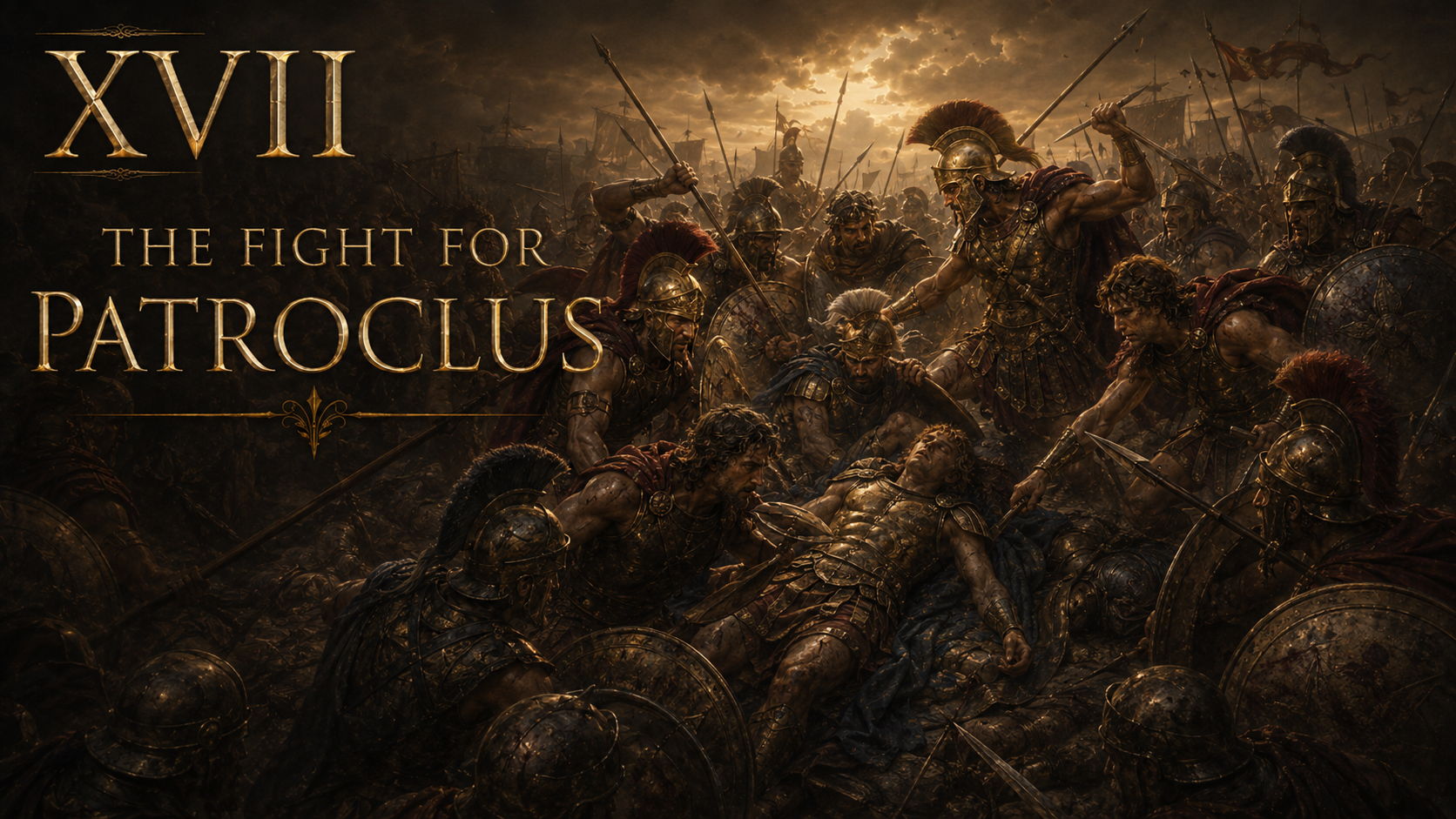
The body of Patroclus
Will not pass through!
We are the wall around the fallen,
We are the bronze that will not break!
Let Hector strike, let Troy come roaring,
Not one step backward shall we take!
Over the dead our shields are closing,
Under the spears our feet remain.
We are the wall around Patroclus—
Built out of honour, blood and pain!
They formed a ring above the ground,
A living fortress, locked and bound.
Their helmets touched, their spearpoints crossed,
Each man already counting loss.
Behind the shield rims, eyes burned red,
Before their feet lay Greece’s dead.
No open space, no breath, no sky—
Only the choice to stand or die.
Then Hector came in stolen light,
Achilles’ armour burning bright.
He lifted high his ashwood spear,
And Trojan voices thundered near.
Men of Troy, the hour is ours!
Break their shields and crush their powers!
Drag the corpse from beneath their feet—
Let dogs of Ilium taste Greek meat!
Who brings Patroclus to our wall
Shall stand in glory above you all!
Half of the spoils shall be his prize—
Now strike where Greece’s honour lies!
Forward!
Forward!
Break the ring!
Forward!
Forward!
Seize the king!
Take the body!
Take the fame!
Let Troy remember
Hector’s name!
Lock the shields!
Drive them apart!
Hold the ground!
Strike at the heart!
No man yields!
No man stands!
Bronze against bronze!
Hands against hands!
We are the wall around the fallen,
We are the bronze that will not break!
Let Hector strike, let Troy come roaring,
Not one step backward shall we take!
Over the dead our shields are closing,
Under the spears our feet remain.
We are the wall around Patroclus—
Built out of honour, blood and pain!
The Trojans crashed against the line
Like winter seas against a shrine.
The shields bent inward, wood was torn,
The horsehair crests were ripped and shorn.
Spears struck bronze and bronze struck bone,
Men died unseen and fell unknown.
The living stumbled on the dead,
While dark earth drank the blood they shed.
Three times the Trojans reached the slain,
Three times the Greeks drove back the chain.
Three times the body changed its ground,
Dragged by hands from all around.
No single warrior ruled the fight,
No hero stood alone in light.
The battle had no face or name—
One beast of bronze, one mouth of flame.
Close the gap upon the right!
They press us hard—stand firm and fight!
The shield beside you is your breath,
The man beside you bars your death!
Do not look down, do not look back!
The Trojan spear seeks every crack!
Let every shoulder bear the weight—
One broken line will seal our fate!
Patroclus, hear us through the ground!
Your friends still stand, your guards surround!
Though you lie silent beneath our feet,
We will not give you in defeat!
Again, you sons of Troy, again!
Their arms grow weak, they bury their pain!
Their shields are split, their breathing slow—
One final strike will lay them low!
Push them!
Crush them!
Tear the wall!
Drag the fallen!
Take them all!
Hold now!
Hold now!
Do not bend!
Guard the body!
Guard the friend!
The sun disappeared behind the dust,
The air became a cloak of rust.
No warrior knew if day remained,
No eye could see the ground bloodstained.
The Greeks stood blind beneath the cloud,
Their breathing harsh, their silence loud.
The weight of shields broke arm and spine,
Yet none stepped out from the dying line.
Father Zeus, we ask no flight,
We ask no rescue from the fight.
Only tear this darkness from our eyes—
Let us die beneath an open sky!
Give us light to see the spear,
Give us light to master fear!
If death must take us where we stand,
Let death approach with face and hand!
Then through the dust a pale light broke,
Across the shields, across the smoke.
The Greeks beheld the field once more—
The dead, the blood, the Trojan shore.
And in that light their courage grew,
For every man beside them knew:
Patroclus must be borne away,
Before the ending of the day.
Lift him now, but guard the line!
Echepolus, Meriones—combine!
Take the body, bear the weight!
The Ajaxes shall close the gate!
Step by step and shield by shield,
Carry him backward from the field!
No hurried flight, no broken chain—
We bring Patroclus home again!
Lift the fallen!
Guard the way!
Lift the fallen!
Do not sway!
Shield above him!
Spears behind!
One dead brother!
One living line!
We are the wall around the fallen,
We are the bronze that did not break!
Hector struck and Troy came roaring,
But not one friend did we forsake!
Over the dead our shields were closing,
Under the spears our feet remained.
We were the wall around Patroclus—
Built out of honour, blood and pain!
Carry him home through dust and thunder!
Carry him back toward the sea!
Let every spear descend upon us—
His body shall return with me!
We are the wall!
We are the shield!
We are the men
Who would not yield!
Behind them Hector still pursued,
Through broken ranks and fields of blood.
Before them waited ships and shore—
And one who knew his friend no more.
The body moved beneath the shields,
Slowly from the killing fields.
But somewhere near the distant sea,
Achilles waited silently.
Carry him home…
Carry him home…
The news must follow…
The grief must come…
Translations
English
The original English lyrics are shown in the Lyrics section above.
Deutsch
Menelaos ruft die beiden Aias herbei, und die Griechen schließen ihre Schilde zu einer Mauer um Patroklos. Jede Lücke wird zur Gefahr; jeder Nebenmann wird zum Schutz des anderen.
Hektor verspricht Ruhm und Beute für die Eroberung des Leichnams. Trojaner und Griechen prallen wiederholt aufeinander, während Staub, Lärm und Blut die einzelnen Kämpfer in zwei gewaltige Massen verwandeln.
Als Zeus den Staub aufreißt und wieder Sicht gibt, beginnen die Griechen den Rückzug. Einige tragen Patroklos, die Aias decken den Weg: Schild für Schild kehrt der Tote zu den Schiffen zurück.
Español
Menelao llama a los dos Áyax y los griegos cierran sus escudos como un muro alrededor de Patroclo. Cada abertura es un peligro; cada compañero se convierte en protección para el siguiente.
Héctor promete gloria y botín a quien capture el cadáver. Troyanos y griegos chocan una y otra vez, mientras polvo, ruido y sangre convierten a los guerreros individuales en dos masas enormes.
Cuando Zeus abre la nube de polvo y devuelve la visión, los griegos comienzan a retirarse. Unos cargan a Patroclo y los Áyax cubren el camino: escudo tras escudo, el muerto vuelve hacia las naves.
Français
Ménélas appelle les deux Ajax et les Grecs ferment leurs boucliers en un mur autour de Patrocle. Chaque ouverture devient un danger ; chaque voisin protège celui qui se tient près de lui.
Hector promet gloire et butin à celui qui s’emparera du cadavre. Troyens et Grecs se heurtent sans cesse, tandis que poussière, bruit et sang transforment les combattants en deux masses immenses.
Lorsque Zeus déchire le nuage de poussière et rend la vue, les Grecs commencent leur retraite. Certains portent Patrocle, les Ajax couvrent le chemin : bouclier après bouclier, le mort revient vers les nefs.
Reflection
English
This struggle suspends the Iliad’s usual focus on the exceptional individual. No single warrior can save Patroclus; survival and fidelity depend on bodies aligned, overlapping shields, and the willingness to bear a shared weight.
The wall is both military formation and moral image. It is made from vulnerability rather than invulnerability: each man can be pierced, yet together they create enough time and space to return the dead to his community.
Textual basis
Homer, Iliad, Book XVII, lines 262–425 and 715–761.
Reference edition used
Homer, Ilias. Griechisch–deutsch. Translated into German from the ancient Greek by Hans Rupé, 16th edition, Akademie Verlag, Berlin, 2013.
Deutsch
Dieser Kampf setzt den üblichen Fokus der Ilias auf den außergewöhnlichen Einzelnen zeitweise außer Kraft. Kein einzelner Krieger kann Patroklos retten; Überleben und Treue hängen von ausgerichteten Körpern, überlappenden Schilden und der Bereitschaft ab, eine gemeinsame Last zu tragen.
Der Wall ist militärische Formation und moralisches Bild zugleich. Er besteht nicht aus Unverwundbarkeit, sondern aus geteilter Verletzlichkeit: Jeder Mann kann getroffen werden, doch gemeinsam schaffen sie genügend Zeit und Raum, um den Toten zu seiner Gemeinschaft zurückzubringen.
Textgrundlage
Homer, Ilias, Gesang XVII, Verse 262–425 and 715–761.
Verwendete Referenzausgabe
Homer, Ilias. Griechisch–deutsch. Übertragen von Hans Rupé, 16. Auflage, Akademie Verlag, Berlin 2013.
Español
Esta lucha suspende el habitual énfasis de la Ilíada en el individuo excepcional. Ningún guerrero puede salvar solo a Patroclo; la supervivencia y la fidelidad dependen de cuerpos alineados, escudos superpuestos y la voluntad de cargar un peso común.
El muro es a la vez formación militar e imagen moral. No nace de la invulnerabilidad, sino de una vulnerabilidad compartida: cada hombre puede ser atravesado, pero juntos crean el tiempo y el espacio necesarios para devolver al muerto a su comunidad.
Base textual
Homer, Ilíada, canto XVII, versos 262–425 and 715–761.
Edición de referencia utilizada
Homer, Ilias. Griechisch–deutsch. Traducción alemana del griego antiguo de Hans Rupé, 16.ª edición, Akademie Verlag, Berlín, 2013.
Français
Ce combat suspend l’attention habituelle de l’Iliade portée à l’individu exceptionnel. Aucun guerrier ne peut sauver Patrocle seul ; survie et fidélité dépendent de corps alignés, de boucliers superposés et de la volonté de porter un poids commun.
Le mur est à la fois une formation militaire et une image morale. Il ne vient pas de l’invulnérabilité, mais d’une vulnérabilité partagée : chacun peut être transpercé, pourtant tous ensemble créent le temps et l’espace nécessaires pour rendre le mort à sa communauté.
Base textuelle
Homer, Iliade, chant XVII, vers 262–425 and 715–761.
Édition de référence utilisée
Homer, Ilias. Griechisch–deutsch. Traduction allemande du grec ancien par Hans Rupé, 16e édition, Akademie Verlag, Berlin, 2013.