Lyrics
Bronze of the gods…
Gift of the heavens…
Forged for a hero…
Worn by the doomed…
Dust moved like smoke across the plain,
And bronze on bronze rang out like rain.
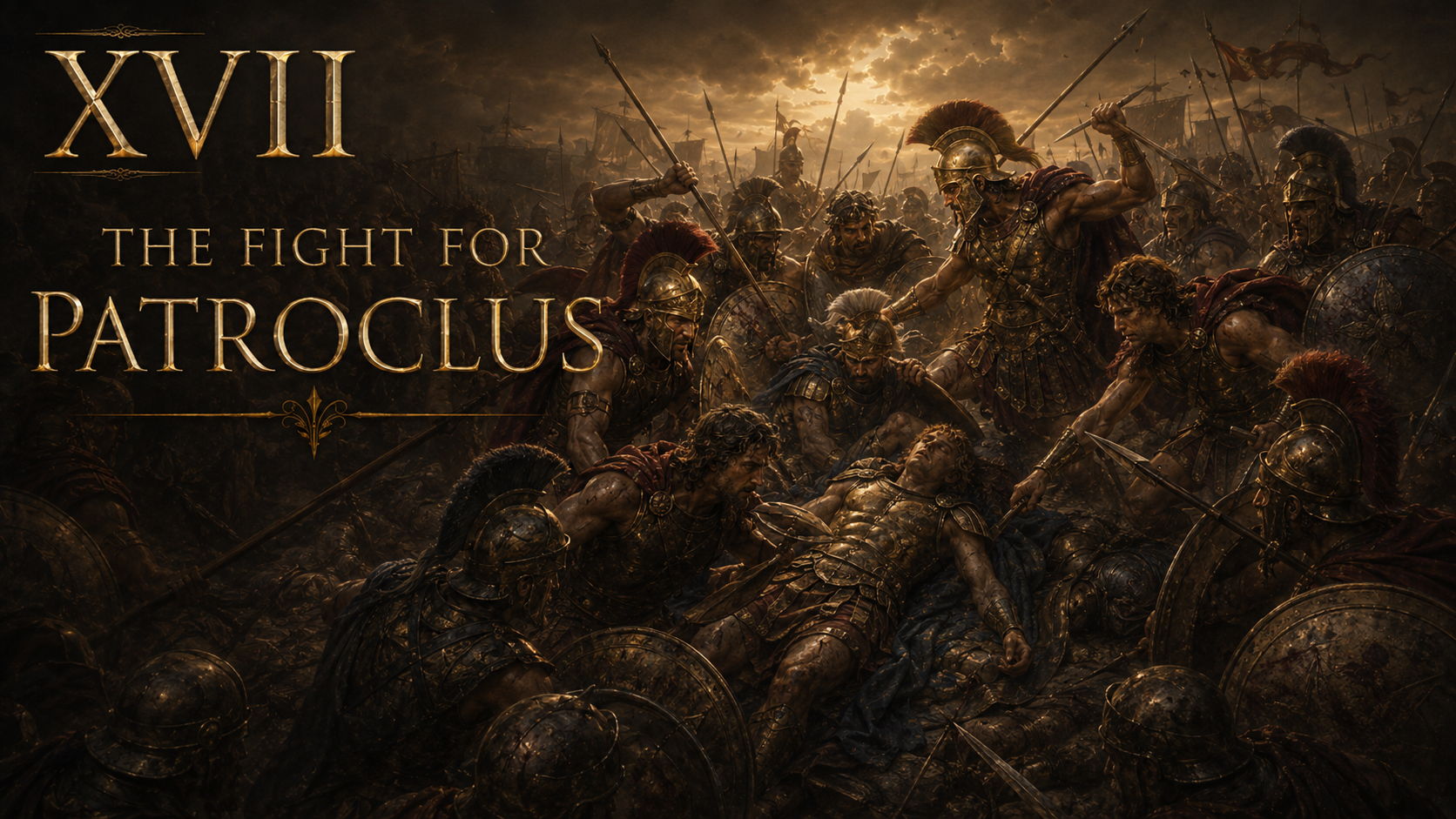
Around Patroclus, shield and spear
Closed in through blood, through rage, through fear.
His breath was gone; he lay there still,
While men fought on with iron will.
Beside him, in the trampled sand,
Lay deathless work of heaven’s hand.
The greaves, the breastplate, shield and helm
Had clothed the terror of the realm.
The armour, beautiful and bright,
Had made Achilles blaze in fight.
Now Hector came through smoke and cries
And saw that glory with his eyes.
He knew the gift, he knew the fame,
And reached to clothe himself in flame.
The deathless gods to Peleus gave
This shining wall no spear could brave.
From father into Achilles’ hand,
It came like fire upon the land.
Now Hector called above the roar:
“Bring me the arms Achilles wore!”
I wear Achilles’ thunder,
I bear his god-forged flame.
Let every Greek behold me now
And tremble at my name.
Bronze of heaven, bind me tight,
Crown me for the coming fight.
Let the towers of Ilium cry:
Hector stands beneath the sky!
Raise it!
Fasten it!
Lift the horsehair high!
Hector walks in Achilles’ light—
And men believe he cannot die.
The bronze greaves closed around his shins,
The breastplate locked the fury in.
The mighty shield embraced his arm,
The helmet blazed with fatal charm.
The horsehair streamed above his head,
Like fire awakened from the dead.
The armour fitted limb to limb,
And Ares breathed his strength through him.
The Trojans roared; the Argives turned,
Across the field the bronze light burned.
Hector struck his shield and cried:
“Stand with me now!
Cast fear aside!”
His voice ran down the Trojan line
And made their battered faces shine.
One gleaming shape in borrowed gold
Made weary warriors fierce and bold.
I wear Achilles’ thunder,
I bear his god-forged flame.
Let every Greek behold me now
And tremble at my name.
Bronze of heaven, bind me tight,
Crown me for the coming fight.
Let the towers of Ilium cry:
Hector stands beneath the sky!
But Zeus looked down through veils of cloud
And spoke where thunder was not loud:
“Poor mortal, dressed in deathless fire,
You wear the crown of your desire.
You stripped the friend no bronze could save,
Then dressed for glory by his grave.
I grant you power for this brief day,
But Fate will never turn away.
You shall not bear this armour home;
Your final road is yours alone.
Andromache will wait in vain.
She will not see this bronze again.”
No warning reached the hero’s ear;
The battle drowned the voice of fear.
He raised his spear into the sun
And called as though the war were won:
“Let Achilles linger by the sea—
His god-made glory walks with me.
The greatest shield beneath the sky
Now serves a man who cannot die!”
I wear Achilles’ thunder,
I bear his god-forged flame.
Let every Greek behold me now
And tremble at my name.
Bronze of heaven, bind me tight,
Crown me in the dying light.
Let the towers of Ilium cry:
Hector stands—he cannot die!
Borrowed thunder…
Borrowed flame…
Death has heard the victor’s name.
Bronze may blaze and armies cry—
Even Hector has to die.
The war cry climbed; the daylight waned,
The armour shone; the doom remained.
A gift of heaven, seized in pride,
Burned like a star where heroes died.
The shield was bright, the helmet high,
The horsehair moved against the sky.
But under all that deathless gold,
A mortal fate had been foretold.
Bronze of the gods…
Gift of the heavens…
Forged for a hero…
Worn by the doomed.
Translations
English
The original English lyrics are shown in the Lyrics section above.
Deutsch
Im Staub der Schlacht liegt Patroklos tot, während Griechen und Trojaner um seinen Körper und die göttliche Rüstung kämpfen. Einst gaben die unsterblichen Götter sie Peleus; von ihm gelangte sie an Achilleus. Nun sieht Hektor den strahlenden Panzer, den Schild, die Beinschienen und den Helmbusch und lässt sich mit diesem fremden Ruhm bekleiden.
Die Rüstung schließt sich um seinen Körper, als wäre sie für ihn geschaffen. Ares erfüllt ihn mit Kraft, die Trojaner jubeln und Hektor ruft ihnen zu, Achilleus’ göttlicher Glanz gehe nun mit ihm. Im geliehenen Licht hält er sich für unbesiegbar und führt die erschöpften Krieger erneut in den Kampf.
Doch Zeus sieht bereits das Ende. Er gewährt Hektor Macht für diesen kurzen Tag, ohne das Schicksal abzuwenden: Hektor wird die Rüstung nicht heimtragen, und Andromache wird ihren Glanz niemals begrüßen. Der gestohlene Donner wird zur Krone seines Stolzes und zugleich zum sichtbaren Zeichen seines nahen Todes.
Español
Patroclo yace muerto en el polvo de la batalla mientras griegos y troyanos luchan por su cuerpo y por la armadura divina. Los dioses inmortales se la entregaron a Peleo y de él pasó a Aquiles. Ahora Héctor contempla la coraza resplandeciente, el escudo, las grebas y el casco, y se reviste con aquella gloria ajena.
La armadura se cierra alrededor de su cuerpo como si hubiera sido creada para él. Ares lo llena de fuerza, los troyanos aclaman y Héctor proclama que el esplendor divino de Aquiles marcha ahora con él. Envuelto en una luz prestada, se cree invencible y conduce de nuevo al combate a los guerreros agotados.
Pero Zeus ya conoce el final. Concede poder a Héctor durante ese breve día sin alterar el destino: Héctor no llevará la armadura a casa y Andrómaca nunca recibirá su resplandor. El trueno robado se convierte a la vez en corona de su orgullo y en señal visible de su muerte cercana.
Français
Patrocle gît mort dans la poussière du combat tandis que Grecs et Troyens se disputent son corps et l’armure divine. Les dieux immortels l’avaient offerte à Pélée, qui l’avait transmise à Achille. Hector contemple maintenant la cuirasse étincelante, le bouclier, les cnémides et le casque, puis se revêt de cette gloire étrangère.
L’armure se referme autour de son corps comme si elle avait été façonnée pour lui. Arès l’emplit de force, les Troyens l’acclament et Hector proclame que l’éclat divin d’Achille marche désormais avec lui. Enveloppé d’une lumière empruntée, il se croit invincible et ramène les guerriers épuisés au combat.
Mais Zeus connaît déjà la fin. Il accorde à Hector la puissance pour ce bref jour sans détourner le destin : Hector ne rapportera pas l’armure chez lui et Andromaque n’en accueillera jamais l’éclat. Le tonnerre dérobé devient à la fois la couronne de son orgueil et le signe visible de sa mort prochaine.
Reflection
English
The armour creates a cruel dramatic irony. Hector experiences it as an enlargement of the self, but the audience sees that he is wearing another man’s identity and the material sign of his own approaching death.
Zeus’ pity does not interrupt the pattern. Divine knowledge can name the cost without preventing it. The scene therefore joins splendour and mortality so tightly that triumph becomes indistinguishable from a funeral omen.
Textual basis
Homer, Iliad, Book XVII, lines 188–208.
Reference edition used
Homer, Ilias. Griechisch–deutsch. Translated into German from the ancient Greek by Hans Rupé, 16th edition, Akademie Verlag, Berlin, 2013.
Deutsch
Die Rüstung erzeugt eine grausame dramatische Ironie. Hektor erlebt sie als Vergrößerung seiner selbst; das Publikum sieht dagegen, dass er die Identität eines anderen und zugleich das sichtbare Zeichen des eigenen nahen Todes trägt.
Zeus’ Mitleid unterbricht den Ablauf nicht. Göttliches Wissen kann den Preis benennen, ohne ihn zu verhindern. Dadurch verbindet die Szene Glanz und Sterblichkeit so eng, dass Triumph von einem Todesvorzeichen kaum noch zu unterscheiden ist.
Textgrundlage
Homer, Ilias, Gesang XVII, Verse 188–208.
Verwendete Referenzausgabe
Homer, Ilias. Griechisch–deutsch. Übertragen von Hans Rupé, 16. Auflage, Akademie Verlag, Berlin 2013.
Español
La armadura produce una cruel ironía dramática. Héctor la vive como una ampliación de sí mismo, pero el público ve que lleva la identidad de otro hombre y el signo material de su propia muerte cercana.
La compasión de Zeus no interrumpe el curso de los hechos. El saber divino puede nombrar el precio sin impedirlo. Así, esplendor y mortalidad quedan tan unidos que el triunfo se vuelve indistinguible de un presagio fúnebre.
Base textual
Homer, Ilíada, canto XVII, versos 188–208.
Edición de referencia utilizada
Homer, Ilias. Griechisch–deutsch. Traducción alemana del griego antiguo de Hans Rupé, 16.ª edición, Akademie Verlag, Berlín, 2013.
Français
L’armure produit une cruelle ironie dramatique. Hector la ressent comme un agrandissement de lui-même, mais le public voit qu’il porte l’identité d’un autre homme et le signe matériel de sa propre mort prochaine.
La pitié de Zeus n’interrompt pas le cours des choses. Le savoir divin peut nommer le prix sans l’empêcher. La scène unit donc splendeur et mortalité au point que le triomphe devient indissociable d’un présage funèbre.
Base textuelle
Homer, Iliade, chant XVII, vers 188–208.
Édition de référence utilisée
Homer, Ilias. Griechisch–deutsch. Traduction allemande du grec ancien par Hans Rupé, 16e édition, Akademie Verlag, Berlin, 2013.