Lyrics
Hold the line…
Guard the fallen…
Bronze in dust…
Blood in silence…
The storm of spears rolled over the plain,
The earth drank deeply of sorrow and pain.
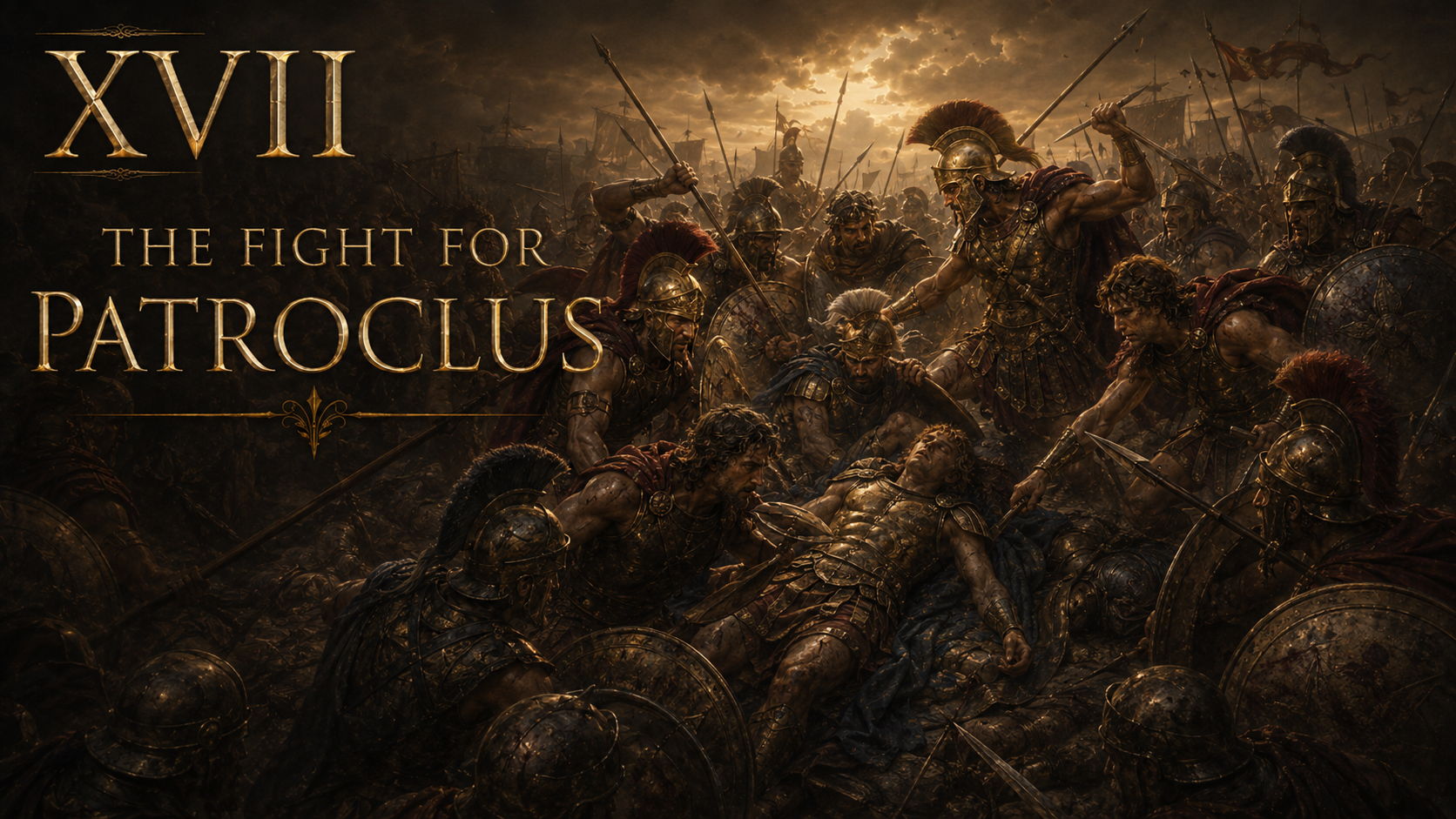
There in the dust lay Patroclus, alone,
His armour taken, his breathing gone.
But Menelaus came through the iron rain,
His shield held high above the slain.
Like a lion standing over its own,
He faced the Trojans there alone.
No hand shall drag him through the sand,
No enemy shall claim this man.
Though every spear of Troy descend,
I stand beside my fallen friend.
I will not leave him to the carrion sky,
I will not turn while the battle cries.
Let bronze meet bronze, let the red earth shake,
No Trojan hand shall his body take.
Stand over the fallen!
Stand where honour calls!
Stand over the fallen!
Though the whole world falls!
I struck him first beneath the sun,
Before the work of death was done.
The glory is mine, the spoils are mine,
Leave him now, son of Atreus’ line.
Your brother’s blood once stained my spear,
Do you remember? Do you fear?
Step back, Menelaus, while you may,
Or beside Patroclus you shall lay.
Proud words are lighter than the air,
And youth knows little of despair.
You boast before the dead and brave,
But now your pride shall find its grave.
Your brother fell when battle chose,
And now you stand where no man goes
Without the price the Fates demand—
Come take Patroclus from my hand.
Shield against shield!
Spear against spear!
Honour stands firm
When death draws near!
Euphorbus cast with all his might,
The spearhead flashed in the morning light.
It struck the shield but could not break,
The ashwood bent and began to shake.
Then Menelaus raised his spear,
No trembling hand, no trace of fear.
Through throat and neck the bronze point sped,
And Euphorbus fell among the dead.
His hair, once bound with silver and gold,
Lay dark in blood upon the wold.
His armour rang against the ground,
And silence held him without sound.
He did not leave him to the carrion sky,
He did not turn while the battle cried.
Bronze met bronze and the red earth shook,
But no Trojan hand the body took.
Stand over the fallen!
Stand where honour calls!
Stand over the fallen!
Though the whole world falls!
Patroclus, brother in the dust,
I guard what remains because I must.
Achilles waits beside the sea,
Not knowing what has come to be.
How shall I carry this grief to his shore?
How shall the world endure what comes once more?
The son of Peleus will hear your name—
And all of Troy shall answer in flame.
Stand over the fallen!
Raise the blood-dark shield!
Stand over the fallen!
Never break, never yield!
Though horses scream and war horns cry,
Though spears fall down from the burning sky,
Until my strength and breath are gone,
Beside Patroclus I stand on!
But beyond the dust…
Through the ranks of Troy…
A shadow comes wearing stolen bronze…
Hector is coming…
Hector is coming…
Hector is coming…
Translations
English
The original English lyrics are shown in the Lyrics section above.
Deutsch
Ein Sturm aus Speeren zieht über das Feld, doch Menelaos stellt sich schützend über Patroklos. Er weigert sich, den gefallenen Freund den Trojanern oder den Aasvögeln zu überlassen.
Euphorbos beansprucht Ruhm und Beute, weil er Patroklos verwundet hat. Menelaos weist seine Drohungen zurück; im Zweikampf durchbohrt er Euphorbos und bleibt bei dem Toten.
Am Ende wächst hinter den trojanischen Reihen eine neue Gefahr: Hektor kommt in geraubtem Glanz. Menelaos weiß, dass seine persönliche Tapferkeit nun Unterstützung braucht.
Español
Una tormenta de lanzas cruza el campo, pero Menelao se coloca sobre Patroclo para protegerlo. Se niega a entregar al compañero caído a los troyanos o a las aves de rapiña.
Euforbo reclama la gloria y el botín porque había herido a Patroclo. Menelao rechaza sus amenazas, lo mata en combate singular y permanece junto al muerto.
Al final crece una amenaza tras las filas troyanas: Héctor se acerca cubierto de un brillo robado. Menelao comprende que su valor individual necesitará ayuda.
Français
Une tempête de lances traverse la plaine, mais Ménélas se tient au-dessus de Patrocle pour le protéger. Il refuse d’abandonner le compagnon tombé aux Troyens ou aux oiseaux de proie.
Euphorbe réclame la gloire et le butin parce qu’il avait blessé Patrocle. Ménélas repousse ses menaces, le tue en combat singulier et demeure auprès du mort.
À la fin, une nouvelle menace grandit derrière les rangs troyens : Hector approche dans un éclat dérobé. Ménélas comprend que son courage individuel a désormais besoin d’aide.
Reflection
English
Menelaus’ stand turns care for the dead into an ethical action performed under immediate danger. Patroclus can no longer defend his name or body; honour therefore depends on someone living who accepts responsibility for him.
Euphorbus treats the corpse as proof of personal glory, while Menelaus treats it as the remains of a companion. Their duel opposes two meanings of honour: possession and boast on one side, fidelity and protection on the other.
Textual basis
Homer, Iliad, Book XVII, lines 1–105.
Reference edition used
Homer, Ilias. Griechisch–deutsch. Translated into German from the ancient Greek by Hans Rupé, 16th edition, Akademie Verlag, Berlin, 2013.
Deutsch
Menelaos’ Stand macht die Sorge für den Toten zu einer ethischen Handlung unter unmittelbarer Gefahr. Patroklos kann weder seinen Namen noch seinen Körper verteidigen; seine Ehre hängt deshalb von einem Lebenden ab, der Verantwortung für ihn übernimmt.
Euphorbos behandelt den Leichnam als Beweis persönlichen Ruhms, Menelaos dagegen als die sterblichen Überreste eines Gefährten. Ihr Zweikampf stellt zwei Ehrbegriffe gegeneinander: Besitz und Prahlen auf der einen, Treue und Schutz auf der anderen Seite.
Textgrundlage
Homer, Ilias, Gesang XVII, Verse 1–105.
Verwendete Referenzausgabe
Homer, Ilias. Griechisch–deutsch. Übertragen von Hans Rupé, 16. Auflage, Akademie Verlag, Berlin 2013.
Español
La resistencia de Menelao convierte el cuidado del muerto en una acción ética realizada bajo peligro inmediato. Patroclo ya no puede defender su nombre ni su cuerpo; su honor depende de un vivo que acepte la responsabilidad por él.
Euforbo trata el cadáver como prueba de gloria personal, mientras Menelao lo trata como los restos de un compañero. Su duelo opone dos sentidos del honor: posesión y jactancia frente a fidelidad y protección.
Base textual
Homer, Ilíada, canto XVII, versos 1–105.
Edición de referencia utilizada
Homer, Ilias. Griechisch–deutsch. Traducción alemana del griego antiguo de Hans Rupé, 16.ª edición, Akademie Verlag, Berlín, 2013.
Français
La résistance de Ménélas transforme le soin du mort en un acte éthique accompli sous un danger immédiat. Patrocle ne peut plus défendre ni son nom ni son corps ; son honneur dépend donc d’un vivant qui accepte d’en répondre.
Euphorbe traite le cadavre comme la preuve d’une gloire personnelle, tandis que Ménélas y voit les restes d’un compagnon. Leur duel oppose deux conceptions de l’honneur : possession et vantardise d’un côté, fidélité et protection de l’autre.
Base textuelle
Homer, Iliade, chant XVII, vers 1–105.
Édition de référence utilisée
Homer, Ilias. Griechisch–deutsch. Traduction allemande du grec ancien par Hans Rupé, 16e édition, Akademie Verlag, Berlin, 2013.