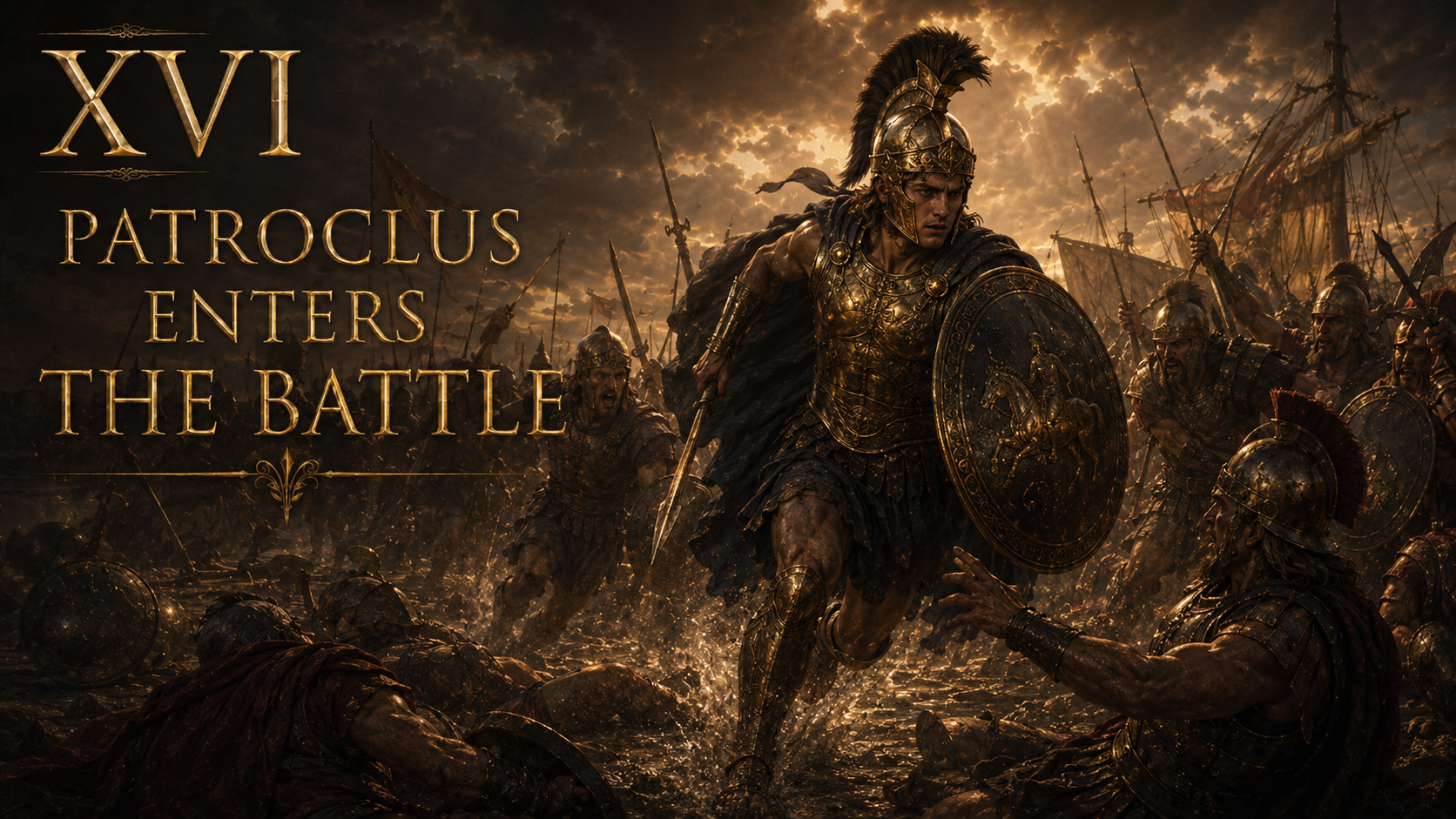
Lyrics
The god had passed behind him
Like winter through the flame
The bronze no longer knew him
The field forgot his name
His hands were full of thunder
But thunder would not stay
The light that drove the Trojans
Was falling into clay
Then out of dust and terror
A young spear found its mark
Not the final hand of darkness
But the first cut in the dark
First blood in the shadow
First crack in the borrowed light
First cold breath of evening
Moving through the fight
First blood in the shadow
Where the bright road starts to bend
Not yet the final silence
But the beginning of the end
He had run beside the deathless
He had burned beyond the line
He had taken mercy farther
Than the warning could define
Now the plain rose up around him
With its teeth beneath the sand
And every cheer behind him
Fell like water from his hand
The spear came not with thunder
Not with glory, not with flame
But sometimes death comes softly
Through a lesser-known name
First blood in the shadow
First crack in the borrowed light
First cold breath of evening
Moving through the fight
First blood in the shadow
Where the bright road starts to bend
Not yet the final silence
But the beginning of the end
The wound was not the whole night
The wound was not the grave
But it opened up the doorway
No courage now could save
The armor hung like memory
The helm was gone from sight
The man inside the legend
Stood alone without its light
He was not Achilles’ anger
He was not Achilles’ pride
He was Patroclus in the dust now
With the world torn open wide
First blood in the shadow
First crack in the borrowed light
First cold breath of evening
Moving through the fight
First blood in the shadow
Where the bright road starts to bend
Not yet the final silence
But the beginning of the end
There are blows that shout like thunder
There are blows no songs recall
There are hands that start the falling
Though another ends the fall
And the young man who had struck him
Saw the brightness leave the field
Saw the borrowed storm grow mortal
Saw the great disguise revealed
But the wounded heart kept beating
And the wounded feet still stood
For a little more of daylight
For a little more of blood
First blood in the shadow
First crack in the borrowed light
First cold breath of evening
Moving through the fight
First blood in the shadow
Where the bright road starts to bend
Not yet the final silence
But the beginning of the end
Far behind, the ships were breathing
Far behind, the saved men cried
Far ahead, the towers waited
With their stone mouths open wide
Somewhere Achilles still sat burning
By the sea that knew his name
Not yet knowing that his armor
Had become another flame
And the field drew close around him
And the dust began to sing
Not of victory, not of rescue
But of what the dark would bring
First blood in the shadow
First crack in the borrowed light
First cold breath of evening
Moving through the fight
First blood in the shadow
Where the bright road starts to bend
Not yet the final silence
But the beginning of the end
First blood in the shadow
First wound beneath the sky
The borrowed thunder faltered
But the brave heart would not lie
First blood in the shadow
First step where all roads bend
Not yet the final silence
But the beginning of the end
Translations
English
The original English lyrics are shown in the Lyrics section above.
Deutsch
Apollon ist wie Winter durch die Flamme gegangen. Die Bronze kennt Patroklos nicht mehr, das Licht sinkt in den Lehm. Aus Staub und Schrecken trifft ein junger Speer – nicht die letzte Hand des Todes, sondern der erste Schnitt in der Dunkelheit.
Die Wunde ist noch nicht das Grab, doch sie öffnet eine Tür, die Mut nicht mehr schließen kann. Ohne Helm und schützende Erscheinung steht nicht Achilleus im Staub, sondern Patroklos selbst, verwundbar und sichtbar.
Manche Schläge beginnen einen Sturz, den ein anderer vollendet. Euphorbos sieht den großen Schein sterblich werden. Patroklos steht noch einen Rest des Tages, während sich das Feld um ihn zusammenzieht.
Español
Apolo ha pasado como invierno a través de la llama. El bronce ya no reconoce a Patroclo y la luz cae hacia el barro. Desde el polvo y el miedo llega una lanza joven: no es la última mano de la muerte, sino el primer corte dentro de la sombra.
La herida todavía no es la tumba, pero abre una puerta que el valor ya no puede cerrar. Sin casco ni apariencia protectora, no es Aquiles quien está en el polvo, sino el propio Patroclo, vulnerable y visible.
Algunos golpes inician una caída que otro completará. Euforbo ve cómo el gran resplandor se vuelve mortal. Patroclo permanece en pie un poco más mientras el campo se cierra a su alrededor.
Français
Apollon a traversé la flamme comme l’hiver. Le bronze ne reconnaît plus Patrocle et la lumière tombe dans l’argile. De la poussière et de la peur surgit la lance d’un jeune homme : non la dernière main de la mort, mais la première coupure dans l’ombre.
La blessure n’est pas encore la tombe, mais elle ouvre une porte que le courage ne peut plus fermer. Sans casque ni apparence protectrice, ce n’est pas Achille qui se tient dans la poussière, mais Patrocle lui-même, vulnérable et visible.
Certains coups commencent une chute qu’un autre achèvera. Euphorbe voit le grand éclat devenir mortel. Patrocle reste debout encore un peu tandis que le champ se resserre autour de lui.
English
Patroclus does not fall to one clean heroic victory. Apollo disables him, Euphorbus wounds him, and Hector will finish the act. This distributed killing matters because it exposes the simplification behind later boasting: no single warrior can honestly claim the whole event.
Euphorbus is a lesser-known name, but that is precisely the point. History often remembers the final blow and forgets the first opening. The song preserves the intermediate moment in which the invincible image becomes a wounded person and shows how catastrophe is assembled from unequal, successive acts.
Textual basis
Homer, Iliad, Book XVI, lines 806–817: After Apollo has stunned and disarmed Patroclus, Euphorbus strikes him between the shoulders and withdraws.
Reference edition used
Homer, Ilias. Griechisch–deutsch. Translated into German from the ancient Greek by Hans Rupé, 16th edition, Akademie Verlag, Berlin, 2013.
Deutsch
Patroklos fällt nicht in einem einzigen klaren Heldensieg. Apollon entkräftet ihn, Euphorbos verwundet ihn, und Hektor wird die Tat vollenden. Diese verteilte Tötung ist wichtig, weil sie die Vereinfachung späteren Prahlens bloßlegt: Kein einzelner Krieger kann das ganze Geschehen redlich für sich beanspruchen.
Euphorbos ist ein weniger bekannter Name, und gerade darin liegt die Bedeutung. Erinnerung bewahrt oft den letzten Schlag und vergisst die erste Öffnung. Das Lied hält den Zwischenmoment fest, in dem ein unbesiegbares Bild zum verwundeten Menschen wird, und zeigt, wie Katastrophe aus ungleichen, aufeinanderfolgenden Handlungen entsteht.
Textgrundlage
Homer, Ilias, Gesang XVI, Verse 806–817: Nachdem Apollon Patroklos betäubt und entwaffnet hat, trifft Euphorbos ihn zwischen den Schultern und zieht sich zurück.
Verwendete Referenzausgabe
Homer, Ilias. Griechisch–deutsch. Übertragen von Hans Rupé, 16. Auflage, Akademie Verlag, Berlin 2013.
Español
Patroclo no cae ante una victoria heroica limpia. Apolo lo incapacita, Euforbo lo hiere y Héctor completará el acto. Esta muerte repartida importa porque descubre la simplificación de la jactancia posterior: ningún guerrero puede atribuirse honestamente todo lo ocurrido.
Euforbo es un nombre menos conocido, y justamente ahí reside el sentido. La memoria suele guardar el golpe final y olvidar la primera abertura. La canción conserva el instante intermedio en que la imagen invencible se convierte en una persona herida y muestra cómo la catástrofe se compone de actos sucesivos y desiguales.
Base textual
Homer, Ilíada, canto XVI, versos 806–817: Después de que Apolo aturde y desarma a Patroclo, Euforbo lo hiere entre los hombros y se retira.
Edición de referencia utilizada
Homer, Ilias. Griechisch–deutsch. Traducción alemana del griego antiguo de Hans Rupé, 16.ª edición, Akademie Verlag, Berlín, 2013.
Français
Patrocle ne tombe pas dans une victoire héroïque nette. Apollon le désarme, Euphorbe le blesse et Hector achèvera l’acte. Cette mise à mort partagée compte, car elle révèle la simplification de la vantardise ultérieure : aucun guerrier ne peut honnêtement revendiquer l’événement entier.
Euphorbe est un nom moins célèbre, et c’est précisément le sens de sa présence. La mémoire retient souvent le dernier coup et oublie la première ouverture. Le chant conserve l’instant où l’image invincible devient une personne blessée et montre comment la catastrophe s’assemble en actes successifs et inégaux.
Base textuelle
Homer, Iliade, chant XVI, vers 806–817: Après qu’Apollon a étourdi et désarmé Patrocle, Euphorbe le frappe entre les épaules puis se retire.
Édition de référence utilisée
Homer, Ilias. Griechisch–deutsch. Traduction allemande du grec ancien par Hans Rupé, 16e édition, Akademie Verlag, Berlin, 2013.