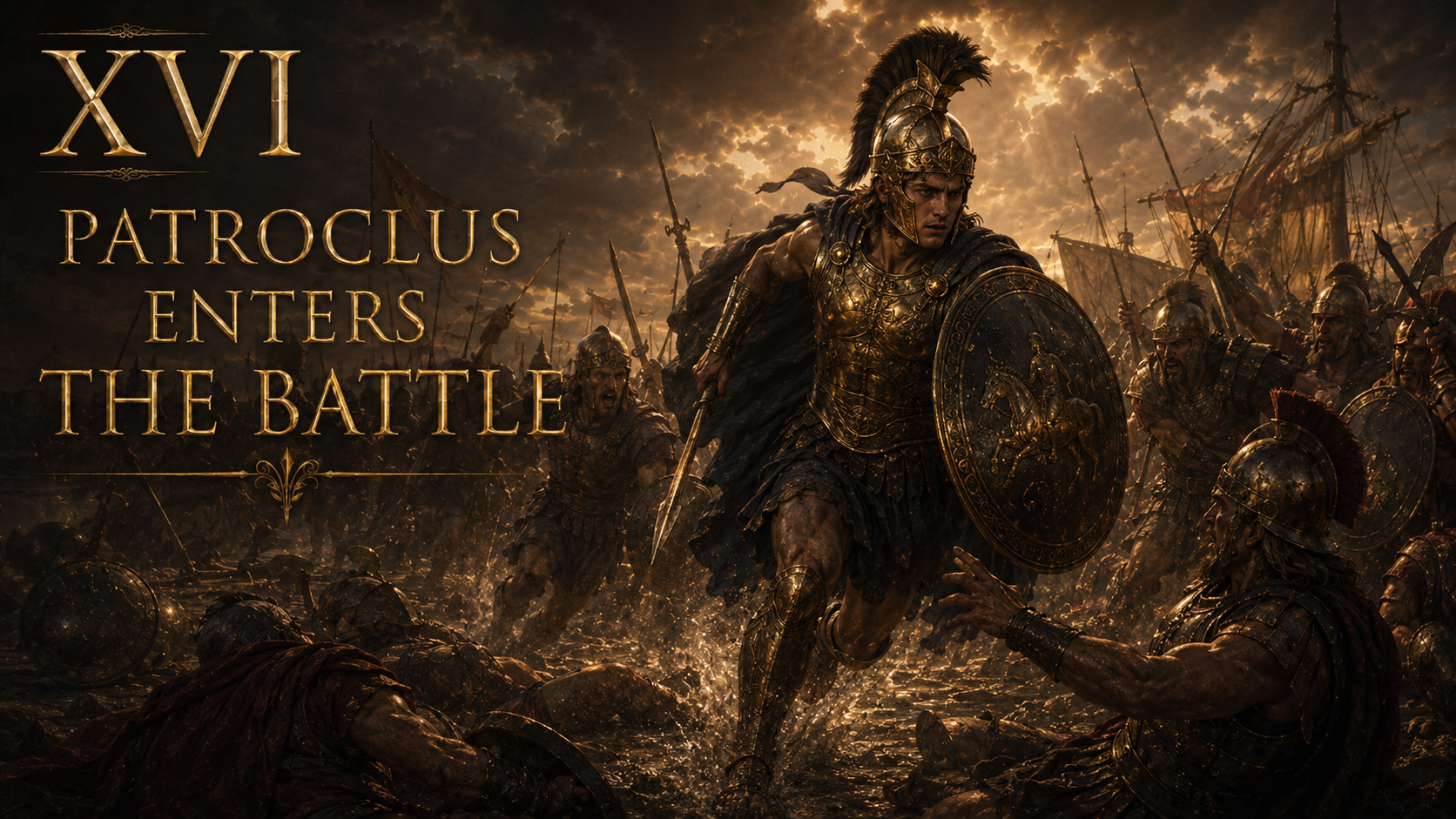
Lyrics
Smoke rolled low on the salt-dark shore
Flame had fingers on the ships
Men were calling through the thunder
Dust and blood upon their lips
Then bronze came burning through the morning
Like a sun the war had known
And every Trojan heart remembered
The man who shook them to the bone
But it was not the storm they feared
It was not the hand they named
It was one brave friend in borrowed fire
Walking out inside the flame
Borrowed thunder
Borrowed light
He came down hard through the broken fight
Borrowed thunder
Borrowed name
He drove the black smoke back again
Run, you towers of pride
Run, you spears in the sand
The ships still breathe by the edge of the tide
And mercy rides in another man’s hand
He did not come for golden glory
He did not come to carve a crown
He came because the wounded begged him
And the burning ropes fell down
The horses knew the weight was different
The armor knew another breath
But fear has eyes that see too quickly
When a shadow walks with death
The Trojans broke before the image
Their courage scattered in the wind
For sometimes even borrowed brightness
Can make the darkest ranks give in
Borrowed thunder
Borrowed light
He came down hard through the broken fight
Borrowed thunder
Borrowed name
He drove the black smoke back again
Run, you towers of pride
Run, you spears in the sand
The ships still breathe by the edge of the tide
And mercy rides in another man’s hand
He struck like rain on summer ashes
He moved like grief that learned to run
He saw the ships come back from dying
He saw the men turn toward the sun
Every cry became a commandment
Every wound became a road
And in his chest a human mercy
Carried more than bronze could hold
But far away the gods were watching
Far above the dust and screams
And every victory has a doorway
Where a bright man leaves his dreams
Borrowed thunder
Borrowed light
He came down hard through the broken fight
Borrowed thunder
Borrowed name
He drove the black smoke back again
Run, you towers of pride
Run, you spears in the sand
The ships still breathe by the edge of the tide
And mercy rides in another man’s hand
Back from the fire
Back from the foam
Back from the death at the black ships’ side
Back from the ruin
Back from the smoke
Back where the living had almost died
But the field kept opening wider
And the cries kept calling him on
One step more beyond the rescue
One step more toward the gone
Still he rode in borrowed thunder
Still he burned in borrowed light
Still the Trojans fled before him
Still the day forgot the night
Borrowed thunder
Borrowed light
He came down hard through the broken fight
Borrowed thunder
Borrowed name
He drove the black smoke back again
Run, you towers of pride
Run, you spears in the sand
The ships still breathe by the edge of the tide
And mercy rides in another man’s hand
Borrowed thunder
Borrowed flame
A brother’s armor, a brother’s name
Borrowed thunder
Borrowed breath
One man’s mercy
Walking close to death
Translations
English
The original English lyrics are shown in the Lyrics section above.
Deutsch
Rauch liegt über dem salzdunklen Ufer, als eine bronzene Gestalt wie eine bekannte Sonne hervortritt. Die Trojaner glauben, der gefürchtete Achilleus sei zurückgekehrt; tatsächlich geht ein mutiger Freund in geliehenem Feuer durch die Flammen.
Patroklos kommt weder für eine Krone noch für goldenen Ruhm. Er antwortet auf die Bitten der Verwundeten und drängt den schwarzen Rauch von den Schiffen zurück. Seine Barmherzigkeit trägt mehr Gewicht als die Bronze, doch die Rüstung und die Pferde spüren, dass ein anderer Mensch in ihnen kämpft.
Der Sieg öffnet das Feld immer weiter. Jeder gerettete Mann und jeder zurückweichende Gegner ruft Patroklos noch einen Schritt weiter. Der geliehene Donner rettet das Ufer – und bringt den Träger zugleich näher an den Tod.
Español
El humo cubre la orilla oscura de sal cuando una figura de bronce aparece como un sol conocido. Los troyanos creen que el temido Aquiles ha regresado; en realidad, un amigo valiente avanza dentro de un fuego prestado.
Patroclo no viene por una corona ni por gloria dorada. Responde a las súplicas de los heridos y rechaza el humo negro de las naves. Su compasión carga más peso que el bronce, aunque la armadura y los caballos perciben que otro hombre combate en ellos.
La victoria abre cada vez más el campo. Cada hombre salvado y cada enemigo que huye invita a Patroclo a dar otro paso. El trueno prestado salva la orilla y, al mismo tiempo, acerca a quien lo lleva a la muerte.
Français
La fumée couvre le rivage sombre de sel lorsqu’une silhouette de bronze surgit comme un soleil familier. Les Troyens croient au retour du redoutable Achille ; en réalité, un ami courageux avance dans un feu emprunté.
Patrocle ne vient ni pour une couronne ni pour une gloire dorée. Il répond aux appels des blessés et repousse la fumée noire loin des nefs. Sa compassion porte davantage que le bronze, même si l’armure et les chevaux sentent qu’un autre homme combat en eux.
La victoire ouvre toujours davantage la plaine. Chaque homme sauvé et chaque ennemi en fuite invite Patrocle à faire un pas de plus. Le tonnerre emprunté sauve le rivage tout en rapprochant son porteur de la mort.
English
The Trojans retreat before an image before they can judge the man inside it. The episode understands the battlefield as a theatre of recognition: Achilles’ armour carries accumulated memory, and that memory becomes a weapon in Patroclus’ hands.
But Patroclus is not merely an imitation. His motive is mercy, his courage is his own, and the rescue succeeds because he turns a borrowed sign toward a human purpose. The danger begins when the sign starts directing its bearer, making him feel that the reach of Achilles’ image is also the measure of his own life.
Textual basis
Homer, Iliad, Book XVI, lines 101–350: Patroclus puts on Achilles’ armour, the Myrmidons march out, and the Trojans panic at the apparent return of Achilles.
Reference edition used
Homer, Ilias. Griechisch–deutsch. Translated into German from the ancient Greek by Hans Rupé, 16th edition, Akademie Verlag, Berlin, 2013.
Deutsch
Die Trojaner weichen vor einem Bild zurück, noch bevor sie den Menschen darin erkennen können. Die Schlacht erscheint als Theater der Wahrnehmung: Achilleus’ Rüstung trägt angesammelte Erinnerung, und diese Erinnerung wird in Patroklos’ Händen zur Waffe.
Doch Patroklos ist keine bloße Nachahmung. Sein Motiv ist Barmherzigkeit, sein Mut gehört ihm selbst, und die Rettung gelingt, weil er ein geliehenes Zeichen einem menschlichen Zweck dienstbar macht. Die Gefahr beginnt, als das Zeichen seinen Träger zu lenken scheint und die Reichweite des Bildes zum Maß des eigenen Lebens wird.
Textgrundlage
Homer, Ilias, Gesang XVI, Verse 101–350: Patroklos legt Achilleus’ Rüstung an, die Myrmidonen ziehen aus, und die Trojaner geraten über die vermeintliche Rückkehr des Achilleus in Panik.
Verwendete Referenzausgabe
Homer, Ilias. Griechisch–deutsch. Übertragen von Hans Rupé, 16. Auflage, Akademie Verlag, Berlin 2013.
Español
Los troyanos retroceden ante una imagen antes de poder juzgar al hombre que hay dentro. La batalla se convierte en un teatro del reconocimiento: la armadura de Aquiles lleva una memoria acumulada, y esa memoria se transforma en arma en manos de Patroclo.
Pero Patroclo no es una mera imitación. Su motivo es la compasión, su valor le pertenece y el rescate triunfa porque dirige un signo prestado hacia un fin humano. El peligro comienza cuando el signo parece dirigir a su portador y el alcance de la imagen de Aquiles se vuelve medida de su propia vida.
Base textual
Homer, Ilíada, canto XVI, versos 101–350: Patroclo viste la armadura de Aquiles, los mirmidones salen y los troyanos se aterrorizan ante el aparente regreso de Aquiles.
Edición de referencia utilizada
Homer, Ilias. Griechisch–deutsch. Traducción alemana del griego antiguo de Hans Rupé, 16.ª edición, Akademie Verlag, Berlín, 2013.
Français
Les Troyens reculent devant une image avant de pouvoir juger l’homme qui l’habite. La bataille devient un théâtre de la reconnaissance : l’armure d’Achille porte une mémoire accumulée, et cette mémoire devient une arme entre les mains de Patrocle.
Mais Patrocle n’est pas une simple imitation. Son motif est la compassion, son courage lui appartient et le secours réussit parce qu’il tourne un signe emprunté vers une fin humaine. Le danger commence lorsque le signe semble diriger son porteur et que la portée de l’image d’Achille devient la mesure de sa propre vie.
Base textuelle
Homer, Iliade, chant XVI, vers 101–350: Patrocle revêt l’armure d’Achille, les Myrmidons sortent et les Troyens paniquent devant le retour apparent d’Achille.
Édition de référence utilisée
Homer, Ilias. Griechisch–deutsch. Traduction allemande du grec ancien par Hans Rupé, 16e édition, Akademie Verlag, Berlin, 2013.