Lyrics
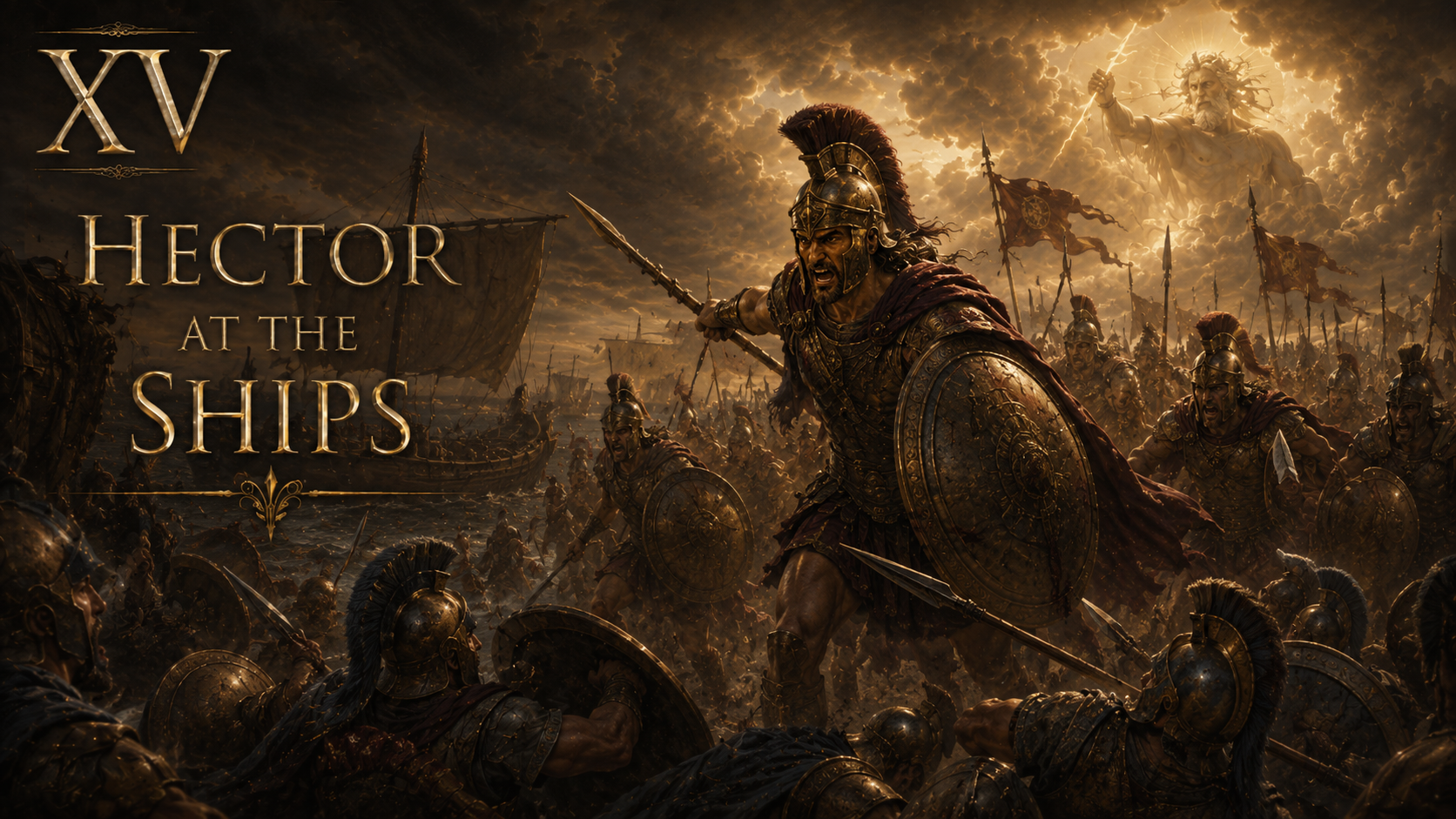
The sea was at their backs now,
the smoke was in their breath.
The ships that carried homeward dreams
stood waiting beside death.
The Greeks were driven shoreward,
past the ditch and broken wall.
Their shields were bent like storm doors,
their captains heard them call.
Behind them came the Trojans,
with Hector at the flame.
Ahead of them the black ships stood,
each plank a sailor’s name.
No harbor feels like safety
when the fire learns your road.
No mast can promise morning
when the night begins to glow.
Fire near the ships,
fire near the sea.
If the timber takes the burning,
where can the weary flee?
Fire near the ships,
red breath on the foam.
When the black hulls start to tremble,
war is standing inside home.
Apollo moved before them,
bright terror in his hand.
He shook the hearts of Argive men
like dry leaves across the sand.
Hector shouted forward,
his voice was bronze and rain.
The Trojans heard their prince return
and rose like flood again.
The ropes began to shiver,
the oars lay cold and still.
And every man remembered
the long road westward still.
Fire near the ships,
fire near the sea.
If the timber takes the burning,
where can the weary flee?
Fire near the ships,
red breath on the foam.
When the black hulls start to tremble,
war is standing inside home.
This was more than battle,
more than spear and shield.
This was the door behind them
closing on the field.
For ships are not just timber,
not just pitch and cord.
They are the path to fathers,
to wives, to sons, to doors.
Burn the ships, burn memory,
burn the way through foam.
Leave the victors homeless,
leave the living without home.
And somewhere far from shouting,
Achilles kept apart,
while fire moved toward the shoreline
like a hand around the heart.
The Greeks stood hard by the sterns now,
with sea wind in their eyes.
No further ground behind them,
no room for proud replies.
The Trojans pressed like weather,
the sky bent low with smoke.
And every wave behind the ships
seemed waiting till they broke.
The shore became a judgment,
the dusk became a blade.
And all the prayers of warriors
were naked and afraid.
Fire near the ships,
fire near the sea.
If the timber takes the burning,
where can the weary flee?
Fire near the ships,
red breath on the foam.
When the black hulls start to tremble,
war is standing inside home.
The sea was at their backs now,
the smoke was in their breath.
The ships that carried homeward dreams
stood waiting beside death.
Translations
Deutsch
Das Meer liegt nun im Rücken der Griechen, der Rauch in ihrem Atem. Die Schiffe, die Träume von Heimkehr tragen, warten neben dem Tod. Über Graben und gebrochene Mauer hinweg werden die Achaier ans Ufer gedrängt; hinter ihnen kommen die Trojaner mit Hektor an der Flamme.
Vor ihnen stehen die schwarzen Schiffe, und jede Planke trägt den Namen eines Seemanns. Kein Hafen fühlt sich sicher an, wenn das Feuer den Weg dorthin kennt; kein Mast verspricht Morgen, wenn die Nacht zu glühen beginnt. Wenn die schwarzen Rümpfe zittern, steht der Krieg bereits im Inneren der Heimat.
Apollon geht mit hellem Schrecken voran und schüttelt die Herzen der Argiver wie trockene Blätter. Hektor ruft zum Angriff, seine Stimme aus Bronze und Regen. Die Trojaner hören ihren zurückgekehrten Prinzen und erheben sich erneut wie eine Flut.
Dies ist mehr als eine Schlacht. Die Tür hinter den Griechen schließt sich. Schiffe sind nicht bloß Holz, Pech und Tauwerk, sondern der Weg zu Vätern, Frauen, Söhnen und Türen. Wer sie verbrennt, verbrennt Erinnerung und Heimweg und macht selbst mögliche Sieger heimatlos.
Fern vom Geschrei hält sich Achilleus weiter abseits, während das Feuer wie eine Hand um das Herz zum Ufer greift. Die Griechen stehen an den Hecks, den Seewind in den Augen. Hinter ihnen bleibt kein Boden und kein Raum für stolze Antworten; das Ufer wird zum Urteil.
Español
El mar queda ahora a la espalda de los griegos y el humo en su aliento. Las naves que transportan sueños de regreso esperan junto a la muerte. Expulsados más allá del foso y de la muralla rota, los aqueos llegan a la costa; detrás avanzan los troyanos con Héctor junto a la llama.
Ante ellos están las naves negras, y cada tabla lleva el nombre de un marinero. Ningún puerto parece seguro cuando el fuego conoce el camino; ningún mástil promete mañana cuando la noche empieza a brillar. Cuando tiemblan los cascos negros, la guerra ya está dentro del hogar.
Apolo avanza con un terror luminoso y sacude los corazones argivos como hojas secas. Héctor llama al ataque con voz de bronce y lluvia. Los troyanos oyen regresar a su príncipe y vuelven a alzarse como una inundación.
Esto es más que una batalla: la puerta detrás de los griegos se cierra. Las naves no son solo madera, brea y cuerda, sino el camino hacia padres, esposas, hijos y puertas. Quemarlas es quemar la memoria y el regreso, dejando sin hogar incluso a posibles vencedores.
Lejos de los gritos, Aquiles permanece apartado mientras el fuego alcanza la costa como una mano alrededor del corazón. Los griegos resisten junto a las popas con viento marino en los ojos. No queda tierra detrás ni espacio para respuestas orgullosas; la playa se convierte en juicio.
Français
La mer est désormais dans le dos des Grecs et la fumée dans leur souffle. Les navires qui portent les rêves du retour attendent près de la mort. Repoussés au-delà du fossé et du rempart brisé, les Achéens atteignent le rivage ; derrière eux avancent les Troyens avec Hector près de la flamme.
Devant eux se dressent les navires noirs, chaque planche portant le nom d’un marin. Aucun port ne semble sûr lorsque le feu connaît le chemin ; aucun mât ne promet le matin lorsque la nuit commence à rougeoyer. Quand les coques noires tremblent, la guerre est déjà entrée dans la maison.
Apollon avance, une terreur lumineuse à la main, et secoue les cœurs argiens comme des feuilles sèches. Hector appelle à l’assaut d’une voix de bronze et de pluie. Les Troyens entendent leur prince revenu et se lèvent de nouveau comme une crue.
C’est plus qu’une bataille : la porte derrière les Grecs se ferme. Les navires ne sont pas seulement du bois, de la poix et des cordages, mais la route vers les pères, les épouses, les fils et les maisons. Les brûler, c’est brûler la mémoire et le retour, et rendre sans patrie même d’éventuels vainqueurs.
Loin des cris, Achille demeure à l’écart tandis que le feu gagne le rivage comme une main autour du cœur. Les Grecs tiennent près des poupes, le vent marin dans les yeux. Il ne reste plus de terrain derrière eux ni de place pour de fières réponses ; le rivage devient jugement.
Reflection
English
The ships transform military defeat into the threat of erasure. They are the material form of return: memory, family and a future beyond war. Once fire reaches them, the battlefield enters the idea of home, and defending timber becomes defending the possibility of another life.
Book XV restores Zeus’s command and drives the battle toward the ships with frightening speed. Divine orders pass from messenger to god to warrior, yet on the shore every command becomes human exhaustion, panic, endurance, and the approaching necessity of Patroclus.
Textual basis
Homer, Iliad, Book XV, lines 590–746: the Trojans reach the ships and Hector struggles to bring fire to the fleet.
Reference edition used
Homer, Ilias. Griechisch–deutsch. Translated into German from the ancient Greek by Hans Rupé, 16th edition, Akademie Verlag, Berlin, 2013.
Deutsch
An den Schiffen wird aus militärischer Niederlage die Drohung der Auslöschung. Sie sind die materielle Form der Heimkehr: Erinnerung, Familie und eine Zukunft jenseits des Krieges. Sobald das Feuer sie erreicht, dringt das Schlachtfeld in die Vorstellung von Heimat ein.
Der fünfzehnte Gesang stellt den Befehl des Zeus wieder her und treibt die Schlacht mit erschreckender Geschwindigkeit zu den Schiffen. Göttliche Weisungen wandern vom Boten zum Gott und zum Krieger; doch am Ufer wird jeder Befehl zu menschlicher Erschöpfung, Panik, Ausdauer und zur nahenden Notwendigkeit des Patroklos.
Textgrundlage
Homer, Ilias, 15. Gesang, Verse 590–746: die Trojaner die Schiffe erreichen und Hektor darum kämpft, Feuer an die Flotte zu bringen.
Verwendete Referenzausgabe
Homer, Ilias. Griechisch–deutsch. Übertragen von Hans Rupé, 16. Auflage, Akademie Verlag, Berlin 2013.
Español
En las naves, la derrota militar se convierte en amenaza de desaparición. Son la forma material del regreso: memoria, familia y un futuro más allá de la guerra. Cuando el fuego las alcanza, el campo entra en la idea misma de hogar.
El canto XV restablece el mandato de Zeus y empuja la batalla hacia las naves con una velocidad aterradora. Las órdenes divinas pasan del mensajero al dios y al guerrero; pero en la orilla cada mandato se convierte en agotamiento humano, pánico, resistencia y en la necesidad cada vez más cercana de Patroclo.
Base textual
Homero, Ilíada, canto XV, versos 590–746: los troyanos llegan a las naves y Héctor lucha por llevar fuego a la flota.
Edición de referencia utilizada
Homer, Ilias. Griechisch–deutsch. Traducción alemana del griego antiguo de Hans Rupé, 16.ª edición, Akademie Verlag, Berlín, 2013.
Français
Avec les navires, la défaite militaire devient menace d’effacement. Ils sont la forme matérielle du retour : mémoire, famille et avenir au-delà de la guerre. Lorsque le feu les atteint, le champ de bataille pénètre l’idée même de foyer.
Le chant XV rétablit le commandement de Zeus et pousse la bataille vers les nefs avec une vitesse terrifiante. Les ordres divins passent du messager au dieu puis au guerrier ; mais sur le rivage, chaque ordre devient épuisement humain, panique, endurance et nécessité croissante de Patrocle.
Base textuelle
Homère, Iliade, chant XV, vers 590–746 : les Troyens atteignent les nefs et Hector lutte pour porter le feu à la flotte.
Édition de référence utilisée
Homer, Ilias. Griechisch–deutsch. Traduction allemande du grec ancien par Hans Rupé, 16e édition, Akademie Verlag, Berlin, 2013.