Lyrics
The sea did not kneel,
the sea did not break.
It gathered its thunder
and swallowed its ache.
Poseidon stood in the dust of men,
with salt in his immortal breath.
The shields were crying underfoot,
the field was loud with death.
He heard the word from Ida fall,
hard as a mountain stone.
The sky had called him from the fight,
and claimed the war alone.
His anger moved like water
under a moonless tide.
No mortal eye could measure
what he held inside.
The Earthshaker steps back,
but the deep does not obey.
The wave leaves the shoreline,
but it does not go away.
The Earthshaker steps back,
with storm beneath his skin.
He yields the field to thunder,
but he does not yield within.
He was brother to the lightning,
not servant to the cloud.
He had his share of honor,
and he spoke that name aloud.
The sea was his dominion,
the dark below his throne.
No god with a voice of thunder
could make the deep unknown.
But pride can split the heavens,
and wrath can blind the wise.
A war between immortals
would tear the mortal skies.
The Earthshaker steps back,
but the deep does not obey.
The wave leaves the shoreline,
but it does not go away.
The Earthshaker steps back,
with storm beneath his skin.
He yields the field to thunder,
but he does not yield within.
Not fear, not shame,
not a broken crown.
Not the fall of a lesser god,
not a king cast down.
It was the bitter wisdom
of power held in chains,
the strength to leave the battlefield
with anger in the veins.
For if the sea rose screaming,
if the mountain answered flame,
the men who fought for ashes
would vanish without name.
So he turned from the slaughter,
from the bronze and broken cries,
and the Greeks felt something leaving,
though they never saw his eyes.
The horses shook their manes in fear,
the dust fell cold and wide.
A god had taken one step back,
and pulled away the tide.
Far off, the water darkened,
far off, the caverns rang.
And somewhere under ocean stone,
his silent fury sang.
The Earthshaker steps back,
but the deep does not obey.
The wave leaves the shoreline,
but it does not go away.
The Earthshaker steps back,
with storm beneath his skin.
He yields the field to thunder,
but he does not yield within.
The sea did not kneel,
the sea did not break.
It gathered its thunder
and waited awake.
Translations
Deutsch
Das Meer kniete nicht nieder und zerbrach nicht. Es sammelte seinen Donner und verschluckte seinen Schmerz. Poseidon stand im Staub der Menschen, Salz im unsterblichen Atem, während die Schilde unter seinen Füßen schrien.
Das Wort vom Ida fiel hart wie Berggestein. Der Himmel rief ihn aus dem Kampf und beanspruchte den Krieg für sich. Poseidons Zorn bewegte sich wie Wasser unter einer mondlosen Flut; kein sterbliches Auge konnte ermessen, was er in sich trug.
Der Erderschütterer weicht zurück, doch die Tiefe gehorcht nicht. Die Welle verlässt das Ufer, verschwindet aber nicht. Er überlässt das Feld dem Donner, ohne sich im Innern zu beugen. Denn er ist Bruder des Blitzes, nicht Diener der Wolke, und das Meer bleibt sein Reich.
Doch Stolz kann den Himmel spalten, und Zorn selbst die Weisen blenden. Ein Krieg der Unsterblichen würde den sterblichen Himmel zerreißen. Sein Rückzug ist daher weder Furcht noch Schande, sondern die bittere Weisheit gebändigter Macht.
Als Poseidon sich von Bronze und Schreien abwendet, spüren die Griechen, dass etwas das Feld verlässt. Die Pferde zittern, der Staub fällt kalt. In der Ferne verdunkelt sich das Wasser, und unter dem Meeresstein singt sein stummer Zorn weiter.
Español
El mar no se arrodilló ni se quebró. Reunió su trueno y tragó su dolor. Poseidón estaba en el polvo de los hombres, con sal en el aliento inmortal, mientras los escudos gritaban bajo sus pies.
La palabra del Ida cayó dura como piedra de montaña. El cielo lo llamó fuera de la lucha y reclamó la guerra. La ira de Poseidón se movía como agua bajo una marea sin luna; ningún ojo mortal podía medir lo que guardaba dentro.
El que sacude la tierra retrocede, pero las profundidades no obedecen. La ola abandona la costa, pero no desaparece. Cede el campo al trueno sin ceder por dentro. Es hermano del relámpago, no siervo de la nube, y el mar sigue siendo su dominio.
Sin embargo, el orgullo puede partir los cielos y la cólera cegar a los sabios. Una guerra entre inmortales desgarraría el cielo de los mortales. Su retirada no es miedo ni vergüenza, sino la amarga sabiduría de un poder contenido.
Cuando Poseidón se aleja del bronce y de los gritos, los griegos sienten que algo abandona el campo. Los caballos tiemblan y el polvo cae frío. Lejos, el agua se oscurece, y bajo la piedra del océano continúa cantando su furia silenciosa.
Français
La mer ne s’agenouilla pas et ne se brisa pas. Elle rassembla son tonnerre et avala sa douleur. Poséidon se tenait dans la poussière des hommes, le sel dans son souffle immortel, tandis que les boucliers criaient sous ses pieds.
La parole de l’Ida tomba, dure comme une pierre de montagne. Le ciel le rappelait du combat et revendiquait la guerre. La colère de Poséidon se mouvait comme l’eau sous une marée sans lune ; aucun regard mortel ne pouvait mesurer ce qu’il retenait.
L’Ébranleur du sol recule, mais les profondeurs n’obéissent pas. La vague quitte le rivage sans disparaître. Il cède le champ au tonnerre sans céder intérieurement. Il est le frère de l’éclair, non le serviteur du nuage, et la mer demeure son domaine.
Pourtant, l’orgueil peut fendre les cieux et la colère aveugler les sages. Une guerre entre immortels déchirerait le ciel des mortels. Son retrait n’est ni peur ni honte, mais l’amère sagesse d’une puissance contenue.
Lorsque Poséidon se détourne du bronze et des cris, les Grecs sentent que quelque chose quitte le champ. Les chevaux tremblent et la poussière tombe, froide. Au loin, l’eau s’assombrit, et sous la pierre océanique sa fureur silencieuse continue de chanter.
Reflection
English
Stepping back is not always surrender. Poseidon preserves his dignity by distinguishing inward judgment from outward action. The scene offers a severe definition of restraint: strength is not diminished when it refuses to make everyone else pay for its wounded pride.
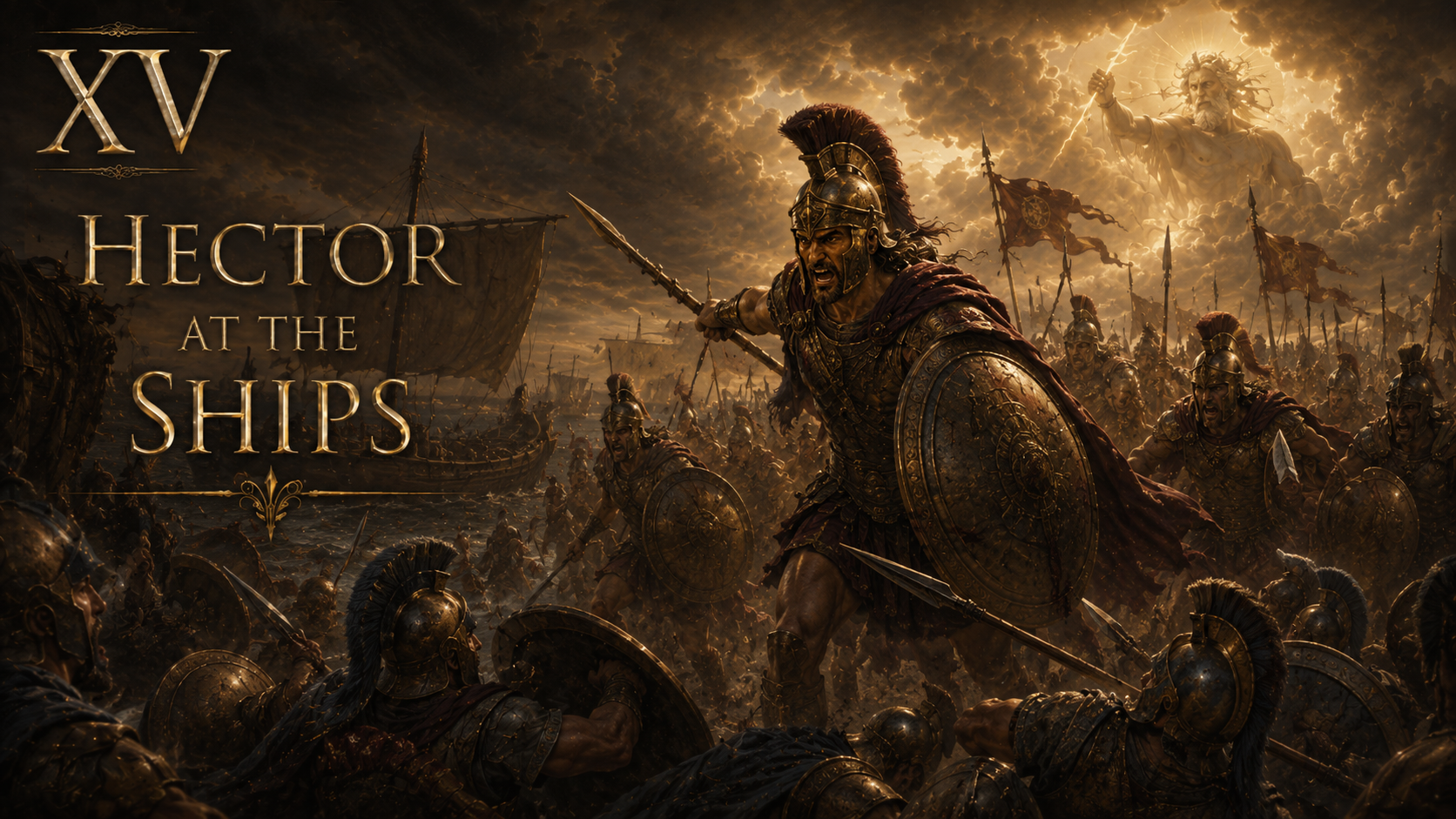
Book XV restores Zeus’s command and drives the battle toward the ships with frightening speed. Divine orders pass from messenger to god to warrior, yet on the shore every command becomes human exhaustion, panic, endurance, and the approaching necessity of Patroclus.
Textual basis
Homer, Iliad, Book XV, lines 174–219: Poseidon protests Zeus’s claim of supremacy but finally leaves the battlefield.
Reference edition used
Homer, Ilias. Griechisch–deutsch. Translated into German from the ancient Greek by Hans Rupé, 16th edition, Akademie Verlag, Berlin, 2013.
Deutsch
Zurückzuweichen ist nicht immer Kapitulation. Poseidon bewahrt seine Würde, indem er inneres Urteil und äußeres Handeln trennt. Die Szene gibt der Selbstbegrenzung eine strenge Bedeutung: Stärke wird nicht kleiner, wenn sie andere nicht für den eigenen verletzten Stolz bezahlen lässt.
Der fünfzehnte Gesang stellt den Befehl des Zeus wieder her und treibt die Schlacht mit erschreckender Geschwindigkeit zu den Schiffen. Göttliche Weisungen wandern vom Boten zum Gott und zum Krieger; doch am Ufer wird jeder Befehl zu menschlicher Erschöpfung, Panik, Ausdauer und zur nahenden Notwendigkeit des Patroklos.
Textgrundlage
Homer, Ilias, 15. Gesang, Verse 174–219: Poseidon gegen Zeus’ Vorrang protestiert, das Schlachtfeld aber schließlich verlässt.
Verwendete Referenzausgabe
Homer, Ilias. Griechisch–deutsch. Übertragen von Hans Rupé, 16. Auflage, Akademie Verlag, Berlin 2013.
Español
Retroceder no siempre es rendirse. Poseidón conserva su dignidad al separar el juicio interior de la acción exterior. La escena define con dureza el dominio propio: la fuerza no disminuye cuando se niega a hacer pagar a todos por el orgullo herido.
El canto XV restablece el mandato de Zeus y empuja la batalla hacia las naves con una velocidad aterradora. Las órdenes divinas pasan del mensajero al dios y al guerrero; pero en la orilla cada mandato se convierte en agotamiento humano, pánico, resistencia y en la necesidad cada vez más cercana de Patroclo.
Base textual
Homero, Ilíada, canto XV, versos 174–219: Poseidón protesta contra la supremacía de Zeus, pero finalmente abandona el campo.
Edición de referencia utilizada
Homer, Ilias. Griechisch–deutsch. Traducción alemana del griego antiguo de Hans Rupé, 16.ª edición, Akademie Verlag, Berlín, 2013.
Français
Reculer n’est pas toujours se rendre. Poséidon préserve sa dignité en séparant le jugement intérieur de l’action extérieure. La scène définit sévèrement la retenue : la force ne diminue pas lorsqu’elle refuse de faire payer aux autres son orgueil blessé.
Le chant XV rétablit le commandement de Zeus et pousse la bataille vers les nefs avec une vitesse terrifiante. Les ordres divins passent du messager au dieu puis au guerrier ; mais sur le rivage, chaque ordre devient épuisement humain, panique, endurance et nécessité croissante de Patrocle.
Base textuelle
Homère, Iliade, chant XV, vers 174–219 : Poséidon proteste contre la suprématie de Zeus mais finit par quitter le champ de bataille.
Édition de référence utilisée
Homer, Ilias. Griechisch–deutsch. Traduction allemande du grec ancien par Hans Rupé, 16e édition, Akademie Verlag, Berlin, 2013.