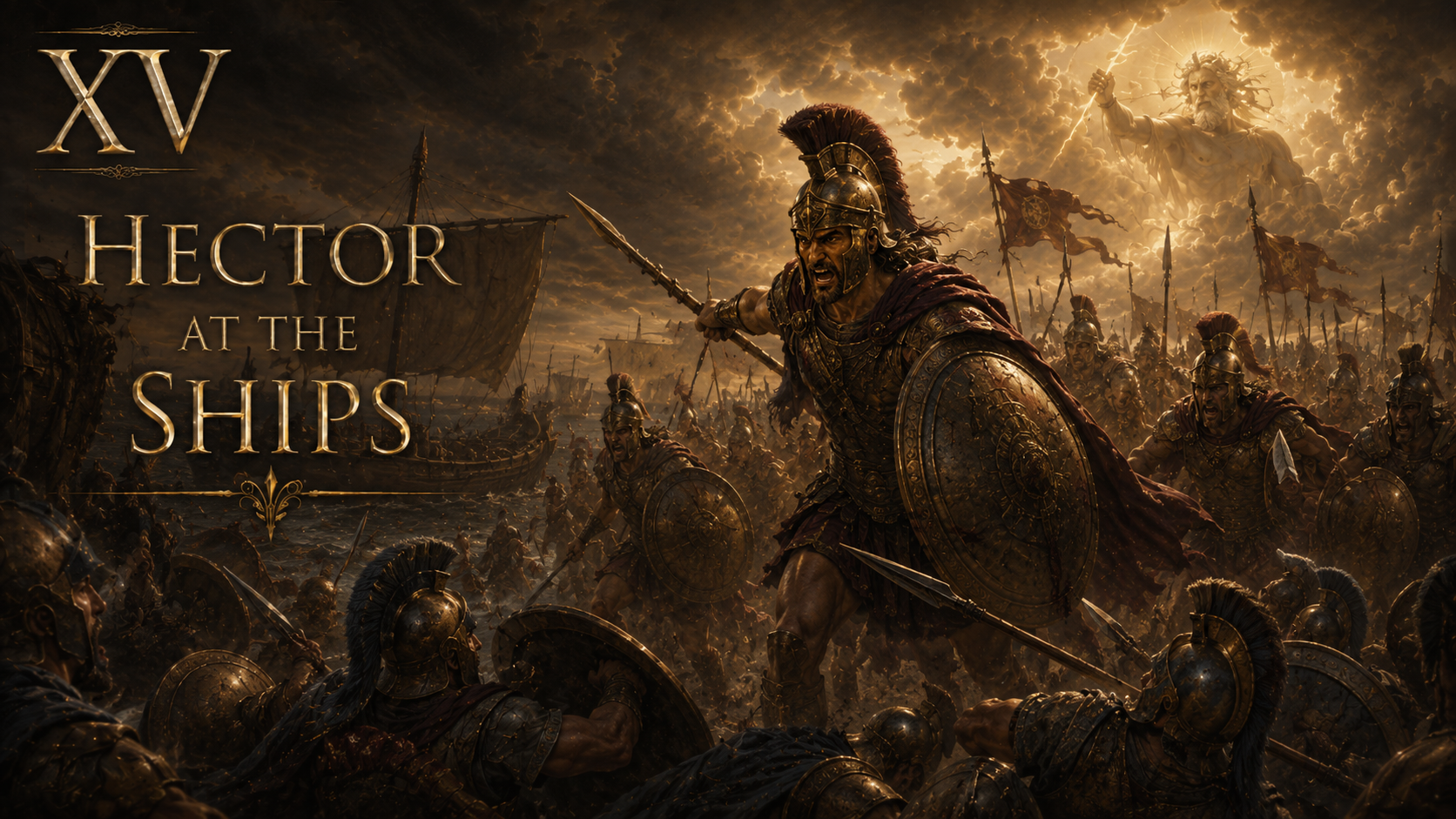
Lyrics
There is a chain no hammer breaks,
there is a road no prayer can bend.
The first link shines in morning light,
the last one waits at the end.
Zeus looked down from Ida’s height
where the clouds were black and still.
He saw the men who thought they chose,
he saw the gods who bent their will.
He saw the ships beside the shore,
he saw the walls of Troy.
He saw the glory men would seek,
and what that glory would destroy.
Not every thunder falls at once,
not every wound is shown.
Some doom is planted underfoot
before the seed is known.
This is the chain of fate,
iron under gold.
One hand lifts the living,
one hand gathers cold.
This is the chain of fate,
link by burning link.
Before the blood is falling,
the cup is raised to drink.
Hector would rise with borrowed fire,
his breath returned by light.
Apollo’s hand would clear the road
and drive the Greeks to flight.
The Trojans would come like winter waves,
the ditch would break in fear.
The ships would feel the breath of flame,
and death would draw near.
But victory has a shadow,
and triumph has a cost.
The louder Hector’s name is sung,
the nearer he is lost.
This is the chain of fate,
iron under gold.
One hand lifts the living,
one hand gathers cold.
This is the chain of fate,
link by burning link.
Before the blood is falling,
the cup is raised to drink.
Patroclus waits in silence,
not knowing where he stands.
A friend will wear another’s arms,
with mercy in his hands.
Achilles keeps his anger,
wrapped tight around his name.
But grief will find his doorway,
and call him back through flame.
And Troy, high Troy, still shining,
still proud against the sky,
already hears in hidden stones
the footstep passing by.
So let the day grow darker,
let the dust climb to the sun.
Let every man believe his hour
has only just begun.
The gods may stir the battlefield,
the heroes may defy,
but fate walks without shouting
beneath the open sky.
This is the chain of fate,
iron under gold.
One hand lifts the living,
one hand gathers cold.
This is the chain of fate,
link by burning link.
Before the blood is falling,
the cup is raised to drink.
There is a chain no hammer breaks,
there is a road no prayer can bend.
The first link shines in morning light,
the last one waits at the end.
Translations
Deutsch
Es gibt eine Kette, die kein Hammer sprengt, und einen Weg, den kein Gebet beugt. Das erste Glied glänzt im Morgenlicht, das letzte wartet am Ende. Vom Ida blickt Zeus auf Männer, die zu wählen glauben, und auf Götter, die ihren Willen verbiegen.
Er sieht die Schiffe am Ufer, die Mauern Trojas, die Herrlichkeit, nach der Menschen greifen, und das, was diese Herrlichkeit zerstören wird. Nicht jeder Donner fällt sofort und nicht jede Wunde ist sichtbar; manches Verderben ist schon unter den Füßen gesät, bevor jemand den Samen kennt.
Hektor wird sich mit geliehenem Feuer erheben, Apollon ihm den Weg freimachen und die Griechen zur Flucht treiben. Die Trojaner werden wie Winterwellen kommen, der Graben wird in Furcht brechen und die Schiffe den Atem des Feuers spüren. Doch jeder Sieg wirft einen Schatten: Je lauter Hektors Name erklingt, desto näher ist sein Verlust.
Patroklos wartet schweigend. Aus Mitleid wird der Freund die Waffen eines anderen tragen. Achilleus hält an seinem Zorn fest, doch die Trauer wird seine Tür finden und ihn durch das Feuer zurückrufen. Selbst das stolze Troja hört in seinen verborgenen Steinen bereits die Schritte des Untergangs.
Die Götter mögen das Schlachtfeld bewegen und die Helden sich widersetzen; das Schicksal geht dennoch lautlos unter freiem Himmel. Das ist die Kette: Eisen unter Gold, ein Glied nach dem anderen, und der Becher steht schon bereit, bevor das Blut fällt.
Español
Existe una cadena que ningún martillo rompe y un camino que ninguna plegaria dobla. El primer eslabón brilla por la mañana y el último espera al final. Desde el Ida, Zeus contempla a los hombres que creen elegir y a los dioses que tuercen su voluntad.
Ve las naves junto a la costa, las murallas de Troya, la gloria que los hombres buscan y aquello que esa gloria destruirá. No todo trueno cae de una vez ni toda herida se muestra; algunas ruinas ya están sembradas bajo los pies antes de que se conozca la semilla.
Héctor se alzará con fuego prestado, Apolo abrirá el camino y hará huir a los griegos. Los troyanos llegarán como olas de invierno, el foso cederá al miedo y las naves sentirán el aliento del fuego. Pero toda victoria tiene sombra: cuanto más alto se canta el nombre de Héctor, más cerca está su pérdida.
Patroclo espera en silencio. Por compasión, un amigo vestirá las armas de otro. Aquiles conserva su ira, pero el dolor encontrará su puerta y lo llamará de vuelta a través del fuego. Incluso la orgullosa Troya oye ya en sus piedras ocultas los pasos de la ruina.
Los dioses pueden agitar el campo y los héroes desafiarlo todo; el destino camina sin gritar bajo el cielo abierto. Esa es la cadena: hierro bajo el oro, eslabón ardiente tras eslabón; la copa se alza antes de que caiga la sangre.
Français
Il existe une chaîne qu’aucun marteau ne brise et une route qu’aucune prière ne courbe. Le premier maillon brille au matin, le dernier attend au terme. Du haut de l’Ida, Zeus regarde les hommes qui croient choisir et les dieux qui infléchissent leur volonté.
Il voit les navires sur le rivage, les murs de Troie, la gloire que les hommes recherchent et ce que cette gloire détruira. Tout tonnerre ne tombe pas d’un seul coup et toute blessure ne se montre pas ; certaines ruines sont semées sous les pas avant même que la graine soit connue.
Hector se relèvera avec un feu emprunté, Apollon ouvrira la route et poussera les Grecs à la fuite. Les Troyens viendront comme des vagues d’hiver, le fossé cédera à la peur et les navires sentiront le souffle du feu. Mais toute victoire a son ombre : plus le nom d’Hector retentit, plus sa perte approche.
Patrocle attend en silence. Par compassion, un ami portera les armes d’un autre. Achille garde sa colère, mais le deuil trouvera sa porte et le rappellera à travers les flammes. Même la fière Troie entend déjà dans ses pierres secrètes les pas de sa ruine.
Les dieux peuvent remuer le champ et les héros défier le sort ; le destin marche sans crier sous le ciel ouvert. Telle est la chaîne : du fer sous l’or, maillon brûlant après maillon ; la coupe est levée avant que le sang ne tombe.
Reflection
English
The song treats fate as sequence rather than a single decree. Each event remains morally distinct—anger, mercy, courage, grief—yet every choice becomes a link in a structure visible only from above. Tragedy comes from acting freely inside a pattern no mortal can see whole.
Book XV restores Zeus’s command and drives the battle toward the ships with frightening speed. Divine orders pass from messenger to god to warrior, yet on the shore every command becomes human exhaustion, panic, endurance, and the approaching necessity of Patroclus.
Textual basis
Homer, Iliad, Book XV, lines 49–77: Zeus sets out the chain of events leading through Patroclus and Achilles toward Troy’s fall.
Reference edition used
Homer, Ilias. Griechisch–deutsch. Translated into German from the ancient Greek by Hans Rupé, 16th edition, Akademie Verlag, Berlin, 2013.
Deutsch
Der Song zeigt das Schicksal als Folge und nicht als einzelnen Befehl. Zorn, Mitleid, Mut und Trauer bleiben moralisch verschieden, doch jede Entscheidung wird zum Glied einer nur von oben sichtbaren Struktur. Tragik entsteht aus freiem Handeln in einem Muster, das kein Sterblicher vollständig erkennt.
Der fünfzehnte Gesang stellt den Befehl des Zeus wieder her und treibt die Schlacht mit erschreckender Geschwindigkeit zu den Schiffen. Göttliche Weisungen wandern vom Boten zum Gott und zum Krieger; doch am Ufer wird jeder Befehl zu menschlicher Erschöpfung, Panik, Ausdauer und zur nahenden Notwendigkeit des Patroklos.
Textgrundlage
Homer, Ilias, 15. Gesang, Verse 49–77: Zeus die Ereigniskette über Patroklos und Achilles bis zum Fall Trojas darlegt.
Verwendete Referenzausgabe
Homer, Ilias. Griechisch–deutsch. Übertragen von Hans Rupé, 16. Auflage, Akademie Verlag, Berlin 2013.
Español
La canción presenta el destino como una secuencia y no como un decreto aislado. Ira, compasión, valor y dolor siguen siendo distintos, pero cada decisión se vuelve eslabón de una estructura visible solo desde arriba. La tragedia nace de actuar libremente dentro de un dibujo que ningún mortal ve completo.
El canto XV restablece el mandato de Zeus y empuja la batalla hacia las naves con una velocidad aterradora. Las órdenes divinas pasan del mensajero al dios y al guerrero; pero en la orilla cada mandato se convierte en agotamiento humano, pánico, resistencia y en la necesidad cada vez más cercana de Patroclo.
Base textual
Homero, Ilíada, canto XV, versos 49–77: Zeus expone la cadena de acontecimientos que pasa por Patroclo y Aquiles hasta la caída de Troya.
Edición de referencia utilizada
Homer, Ilias. Griechisch–deutsch. Traducción alemana del griego antiguo de Hans Rupé, 16.ª edición, Akademie Verlag, Berlín, 2013.
Français
La chanson présente le destin comme une suite plutôt que comme un décret unique. Colère, compassion, courage et deuil restent distincts, mais chaque choix devient le maillon d’une structure visible seulement d’en haut. La tragédie naît d’une action libre au sein d’un dessin qu’aucun mortel ne voit en entier.
Le chant XV rétablit le commandement de Zeus et pousse la bataille vers les nefs avec une vitesse terrifiante. Les ordres divins passent du messager au dieu puis au guerrier ; mais sur le rivage, chaque ordre devient épuisement humain, panique, endurance et nécessité croissante de Patrocle.
Base textuelle
Homère, Iliade, chant XV, vers 49–77 : Zeus expose la chaîne des événements passant par Patrocle et Achille jusqu’à la chute de Troie.
Édition de référence utilisée
Homer, Ilias. Griechisch–deutsch. Traduction allemande du grec ancien par Hans Rupé, 16e édition, Akademie Verlag, Berlin, 2013.