Lyrics
The sea kept speaking softly,
but no man heard it clear.
The ships stood black against the dusk,
and fate was drawing near.
The Greeks were pressed to timber,
to rope and mast and foam.
The field behind was burning dust,
the ships before were home.
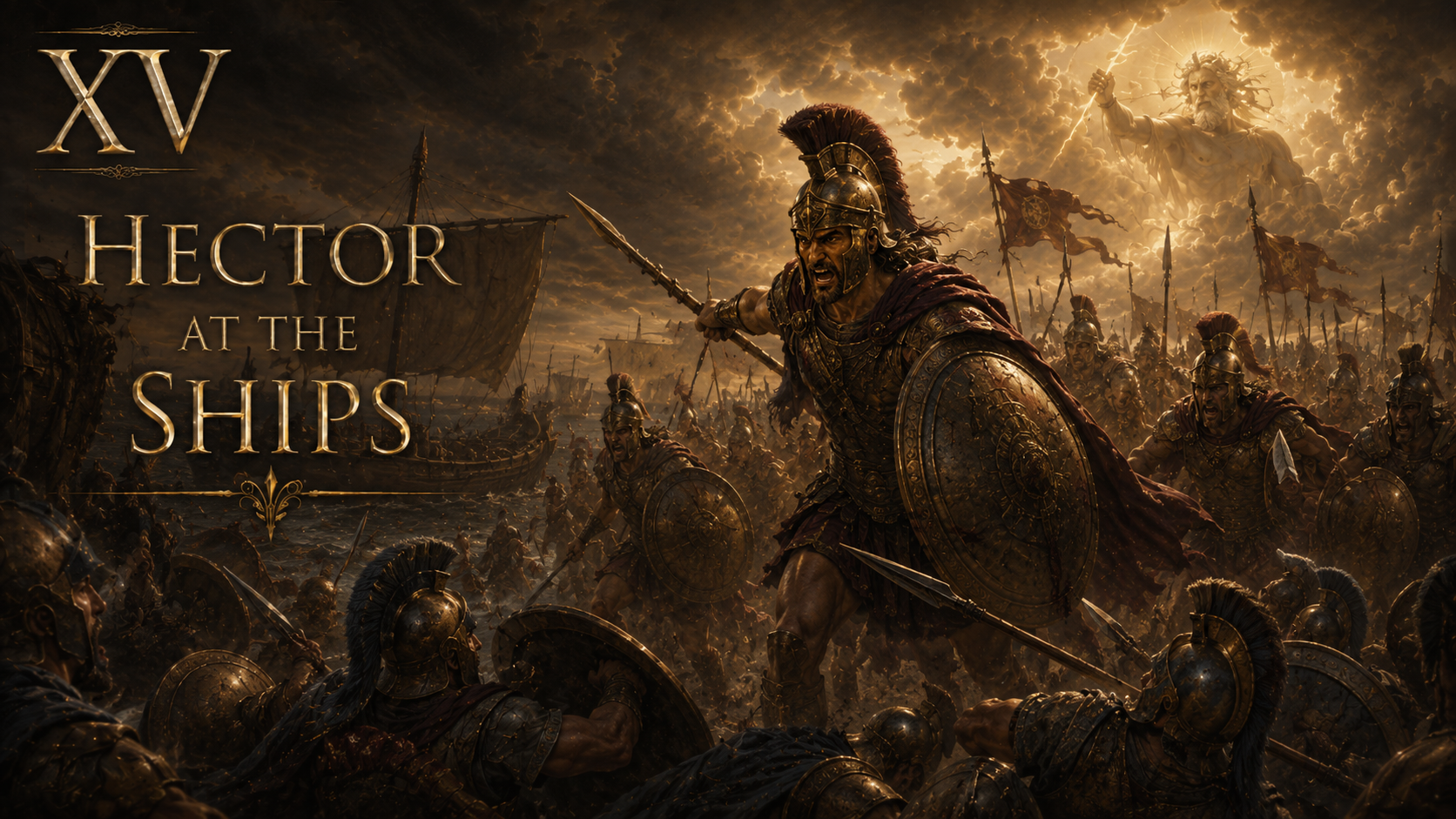
Hector drove the Trojans on,
with fire inside his breath.
Apollo’s light was hard and cold,
a golden road to death.
No wall remained between them,
no trench could hold the tide.
Only hands and splintered shields
stood where hope could hide.
On the shore before Patroclus,
the dark wind starts to turn.
On the shore before Patroclus,
the ships are close to burn.
No one knows the name yet,
no one sees the cost,
but the friend who comes in mercy
will be loved and will be lost.
Achilles sat in anger,
far from the cries of men.
His wounded pride was silent,
but grief would find him then.
The battle called without him,
the sea wind carried flame.
And every shout at sunset
was moving toward his name.
Some roads begin in fury,
some roads begin in tears.
Some men arrive as answers
and open darker years.
On the shore before Patroclus,
the dark wind starts to turn.
On the shore before Patroclus,
the ships are close to burn.
No one knows the name yet,
no one sees the cost,
but the friend who comes in mercy
will be loved and will be lost.
Not yet the borrowed armor,
not yet the fatal chase.
Not yet the prince of Troy
standing face to face.
Not yet the cry of Achilles,
not yet the broken sky.
But all of it is waiting
where the smoke begins to rise.
The fire has not taken all,
the last plank has not burned.
But in the heart of battle,
the next great wheel has turned.
So let the Trojans thunder,
let the Argives hold the line.
Let the ships groan in the sea wind,
let the dusk turn red as wine.
For every spear that misses,
for every shield that falls,
the shadow of Patroclus
moves closer through the calls.
The night is not yet finished,
the grief is not yet named.
But somewhere in the silence,
a friend is touching flame.
On the shore before Patroclus,
the dark wind starts to turn.
On the shore before Patroclus,
the ships are close to burn.
No one knows the name yet,
no one sees the cost,
but the friend who comes in mercy
will be loved and will be lost.
The sea kept speaking softly,
but no man heard it clear.
The ships stood black against the dusk,
and fate was drawing near.
Translations
Deutsch
Das Meer spricht leise, doch kein Mann hört es deutlich. Die Schiffe stehen schwarz gegen die Dämmerung, während sich das Schicksal nähert. Die Griechen werden an Holz, Tauwerk, Masten und Schaum gedrängt; hinter ihnen brennt das Feld aus Staub, vor ihnen liegt in den Schiffen die Heimat.
Hektor treibt die Trojaner voran, Feuer im Atem. Apollons Licht ist hart und kalt, eine goldene Straße zum Tod. Keine Mauer trennt die Heere mehr, kein Graben hält die Flut auf; nur Hände und gesplitterte Schilde stehen dort, wo sich Hoffnung noch verbergen kann.
Am Ufer vor Patroklos beginnt sich der dunkle Wind zu drehen, und die Schiffe sind dem Brand nahe. Noch kennt niemand den Preis. Doch der Freund, der aus Mitleid kommt, wird geliebt und verloren werden.
Achilleus sitzt fern von den Schreien in seinem Zorn. Sein verletzter Stolz schweigt, aber die Trauer wird ihn finden. Die Schlacht ruft ohne ihn, und jeder Schrei im Abendlicht bewegt sich auf seinen Namen zu. Manche Wege beginnen im Zorn, andere in Tränen.
Noch trägt Patroklos nicht die geliehene Rüstung, noch beginnt nicht die tödliche Verfolgung und Hektor steht ihm noch nicht gegenüber. Doch all dies wartet bereits im aufsteigenden Rauch. Mit jedem fehlgehenden Speer und jedem fallenden Schild kommt der Schatten des Patroklos näher.
Español
El mar habla en voz baja, pero ningún hombre lo oye con claridad. Las naves se alzan negras contra el crepúsculo mientras el destino se acerca. Los griegos son empujados hasta la madera, las cuerdas, los mástiles y la espuma; detrás arde el polvo del campo y delante las naves representan el hogar.
Héctor impulsa a los troyanos con fuego en el aliento. La luz de Apolo es dura y fría, un camino dorado hacia la muerte. Ya no queda muralla entre los ejércitos ni foso capaz de contener la marea; solo manos y escudos astillados guardan el último escondite de la esperanza.
En la orilla anterior a Patroclo empieza a girar el viento oscuro y las naves están cerca de arder. Nadie conoce aún el precio. Pero el amigo que llega por compasión será amado y será perdido.
Aquiles permanece lejos de los gritos, sentado en su ira. Su orgullo herido calla, pero el dolor lo encontrará. La batalla llama sin él y cada grito del atardecer avanza hacia su nombre. Algunos caminos empiezan con furia y otros con lágrimas.
Todavía no aparece la armadura prestada, ni comienza la persecución fatal, ni Héctor se enfrenta a Patroclo. Pero todo espera donde se eleva el humo. Con cada lanza que falla y cada escudo que cae, la sombra de Patroclo se acerca.
Français
La mer parle doucement, mais aucun homme ne l’entend clairement. Les navires se dressent, noirs dans le crépuscule, tandis que le destin approche. Les Grecs sont poussés jusqu’au bois, aux cordages, aux mâts et à l’écume ; derrière eux brûle la poussière du champ, devant eux les navires portent l’idée du foyer.
Hector pousse les Troyens, le feu dans son souffle. La lumière d’Apollon est dure et froide, route d’or vers la mort. Aucun rempart ne sépare plus les armées, aucun fossé ne retient la marée ; seules des mains et des boucliers fendus gardent le dernier refuge de l’espoir.
Sur le rivage avant Patrocle, le vent sombre commence à tourner et les navires sont près de brûler. Personne ne connaît encore le prix. Mais l’ami qui vient par compassion sera aimé et sera perdu.
Achille demeure loin des cris, assis dans sa colère. Son orgueil blessé se tait, mais le deuil le trouvera. La bataille appelle sans lui et chaque cri du couchant se dirige vers son nom. Certaines routes commencent dans la fureur, d’autres dans les larmes.
L’armure empruntée n’est pas encore portée, la poursuite fatale n’a pas commencé et Hector ne fait pas encore face à Patrocle. Pourtant tout attend déjà là où la fumée s’élève. À chaque lance manquée et chaque bouclier tombé, l’ombre de Patrocle se rapproche.
Reflection
English
This is a threshold song: nothing decisive has happened yet, but everything has become possible. Patroclus enters first as an absence shaped by suffering. His coming choice will spring from mercy, and the tragedy is that mercy can be both morally beautiful and fatal.
Book XV restores Zeus’s command and drives the battle toward the ships with frightening speed. Divine orders pass from messenger to god to warrior, yet on the shore every command becomes human exhaustion, panic, endurance, and the approaching necessity of Patroclus.
Textual basis
Homer, Iliad, Book XV, lines 654–746: Ajax defends the ships at close quarters as the crisis approaches Patroclus’ intervention.
Reference edition used
Homer, Ilias. Griechisch–deutsch. Translated into German from the ancient Greek by Hans Rupé, 16th edition, Akademie Verlag, Berlin, 2013.
Deutsch
Dies ist ein Schwellenlied: Noch ist nichts Entscheidendes geschehen, doch alles ist möglich geworden. Patroklos tritt zunächst als eine von fremdem Leid geformte Abwesenheit auf. Seine kommende Entscheidung entspringt dem Mitleid – und gerade das moralisch Schöne wird tödlich.
Der fünfzehnte Gesang stellt den Befehl des Zeus wieder her und treibt die Schlacht mit erschreckender Geschwindigkeit zu den Schiffen. Göttliche Weisungen wandern vom Boten zum Gott und zum Krieger; doch am Ufer wird jeder Befehl zu menschlicher Erschöpfung, Panik, Ausdauer und zur nahenden Notwendigkeit des Patroklos.
Textgrundlage
Homer, Ilias, 15. Gesang, Verse 654–746: Aias die Schiffe im Nahkampf verteidigt, während die Krise auf Patroklos’ Eingreifen zutreibt.
Verwendete Referenzausgabe
Homer, Ilias. Griechisch–deutsch. Übertragen von Hans Rupé, 16. Auflage, Akademie Verlag, Berlin 2013.
Español
Esta es una canción de umbral: aún no ha ocurrido lo decisivo, pero todo se ha vuelto posible. Patroclo aparece primero como una ausencia moldeada por el sufrimiento ajeno. Su decisión nacerá de la compasión, y la tragedia consiste en que lo moralmente hermoso puede ser mortal.
El canto XV restablece el mandato de Zeus y empuja la batalla hacia las naves con una velocidad aterradora. Las órdenes divinas pasan del mensajero al dios y al guerrero; pero en la orilla cada mandato se convierte en agotamiento humano, pánico, resistencia y en la necesidad cada vez más cercana de Patroclo.
Base textual
Homero, Ilíada, canto XV, versos 654–746: Áyax defiende las naves cuerpo a cuerpo mientras la crisis se acerca a la intervención de Patroclo.
Edición de referencia utilizada
Homer, Ilias. Griechisch–deutsch. Traducción alemana del griego antiguo de Hans Rupé, 16.ª edición, Akademie Verlag, Berlín, 2013.
Français
C’est une chanson de seuil : rien de décisif ne s’est encore produit, mais tout est devenu possible. Patrocle apparaît d’abord comme une absence façonnée par la souffrance d’autrui. Son choix naîtra de la compassion, et la tragédie veut que ce qui est moralement beau puisse être fatal.
Le chant XV rétablit le commandement de Zeus et pousse la bataille vers les nefs avec une vitesse terrifiante. Les ordres divins passent du messager au dieu puis au guerrier ; mais sur le rivage, chaque ordre devient épuisement humain, panique, endurance et nécessité croissante de Patrocle.
Base textuelle
Homère, Iliade, chant XV, vers 654–746 : Ajax défend les nefs au corps à corps tandis que la crise approche de l’intervention de Patrocle.
Édition de référence utilisée
Homer, Ilias. Griechisch–deutsch. Traduction allemande du grec ancien par Hans Rupé, 16e édition, Akademie Verlag, Berlin, 2013.