Lyrics
The mountain held its breath,
the clouds forgot to move,
the dust below was red with men
who had no time to choose.
High on Ida’s shadowed crown,
where thunder keeps its throne,
the father of the storm awoke
and found the world had turned.
He saw the Trojans driven back,
he saw great Hector fall,
he saw the sea-god’s hidden hand
behind the broken wall.
The dream was torn from heaven,
the lie lost all its grace.
One eye opened in the dark,
and fear returned to place.
When Zeus opened his eyes,
the wind changed on the plain.
The sleep ran from the mountain,
the fire came back again.
When Zeus opened his eyes,
no whisper could survive.
The sky remembered thunder,
and the dead seemed still alive.
Hera stood beside him,
with silence on her tongue,
the scent of stolen softness
still clinging to the sun.
But no veil can hide the lightning,
no smile can chain the storm,
and every secret made by gods
must answer when he calls.
Below, the shields were ringing,
above, the eagles turned.
The field had borrowed mercy,
but mercy now was burned.
When Zeus opened his eyes,
the wind changed on the plain.
The sleep ran from the mountain,
the fire came back again.
When Zeus opened his eyes,
no whisper could survive.
The sky remembered thunder,
and the dead seemed still alive.
Not rage alone was rising,
not anger blind and wild,
but fate with iron footsteps,
fate with a father’s smile.
He saw the ships in danger,
he saw the flames ahead,
he saw the name of Patroclus
moving among the dead.
He saw Achilles waiting,
wrapped in his wounded pride,
and Troy still standing proudly
with doom already inside.
So let the sea withdraw now,
let Apollo take the road,
let Hector breathe like burning bronze
beneath a godly load.
The hour of hidden favor
is finished with the night.
The hand that weighs all mortal things
has tightened on the fight.
When Zeus opened his eyes,
the wind changed on the plain.
The sleep ran from the mountain,
the fire came back again.
When Zeus opened his eyes,
no whisper could survive.
The sky remembered thunder,
and the dead seemed still alive.
High on Ida’s shadowed crown,
the storm sat on its throne.
And every man below could feel
he did not die alone.
Translations
Deutsch
Der Berg hielt den Atem an, die Wolken standen still, und der Staub unter ihnen war rot vom Blut der Männer, die keine Zeit mehr hatten zu wählen. Auf dem schattigen Gipfel des Ida erwachte der Vater des Sturms und sah, dass sich die Welt verändert hatte.
Er sah die zurückgedrängten Trojaner, den gefallenen Hektor und die verborgene Hand des Meeresgottes hinter der gebrochenen Mauer. Der Traum riss entzwei, die Täuschung verlor ihren Glanz. Als Zeus die Augen öffnete, änderte sich der Wind über der Ebene; der Schlaf floh vom Berg, und das Feuer kehrte zurück.
Hera stand schweigend neben ihm, noch umgeben vom Duft der gestohlenen Sanftheit. Doch kein Schleier verbirgt den Blitz und kein Lächeln fesselt den Sturm. Unten klirrten die Schilde, während das Schlachtfeld seine nur geliehene Gnade wieder verlor.
Nicht bloß Zorn erhob sich, sondern das Schicksal mit eisernen Schritten. Zeus sah die bedrohten Schiffe, den kommenden Brand, Patroklos unter den Toten, den wartenden Achilleus in seinem verletzten Stolz und Troja, das seinen Untergang bereits in sich trug.
Nun soll das Meer zurückweichen, Apollon den Weg nehmen und Hektor unter göttlicher Last wieder wie brennende Bronze atmen. Die Stunde der verborgenen Gunst ist vorbei; die Hand, die alles Sterbliche wiegt, schließt sich fester um den Kampf.
Español
La montaña contuvo el aliento, las nubes dejaron de moverse y el polvo de abajo estaba rojo de hombres sin tiempo para elegir. En la cumbre sombría del Ida despertó el padre de la tormenta y descubrió que el mundo había cambiado.
Vio a los troyanos rechazados, al gran Héctor caído y la mano oculta del dios del mar detrás de la muralla rota. El sueño se rasgó y el engaño perdió su gracia. Cuando Zeus abrió los ojos, cambió el viento de la llanura; el sueño huyó de la montaña y el fuego regresó.
Hera permanecía a su lado, silenciosa, aún envuelta en el perfume de la dulzura robada. Pero ningún velo oculta el relámpago ni sonrisa alguna encadena la tempestad. Abajo chocaban los escudos: el campo había recibido una misericordia prestada y ahora la perdía.
No se alzaba solo la ira, sino el destino con pasos de hierro. Zeus vio las naves en peligro, el fuego futuro, el nombre de Patroclo entre los muertos, a Aquiles encerrado en su orgullo herido y a Troya todavía erguida con la perdición ya dentro.
Que el mar se retire, que Apolo tome el camino y que Héctor vuelva a respirar como bronce ardiente bajo una carga divina. La hora del favor secreto ha terminado; la mano que pesa todas las cosas mortales aprieta de nuevo la batalla.
Français
La montagne retint son souffle, les nuages cessèrent de bouger et la poussière, en contrebas, était rouge du sang d’hommes qui n’avaient plus le temps de choisir. Sur la cime ombreuse de l’Ida, le père de l’orage s’éveilla et découvrit que le monde avait changé.
Il vit les Troyens repoussés, le grand Hector abattu et la main cachée du dieu de la mer derrière le rempart brisé. Le sommeil se déchira et la tromperie perdit sa grâce. Quand Zeus ouvrit les yeux, le vent changea sur la plaine ; le sommeil quitta la montagne et le feu revint.
Héra se tenait près de lui, silencieuse, encore enveloppée du parfum de la douceur volée. Mais aucun voile ne cache l’éclair et aucun sourire n’enchaîne la tempête. En bas, les boucliers sonnaient : le champ avait reçu une grâce empruntée, désormais consumée.
Ce n’était pas seulement la colère qui se levait, mais le destin aux pas de fer. Zeus vit les navires menacés, l’incendie à venir, le nom de Patrocle parmi les morts, Achille enfermé dans son orgueil blessé et Troie encore debout, portant déjà sa ruine.
Que la mer se retire, qu’Apollon prenne la route et qu’Hector respire de nouveau comme un bronze en feu sous la charge divine. L’heure de la faveur secrète est terminée ; la main qui pèse toute chose mortelle resserre son étreinte sur le combat.
Reflection
English
Zeus’ awakening ends a temporary suspension of power. What looked like mercy for the Greeks was only borrowed time. The song’s deepest tension lies in divine foreknowledge: Zeus sees the whole chain, while every mortal below experiences only the next blow.
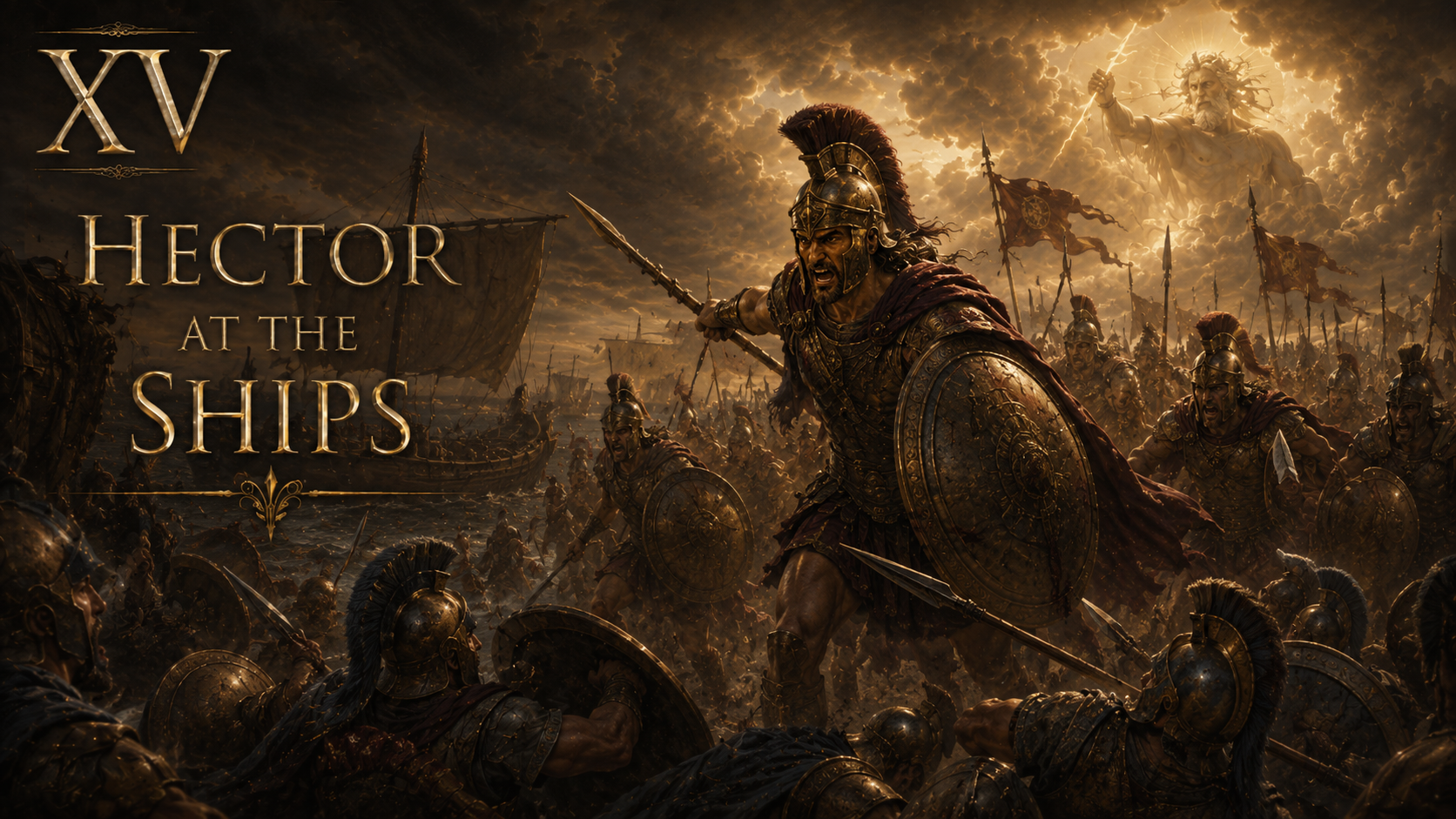
Book XV restores Zeus’s command and drives the battle toward the ships with frightening speed. Divine orders pass from messenger to god to warrior, yet on the shore every command becomes human exhaustion, panic, endurance, and the approaching necessity of Patroclus.
Textual basis
Homer, Iliad, Book XV, lines 1–47: Zeus awakens on Ida, sees Hector fallen, and recognizes Hera’s deception.
Reference edition used
Homer, Ilias. Griechisch–deutsch. Translated into German from the ancient Greek by Hans Rupé, 16th edition, Akademie Verlag, Berlin, 2013.
Deutsch
Das Erwachen des Zeus beendet eine vorübergehende Aussetzung der Macht. Was den Griechen wie Gnade erschien, war nur geliehene Zeit. Die tiefste Spannung liegt im göttlichen Vorauswissen: Zeus sieht die ganze Kette, während jeder Sterbliche nur den nächsten Schlag erlebt.
Der fünfzehnte Gesang stellt den Befehl des Zeus wieder her und treibt die Schlacht mit erschreckender Geschwindigkeit zu den Schiffen. Göttliche Weisungen wandern vom Boten zum Gott und zum Krieger; doch am Ufer wird jeder Befehl zu menschlicher Erschöpfung, Panik, Ausdauer und zur nahenden Notwendigkeit des Patroklos.
Textgrundlage
Homer, Ilias, 15. Gesang, Verse 1–47: Zeus auf dem Ida erwacht, den gefallenen Hektor sieht und Heras Täuschung erkennt.
Verwendete Referenzausgabe
Homer, Ilias. Griechisch–deutsch. Übertragen von Hans Rupé, 16. Auflage, Akademie Verlag, Berlin 2013.
Español
El despertar de Zeus pone fin a una suspensión temporal del poder. Lo que parecía misericordia para los griegos era solo tiempo prestado. La tensión más profunda está en el conocimiento divino: Zeus ve la cadena completa, mientras cada mortal solo vive el golpe siguiente.
El canto XV restablece el mandato de Zeus y empuja la batalla hacia las naves con una velocidad aterradora. Las órdenes divinas pasan del mensajero al dios y al guerrero; pero en la orilla cada mandato se convierte en agotamiento humano, pánico, resistencia y en la necesidad cada vez más cercana de Patroclo.
Base textual
Homero, Ilíada, canto XV, versos 1–47: Zeus despierta en el Ida, ve a Héctor caído y reconoce el engaño de Hera.
Edición de referencia utilizada
Homer, Ilias. Griechisch–deutsch. Traducción alemana del griego antiguo de Hans Rupé, 16.ª edición, Akademie Verlag, Berlín, 2013.
Français
Le réveil de Zeus met fin à une suspension provisoire du pouvoir. Ce qui semblait être une grâce pour les Grecs n’était qu’un temps emprunté. La tension profonde tient au savoir divin : Zeus voit toute la chaîne, tandis que chaque mortel ne connaît que le prochain coup.
Le chant XV rétablit le commandement de Zeus et pousse la bataille vers les nefs avec une vitesse terrifiante. Les ordres divins passent du messager au dieu puis au guerrier ; mais sur le rivage, chaque ordre devient épuisement humain, panique, endurance et nécessité croissante de Patrocle.
Base textuelle
Homère, Iliade, chant XV, vers 1–47 : Zeus s’éveille sur l’Ida, voit Hector abattu et reconnaît la tromperie d’Héra.
Édition de référence utilisée
Homer, Ilias. Griechisch–deutsch. Traduction allemande du grec ancien par Hans Rupé, 16e édition, Akademie Verlag, Berlin, 2013.