Lyrics
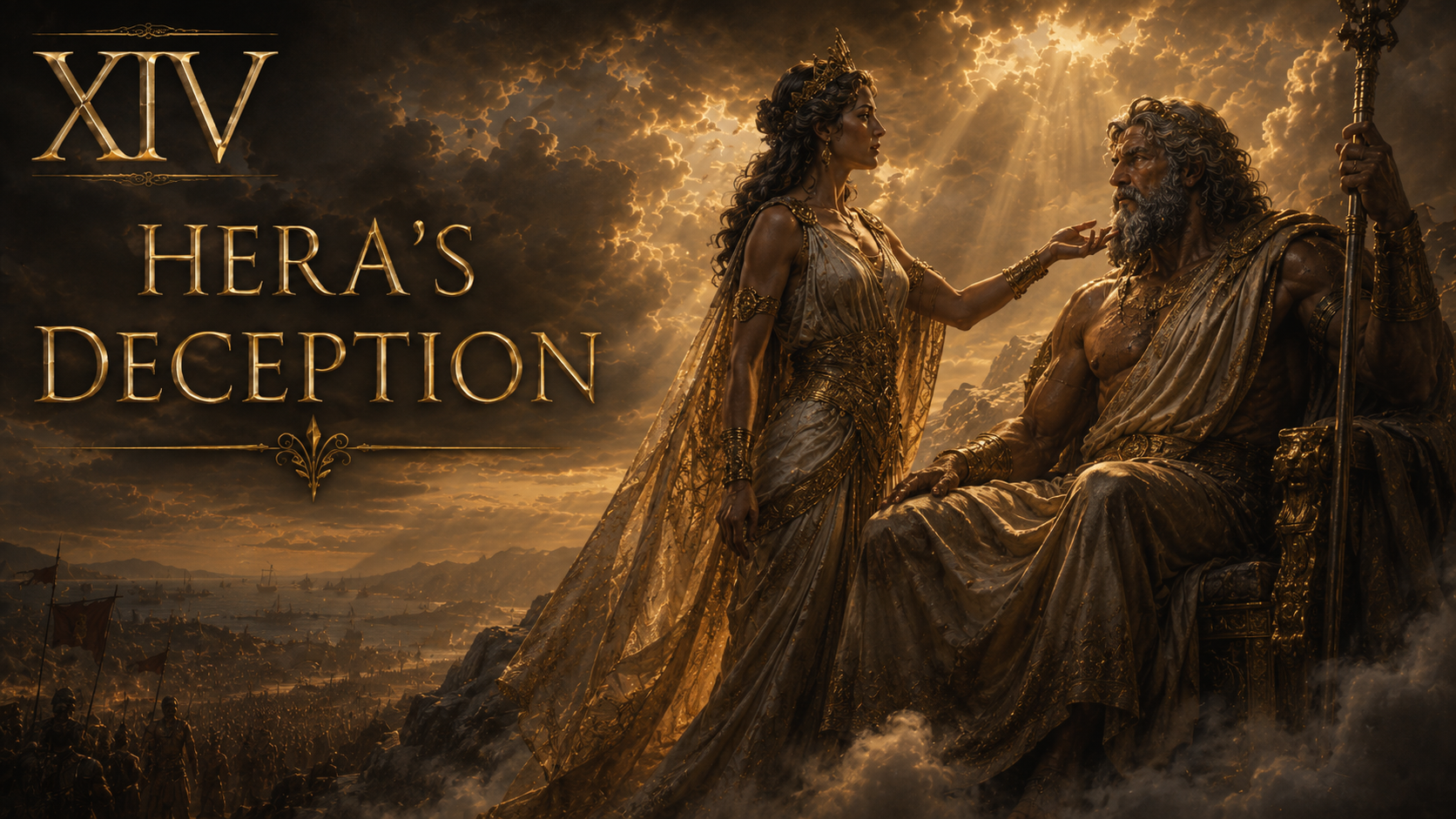
She saw the field below
she saw the field below
where smoke and bronze and broken men
were moving to and fro
She saw the ships beside the sea
she saw the fire near
she saw the Greeks bend back again
beneath the weight of fear
She saw the Trojans pressing hard
with Hector in the flame
she saw the wall that could not hold
she saw the dying name
And high above the cries of men
where no spear reached the sky
Hera watched with narrowed eyes
and would not let it lie
She saw the field below
she saw the field below
not with tears and not with prayer
but with a queenly no
She saw the field below
she saw the field below
and somewhere in her silent heart
a darker river flowed
She knew the will of Zeus was turned
against the Argive line
she knew the thunder had a plan
and called that plan divine
But gods may sit on golden thrones
and still be crossed by pride
and even kings of cloud and storm
may leave one door untied
She did not rush into the fight
she did not call for spears
she had learned the art of waiting
through immortal years
She saw Poseidon in the dust
she saw his hidden hand
she saw old anger rise again
like water under sand
She saw the field below
she saw the field below
where one god stirred the broken ranks
and one god did not know
She saw the field below
she saw the field below
and every cry beneath the smoke
became a thread to sew
No mortal man could hear her thought
no warrior saw her face
but war can change its road at night
through silk and quiet grace
She turned away from open wrath
she turned toward something slow
a plan that moved without a sword
where only gods may go
For power is not always thunder
power is not always flame
sometimes it wears a softer step
and never speaks its name
She saw the field below
she saw the field below
and in the silence of her mind
the first cold flowers grow
She saw the field below
she saw the field below
before the sleep
before the kiss
before the overthrow
The ships still smoked
the Trojans cried
the sea lay dark and wide
And Hera gathered up the night
and kept her storm inside
Translations
Deutsch
Sie sah das Feld unter sich, wo Rauch, Bronze und gebrochene Männer hin und her zogen. Sie sah die Schiffe am Meer, das nahe Feuer und die Griechen, die sich unter dem Gewicht der Angst wieder beugten.
Sie sah die Trojaner mit Hektor in der Flamme vorwärtsdrängen, die Mauer, die nicht hielt, und den sterbenden Namen. Hoch über den Schreien, wohin kein Speer reichte, beobachtete Hera mit schmalen Augen – und wollte es nicht hinnehmen.
Sie sah das Feld nicht mit Tränen oder Gebet, sondern mit dem königlichen Wort: Nein. In ihrem stillen Herzen floss ein dunklerer Strom.
Sie wusste, dass Zeus’ Wille gegen die Argiver gerichtet war, dass der Donner einen Plan hatte und diesen göttlich nannte. Doch auch Götter auf goldenen Thronen können vom Stolz gekreuzt werden, und selbst Könige von Wolke und Sturm lassen manchmal eine Tür unverschlossen.
Hera stürzte nicht in den Kampf und rief nicht nach Speeren. In unsterblichen Jahren hatte sie die Kunst des Wartens gelernt. Sie sah Poseidon im Staub und seine verborgene Hand; sie sah alten Zorn wie Wasser unter Sand aufsteigen.
Wo ein Gott die gebrochenen Reihen bewegte und ein anderer nichts davon wusste, wurde jeder Schrei unter dem Rauch zu einem Faden, den Hera vernähen konnte.
Kein Sterblicher hörte ihren Gedanken und kein Krieger sah ihr Gesicht. Doch ein Krieg kann nachts durch Seide und stille Anmut seinen Weg ändern. Sie wandte sich vom offenen Zorn ab und einem langsamen Plan zu, der ohne Schwert dorthin ging, wohin nur Götter gelangen.
Macht ist nicht immer Donner oder Flamme. Manchmal tritt sie weich auf und nennt nie ihren Namen. Vor dem Schlaf, vor dem Kuss und vor dem Umsturz sammelte Hera die Nacht und hielt ihren Sturm im Innern.
Español
Vio el campo abajo, donde humo, bronce y hombres quebrados iban y venían. Vio las naves junto al mar, el fuego cercano y a los griegos doblarse otra vez bajo el peso del miedo.
Vio a los troyanos presionar con Héctor en la llama, la muralla que no resistió y el nombre moribundo. Muy por encima de los gritos, donde ninguna lanza alcanzaba, Hera observó con los ojos estrechos y se negó a aceptarlo.
No miró el campo con lágrimas ni oración, sino con un no de reina. En su corazón silencioso corría un río más oscuro.
Sabía que la voluntad de Zeus se había vuelto contra los argivos, que el trueno tenía un plan y lo llamaba divino. Pero incluso los dioses en tronos de oro pueden ser contrariados por el orgullo, y hasta los reyes de nube y tormenta dejan alguna puerta sin cerrar.
Hera no se lanzó a la batalla ni pidió lanzas. Había aprendido el arte de esperar durante años inmortales. Vio a Poseidón en el polvo y su mano oculta; vio levantarse la vieja ira como agua bajo la arena.
Donde un dios agitaba las filas rotas y otro no lo sabía, cada grito bajo el humo se volvió un hilo que Hera podía coser.
Ningún mortal oyó su pensamiento ni guerrero alguno vio su rostro. Pero la guerra puede cambiar de camino por la noche mediante seda y gracia silenciosa. Se apartó de la ira abierta y se volvió hacia un plan lento, sin espada, por donde solo caminan los dioses.
El poder no siempre es trueno ni llama. A veces da pasos suaves y nunca dice su nombre. Antes del sueño, del beso y del vuelco, Hera reunió la noche y guardó dentro su tormenta.
Français
Elle vit le champ en dessous, où fumée, bronze et hommes brisés allaient et venaient. Elle vit les navires près de la mer, le feu tout proche et les Grecs plier encore sous le poids de la peur.
Elle vit les Troyens presser avec Hector dans la flamme, le mur qui n’avait pas tenu et le nom mourant. Très haut au-dessus des cris, là où nulle lance n’atteignait, Héra regarda les yeux étroits et refusa d’accepter.
Elle ne vit pas le champ avec des larmes ou une prière, mais avec le non d’une reine. Dans son cœur silencieux coulait un fleuve plus sombre.
Elle savait la volonté de Zeus tournée contre les Argiens, le tonnerre porteur d’un projet qu’il disait divin. Mais les dieux sur leurs trônes d’or peuvent être contrariés par l’orgueil, et même les rois des nuages et de l’orage laissent parfois une porte ouverte.
Héra ne se précipita pas au combat et n’appela pas les lances. Elle avait appris l’art d’attendre au cours des années immortelles. Elle vit Poséidon dans la poussière et sa main cachée ; elle vit une vieille colère monter comme de l’eau sous le sable.
Là où un dieu remuait les rangs brisés tandis qu’un autre l’ignorait, chaque cri sous la fumée devint un fil qu’Héra pouvait coudre.
Nul mortel n’entendit sa pensée et aucun guerrier ne vit son visage. Pourtant la guerre peut changer de route la nuit par la soie et la grâce silencieuse. Elle se détourna de la colère ouverte vers un plan lent, sans épée, là où seuls vont les dieux.
Le pouvoir n’est pas toujours tonnerre ou flamme. Parfois il avance doucement et ne prononce jamais son nom. Avant le sommeil, avant le baiser et avant le renversement, Héra rassembla la nuit et garda sa tempête au-dedans.
Reflection
English
Hera’s gaze turns suffering into strategy. Her response is morally ambiguous—she resists Zeus on behalf of the Greeks, yet treats the battlefield as threads in a divine design. The song presents patience and indirection as forms of power equal to thunder.
Book XIV makes strategy depend on wounded bodies, persuasion, disguise, desire, and sleep. Hera’s deception gives the Achaeans breathing space, but the rescue is morally unstable: tenderness becomes a weapon, and mortal survival turns on a quarrel among immortals.
Textual basis
Homer, Iliad, Book XIV, lines 153–186: Hera looks down upon the battlefield and forms her plan to distract Zeus.
Reference edition used
Homer, Ilias. Griechisch–deutsch. Translated into German from the ancient Greek by Hans Rupé, 16th edition, Akademie Verlag, Berlin, 2013.
Deutsch
Heras Blick verwandelt Leiden in Strategie. Ihre Antwort bleibt moralisch doppeldeutig: Sie widersetzt sich Zeus zugunsten der Griechen, behandelt das Schlachtfeld aber wie Fäden in einem göttlichen Entwurf. Geduld und Umweg erscheinen als Machtformen, die dem Donner ebenbürtig sind.
Der vierzehnte Gesang lässt Strategie von verwundeten Körpern, Überredung, Verstellung, Begehren und Schlaf abhängen. Heras Täuschung verschafft den Achaiern Luft, doch die Rettung bleibt moralisch instabil: Zärtlichkeit wird zur Waffe, und sterbliches Überleben hängt vom Streit der Unsterblichen ab.
Textgrundlage
Homer, Ilias, 14. Gesang, Verse 153–186: Hera auf das Schlachtfeld hinabblickt und ihren Plan fasst, Zeus abzulenken.
Verwendete Referenzausgabe
Homer, Ilias. Griechisch–deutsch. Übertragen von Hans Rupé, 16. Auflage, Akademie Verlag, Berlin 2013.
Español
La mirada de Hera convierte el sufrimiento en estrategia. Su respuesta es ambigua: se opone a Zeus por los griegos, pero trata el campo como hilos de un diseño divino. Paciencia e indirección aparecen como poderes iguales al trueno.
El canto XIV hace que la estrategia dependa de cuerpos heridos, persuasión, disfraz, deseo y sueño. El engaño de Hera concede un respiro a los aqueos, pero el rescate es moralmente inestable: la ternura se convierte en arma y la supervivencia mortal depende de una disputa entre inmortales.
Base textual
Homero, Ilíada, canto XIV, versos 153–186: Hera contempla el campo de batalla y concibe su plan para distraer a Zeus.
Edición de referencia utilizada
Homer, Ilias. Griechisch–deutsch. Traducción alemana del griego antiguo de Hans Rupé, 16.ª edición, Akademie Verlag, Berlín, 2013.
Français
Le regard d’Héra transforme la souffrance en stratégie. Sa réponse demeure ambiguë : elle résiste à Zeus pour les Grecs, mais traite le champ comme les fils d’un dessin divin. Patience et détour deviennent des pouvoirs égaux au tonnerre.
Le chant XIV fait dépendre la stratégie des corps blessés, de la persuasion, du déguisement, du désir et du sommeil. La tromperie d’Héra offre un répit aux Achéens, mais ce secours demeure moralement instable : la tendresse devient une arme et la survie des mortels dépend d’une querelle entre immortels.
Base textuelle
Homère, Iliade, chant XIV, vers 153–186 : Héra contemple le champ de bataille et conçoit son plan pour détourner Zeus.
Édition de référence utilisée
Homer, Ilias. Griechisch–deutsch. Traduction allemande du grec ancien par Hans Rupé, 16e édition, Akademie Verlag, Berlin, 2013.