Lyrics
Hector came through the shouting
With the dust upon his mouth
Driving from the broken wall
Toward the ships and south
The Trojans burned behind him
Like a fire in the reeds
Every shield was hungry
Every spear had needs
But the Greeks had found their footing
Where the sea wind cut the line
And the men who almost vanished
Stood again in brine
Ajax raised his great shield
Idomeneus struck clean
And the shoreline held its breathing
In the iron in between
Hector meets the shield
Bronze against the tide
Hector meets the shield
Where the black ships hide
One man brings the thunder
One line will not yield
At the edge of the sea
Hector meets the shield
No gate was there to break now
No timber bar to throw
Only men with sand beneath them
And nowhere else to go
The spearheads crossed like branches
In a storm above the plain
And the wounded earth below them
Drank the salt and rain
The Trojans shouted forward
The Greeks answered low
Not with songs of triumph
But with work against the blow
For courage in that moment
Had no golden crown
It was shoulder pressed to shoulder
When the sky came down
Hector meets the shield
Bronze against the tide
Hector meets the shield
Where the black ships hide
One man brings the thunder
One line will not yield
At the edge of the sea
Hector meets the shield
Hold the shore
Hold the breath
Hold the ships
Hold back death
Push the bronze
Lift the cry
Sea behind
War in the sky
The gods were in the weather
The gods were in the foam
But each man still was fighting
For his road back home
Hector felt the answer
In the ringing of the wall
Not a wall of stone or timber
But men who would not fall
Hector meets the shield
Bronze against the tide
Hector meets the shield
Where the black ships hide
One man brings the thunder
One line will not yield
At the edge of the sea
Hector meets the shield
Hector meets the shield
And the shore gives none away
The black ships wait in silence
At the edge of a burning day
Translations
Deutsch
Hektor kam durch das Geschrei, Staub auf dem Mund, von der zerbrochenen Mauer südwärts zu den Schiffen. Hinter ihm brannten die Trojaner wie Feuer im Schilf; jeder Schild war hungrig und jeder Speer hatte sein Verlangen.
Doch die Griechen hatten im schneidenden Seewind wieder Boden gefunden. Die Männer, die fast verschwunden waren, standen erneut in der Salzflut. Ajax hob seinen großen Schild, Idomeneus traf sauber, und das Ufer hielt im Eisen dazwischen den Atem an.
Hektor trifft auf den Schild, Bronze gegen die Flut, dort, wo die schwarzen Schiffe liegen. Ein Mann bringt den Donner, doch eine Linie will nicht weichen. Am Rand des Meeres trifft Hektor auf den Schild.
Kein Tor war jetzt zu brechen, kein Holzbalken fortzuschleudern. Nur Männer mit Sand unter den Füßen und ohne einen Ort zum Rückzug. Die Speerspitzen kreuzten sich wie Äste im Sturm über der Ebene, und die verwundete Erde darunter trank Salz und Regen.
Die Trojaner schrien vorwärts, die Griechen antworteten leise – nicht mit Siegesliedern, sondern mit Arbeit gegen den Schlag. Mut trug in diesem Augenblick keine goldene Krone; er war Schulter an Schulter, als der Himmel herunterstürzte.
Haltet Ufer, Atem und Schiffe; haltet den Tod zurück. Drückt die Bronze vor und hebt den Ruf: das Meer im Rücken, Krieg am Himmel.
Die Götter waren im Wetter und im Schaum, doch jeder Mann kämpfte selbst um seinen Weg nach Hause. Hektor spürte die Antwort im Dröhnen der Mauer – nicht einer Mauer aus Stein oder Holz, sondern aus Männern, die nicht fallen wollten.
Hektor trifft auf den Schild, und das Ufer gibt nichts preis. Die schwarzen Schiffe warten schweigend am Rand eines brennenden Tages.
Español
Héctor llegó entre los gritos, con polvo en la boca, desde la muralla rota hacia las naves del sur. Los troyanos ardían detrás de él como fuego entre juncos; cada escudo tenía hambre y cada lanza su necesidad.
Pero los griegos habían recuperado el equilibrio donde el viento del mar cortaba la línea. Los hombres que casi habían desaparecido volvieron a alzarse en la sal. Áyax levantó su gran escudo, Idomeneo golpeó limpio, y la costa contuvo el aliento en el hierro entre ambos.
Héctor encuentra el escudo, bronce contra la marea, donde se esconden las naves negras. Un hombre trae el trueno, pero una línea no cederá. Al borde del mar, Héctor encuentra el escudo.
Ya no había puerta que romper ni travesaño que lanzar. Solo hombres con arena bajo los pies y ningún lugar adonde ir. Las lanzas se cruzaron como ramas en una tormenta sobre la llanura, y la tierra herida bebió sal y lluvia.
Los troyanos gritaron hacia delante; los griegos respondieron bajo, no con cantos de triunfo, sino con trabajo contra el golpe. En aquel instante el valor no llevaba corona de oro: era hombro contra hombro cuando caía el cielo.
Guardad la orilla, el aliento y las naves; mantened lejos a la muerte. Empujad el bronce y alzad el grito: mar detrás, guerra en el cielo.
Los dioses estaban en el tiempo y la espuma, pero cada hombre luchaba por su camino de vuelta. Héctor sintió la respuesta en el resonar de la muralla, no una muralla de piedra o madera, sino hombres que no querían caer.
Héctor encuentra el escudo y la costa no entrega nada. Las naves negras esperan en silencio al borde de un día en llamas.
Français
Hector vint à travers les cris, la poussière sur la bouche, du mur fracassé vers les navires au sud. Les Troyens brûlaient derrière lui comme le feu dans les roseaux ; chaque bouclier avait faim, chaque lance son besoin.
Mais les Grecs avaient retrouvé leur appui là où le vent marin coupait la ligne. Les hommes presque effacés se dressèrent de nouveau dans le sel. Ajax leva son grand bouclier, Idoménée frappa juste, et le rivage retint son souffle dans le fer entre eux.
Hector rencontre le bouclier, le bronze contre la marée, là où se cachent les navires noirs. Un homme apporte le tonnerre, une ligne refuse de céder. Au bord de la mer, Hector rencontre le bouclier.
Il n’y avait plus de porte à briser ni de barre à jeter. Seulement des hommes, le sable sous les pieds et aucun lieu où aller. Les pointes se croisèrent comme des branches dans la tempête, et la terre blessée but le sel et la pluie.
Les Troyens crièrent en avant ; les Grecs répondirent tout bas, non par des chants de victoire, mais par le travail contre le choc. À cet instant le courage ne portait pas de couronne d’or : il était épaule contre épaule quand le ciel tombait.
Tenez le rivage, le souffle et les navires ; retenez la mort. Poussez le bronze et levez le cri : la mer derrière, la guerre dans le ciel.
Les dieux étaient dans le temps et dans l’écume, mais chaque homme combattait encore pour sa route vers la maison. Hector sentit la réponse dans le fracas du mur, non un mur de pierre ou de bois, mais d’hommes refusant de tomber.
Hector rencontre le bouclier et le rivage ne cède rien. Les navires noirs attendent en silence au bord d’un jour en flammes.
Reflection
English
Hector has already broken a constructed wall; here he encounters a human one. The contrast is the song’s core: timber can be shattered, but shared resolve must be tested person by person. Defense becomes an active, collective deed rather than a passive barrier.
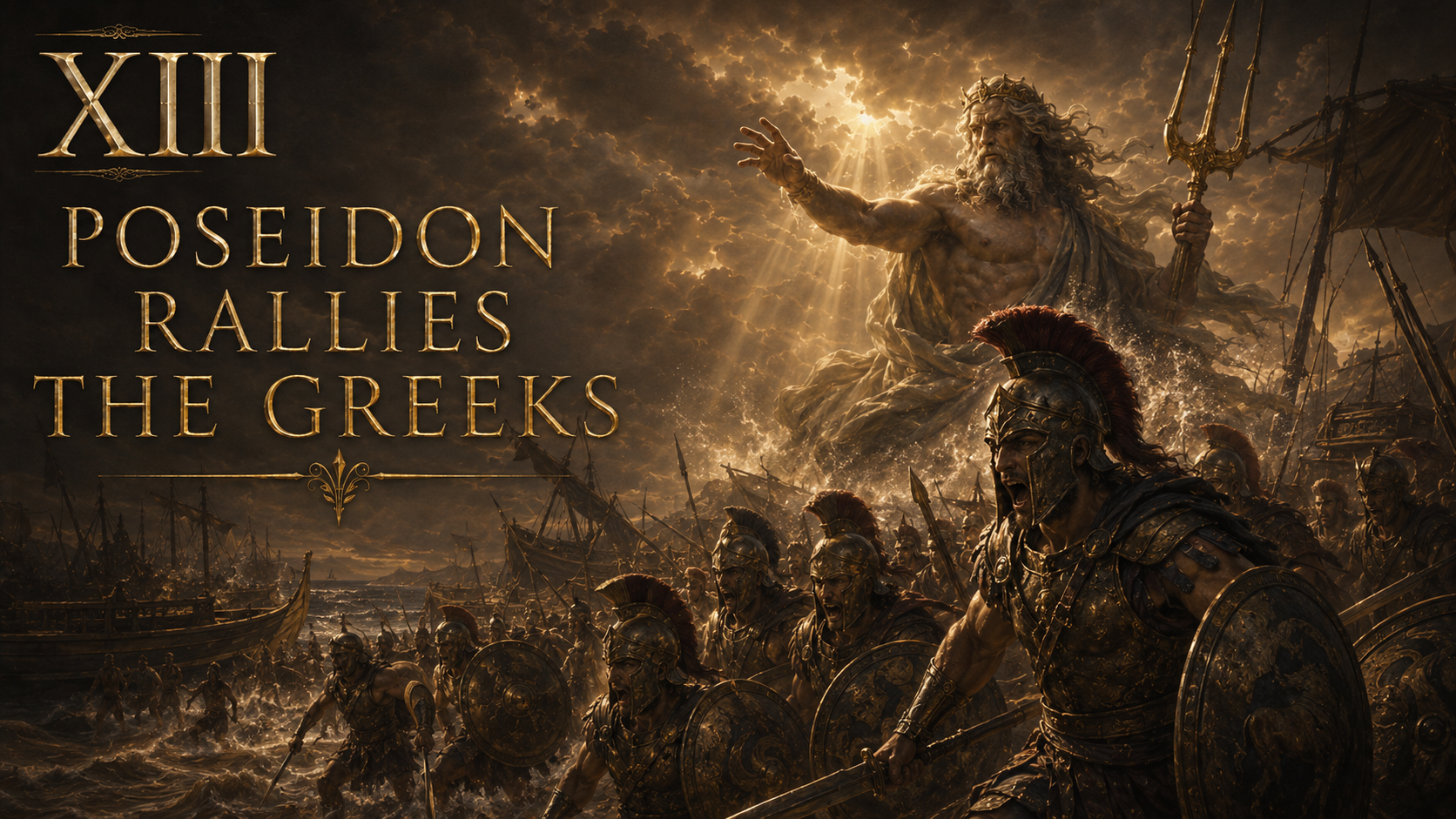
Book XIII answers the Trojan breakthrough with a defense built from many hands. Poseidon’s hidden intervention strengthens the Achaeans, but the line survives through shared courage, exchanged weapons, rescue, and the stubborn refusal to let one collapse become the collapse of all.
Textual basis
Homer, Iliad, Book XIII, lines 673–756: Hector meets the massed Achaean shields near the ships and seeks a way through.
Reference edition used
Homer, Ilias. Griechisch–deutsch. Translated into German from the ancient Greek by Hans Rupé, 16th edition, Akademie Verlag, Berlin, 2013.
Deutsch
Hektor hat bereits eine gebaute Mauer zerbrochen; nun trifft er auf eine menschliche. Darin liegt der Kern des Liedes: Holz lässt sich zerschlagen, gemeinsamer Wille muss Mensch für Mensch geprüft werden. Verteidigung wird zur aktiven gemeinsamen Tat.
Der dreizehnte Gesang beantwortet den trojanischen Durchbruch mit einer Verteidigung vieler Hände. Poseidons verborgenes Eingreifen stärkt die Achaier, doch die Linie hält durch geteilten Mut, weitergereichte Waffen, Rettung und die hartnäckige Weigerung, aus einem Zusammenbruch den Zusammenbruch aller werden zu lassen.
Textgrundlage
Homer, Ilias, 13. Gesang, Verse 673–756: Hektor bei den Schiffen auf die geschlossene achaïsche Schildreihe trifft und einen Durchbruch sucht.
Verwendete Referenzausgabe
Homer, Ilias. Griechisch–deutsch. Übertragen von Hans Rupé, 16. Auflage, Akademie Verlag, Berlin 2013.
Español
Héctor ya ha roto una muralla construida; ahora encuentra una muralla humana. Ahí está el centro de la canción: la madera puede quebrarse, pero la voluntad compartida debe probarse persona por persona. Defender es un acto colectivo y activo.
El canto XIII responde a la irrupción troyana con una defensa construida por muchas manos. La intervención oculta de Poseidón fortalece a los aqueos, pero la línea resiste gracias al valor compartido, las armas intercambiadas, el rescate y la obstinada negativa a convertir una caída en la caída de todos.
Base textual
Homero, Ilíada, canto XIII, versos 673–756: Héctor encuentra la compacta línea de escudos aqueos junto a las naves y busca abrirse paso.
Edición de referencia utilizada
Homer, Ilias. Griechisch–deutsch. Traducción alemana del griego antiguo de Hans Rupé, 16.ª edición, Akademie Verlag, Berlín, 2013.
Français
Hector a déjà brisé un mur construit ; il rencontre ici un mur humain. Le cœur du chant est là : le bois peut être fracassé, mais une volonté commune doit être éprouvée homme par homme. Défendre devient un acte collectif et actif.
Le chant XIII répond à la percée troyenne par une défense portée par de nombreuses mains. L’intervention cachée de Poséidon fortifie les Achéens, mais la ligne tient grâce au courage partagé, aux armes échangées, au secours et au refus obstiné de laisser une chute devenir celle de tous.
Base textuelle
Homère, Iliade, chant XIII, vers 673–756 : Hector rencontre la ligne compacte des boucliers achéens près des nefs et cherche une brèche.
Édition de référence utilisée
Homer, Ilias. Griechisch–deutsch. Traduction allemande du grec ancien par Hans Rupé, 16e édition, Akademie Verlag, Berlin, 2013.