Lyrics
The old spear still cuts
Through the salt and dust
Not for the shout of glory
Not for the young men’s trust
The old spear still cuts
Where the sea winds cry
And every man who doubts it
Learns before he dies
Idomeneus moved forward
With the weight of older years
Not slower in the danger
But quieter than fear
Meriones beside him
Had a hunter’s narrowed eye
And both of them were watching
Where the Trojan line ran high
No bright boy’s hunger led them
No boast upon the tongue
They knew how short a life can be
When bronze and breath are young
They stepped into the pressure
Where the sand was dark and wet
And the men who came against them
Found the war was living yet
The old spear still cuts
Through the salt and dust
Not for the shout of glory
Not for the young men’s trust
The old spear still cuts
Where the sea winds cry
And every man who doubts it
Learns before he dies
A shield came up before them
A sword flashed in the sun
A Trojan name was lifted
And suddenly was done
Another man came shouting
With anger in his chest
But anger is a poor guard
When skill has found its rest
The Cretan bronze went forward
Clean as a line of rain
No wasted rage, no trembling
Only work inside the pain
And where the shoreline tightened
And the black ships held their breath
The old spear made a doorway
Through the crowding face of death
The old spear still cuts
Through the salt and dust
Not for the shout of glory
Not for the young men’s trust
The old spear still cuts
Where the sea winds cry
And every man who doubts it
Learns before he dies
Age is not surrender
And silence is not sleep
Some fires burn low and hidden
But they burn deep
A young hand may be eager
A loud heart may be brave
But the old hand knows the distance
Between a wound and grave
So let the shore remember
Where the Cretan captains stood
With sand around their ankles
And iron in the blood
The old spear still cuts
Through the salt and dust
Not for the shout of glory
Not for the young men’s trust
The old spear still cuts
Where the sea winds cry
And every man who doubts it
Learns before he dies
The old spear still cuts
While the ship ropes strain
And wisdom walks through battle
With salt, bronze, and pain
Translations
Deutsch
Der alte Speer schneidet noch immer durch Salz und Staub – nicht für den Ruf des Ruhmes und nicht für das Vertrauen junger Männer. Wo die Seewinde schreien, lernt jeder Zweifler seine Schärfe, bevor er stirbt.
Idomeneus ging mit dem Gewicht älterer Jahre voran, in der Gefahr nicht langsamer, sondern stiller als die Furcht. Meriones stand neben ihm mit dem schmalen Blick eines Jägers; beide beobachteten, wo die trojanische Linie hoch aufstieg.
Kein Hunger eines glänzenden Knaben führte sie und kein Prahlen lag auf der Zunge. Sie wussten, wie kurz ein Leben sein kann, wenn Bronze und Atem jung sind. Sie traten in den Druck, wo der Sand dunkel und nass war, und ihre Gegner erfuhren, dass der Krieg noch lebte.
Ein Schild hob sich vor ihnen, ein Schwert blitzte in der Sonne. Ein trojanischer Name wurde gerufen und war plötzlich zu Ende. Ein anderer Mann kam zornig schreiend, doch Zorn ist ein schlechter Schutz, wenn das Können zur Ruhe gefunden hat.
Die kretische Bronze fuhr vor, sauber wie eine Regenlinie: keine vergeudete Wut, kein Zittern, nur Arbeit im Schmerz. Wo das Ufer enger wurde und die schwarzen Schiffe den Atem anhielten, öffnete der alte Speer einen Weg durch das Gedränge des Todes.
Alter ist keine Aufgabe und Schweigen kein Schlaf. Manche Feuer brennen niedrig und verborgen, aber tief. Eine junge Hand mag eifrig sein und ein lautes Herz mutig, doch die alte Hand kennt den Abstand zwischen Wunde und Grab.
Das Ufer soll sich erinnern, wo die kretischen Hauptleute standen, Sand um die Knöchel und Eisen im Blut. Der alte Speer schneidet weiter, während die Schiffstaue ächzen, und Weisheit geht mit Salz, Bronze und Schmerz durch die Schlacht.
Español
La vieja lanza todavía corta entre sal y polvo, no por el grito de la gloria ni por la confianza de los jóvenes. Donde lloran los vientos del mar, todo el que duda aprende su filo antes de morir.
Idomeneo avanzó con el peso de los años, no más lento ante el peligro, sino más silencioso que el miedo. Meríones estaba a su lado con la mirada estrecha de un cazador; ambos observaban dónde crecía la línea troyana.
No los guiaba el hambre de un muchacho brillante ni la jactancia en la lengua. Sabían lo breve que puede ser una vida cuando bronce y aliento son jóvenes. Entraron en la presión donde la arena era oscura y húmeda, y sus adversarios descubrieron que la guerra aún vivía.
Un escudo se levantó ante ellos y una espada brilló al sol. Un nombre troyano fue pronunciado y de pronto terminó. Otro hombre llegó gritando de ira, pero la ira protege mal cuando la destreza ha encontrado reposo.
El bronce cretense avanzó limpio como una línea de lluvia: sin furia desperdiciada, sin temblor, solo trabajo dentro del dolor. Donde la costa se estrechaba y las naves negras contenían el aliento, la vieja lanza abrió una puerta entre el rostro apretado de la muerte.
La edad no es rendición y el silencio no es sueño. Algunos fuegos arden bajos y ocultos, pero arden hondo. Una mano joven puede ser impaciente y un corazón ruidoso valiente; la mano vieja conoce la distancia entre herida y tumba.
Que la costa recuerde dónde estuvieron los capitanes cretenses, con arena en los tobillos y hierro en la sangre. La vieja lanza sigue cortando mientras se tensan las cuerdas de las naves, y la sabiduría camina por la batalla con sal, bronce y dolor.
Français
La vieille lance coupe encore à travers le sel et la poussière, non pour le cri de gloire ni pour la confiance des jeunes. Là où pleurent les vents marins, tout homme qui en doute apprend son tranchant avant de mourir.
Idoménée avançait avec le poids des années, non plus lent dans le danger, mais plus silencieux que la peur. Mérion se tenait près de lui avec le regard resserré du chasseur ; tous deux surveillaient l’endroit où montait la ligne troyenne.
Nulle faim de jeune héros ne les conduisait, nulle vantardise sur la langue. Ils savaient combien une vie peut être brève lorsque le bronze et le souffle sont jeunes. Ils entrèrent dans la pression, là où le sable était sombre et humide, et leurs adversaires apprirent que la guerre vivait toujours.
Un bouclier se leva devant eux, une épée brilla au soleil. Un nom troyen fut lancé puis soudain achevé. Un autre homme vint en criant sa colère, mais la colère protège mal lorsque l’adresse a trouvé son repos.
Le bronze crétois partit droit comme une ligne de pluie : nulle rage perdue, nul tremblement, seulement le travail au cœur de la douleur. Là où la côte se resserrait et où les navires noirs retenaient leur souffle, la vieille lance ouvrit une porte dans le visage pressé de la mort.
L’âge n’est pas la reddition et le silence n’est pas le sommeil. Certains feux brûlent bas et cachés, mais profondément. Une jeune main peut être impatiente, un cœur bruyant peut être brave ; la vieille main connaît la distance entre blessure et tombe.
Que le rivage se souvienne de l’endroit où tinrent les chefs crétois, le sable aux chevilles et le fer dans le sang. La vieille lance coupe encore pendant que les cordages se tendent, et la sagesse traverse le combat avec le sel, le bronze et la douleur.
Reflection
English
The song rejects the idea that age is merely decline. Idomeneus’ advantage is economy: he wastes neither motion nor emotion. Experience becomes an ethical image as well as a martial one—the ability to act clearly when noise, pain, and pride compete for control.
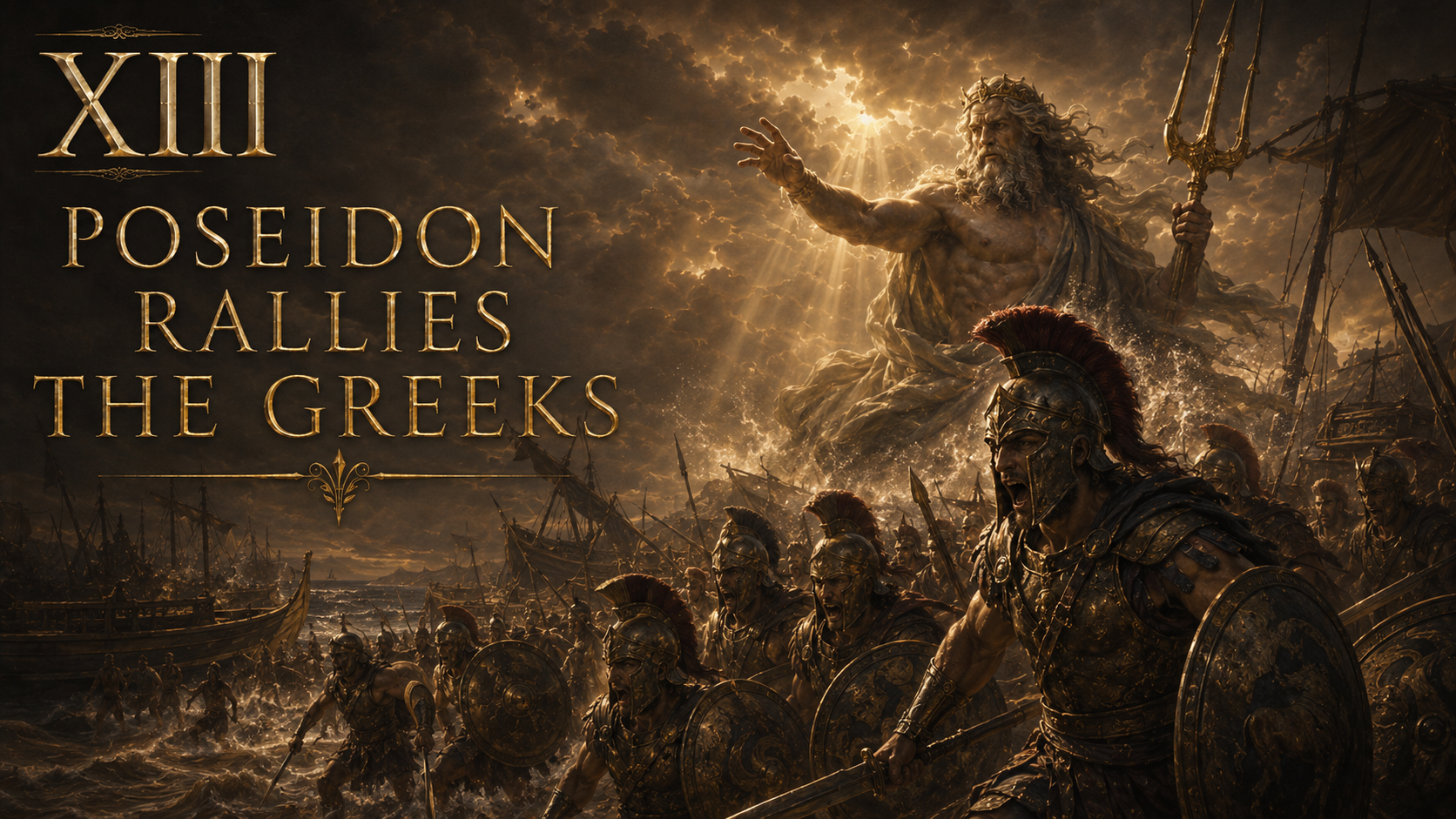
Book XIII answers the Trojan breakthrough with a defense built from many hands. Poseidon’s hidden intervention strengthens the Achaeans, but the line survives through shared courage, exchanged weapons, rescue, and the stubborn refusal to let one collapse become the collapse of all.
Textual basis
Homer, Iliad, Book XIII, lines 361–575: the veteran Idomeneus drives his spear through a sequence of Trojan opponents.
Reference edition used
Homer, Ilias. Griechisch–deutsch. Translated into German from the ancient Greek by Hans Rupé, 16th edition, Akademie Verlag, Berlin, 2013.
Deutsch
Das Lied weist die Vorstellung zurück, Alter bedeute nur Verfall. Idomeneus’ Vorteil ist Ökonomie: Er verschwendet weder Bewegung noch Gefühl. Erfahrung wird zum ethischen wie kämpferischen Bild – klar handeln zu können, wenn Lärm, Schmerz und Stolz um die Kontrolle ringen.
Der dreizehnte Gesang beantwortet den trojanischen Durchbruch mit einer Verteidigung vieler Hände. Poseidons verborgenes Eingreifen stärkt die Achaier, doch die Linie hält durch geteilten Mut, weitergereichte Waffen, Rettung und die hartnäckige Weigerung, aus einem Zusammenbruch den Zusammenbruch aller werden zu lassen.
Textgrundlage
Homer, Ilias, 13. Gesang, Verse 361–575: der erfahrene Idomeneus seinen Speer gegen eine Reihe trojanischer Gegner führt.
Verwendete Referenzausgabe
Homer, Ilias. Griechisch–deutsch. Übertragen von Hans Rupé, 16. Auflage, Akademie Verlag, Berlin 2013.
Español
La canción rechaza la idea de que la edad sea solo decadencia. La ventaja de Idomeneo es la economía: no desperdicia movimiento ni emoción. La experiencia es una imagen ética y guerrera: actuar con claridad cuando ruido, dolor y orgullo compiten por el control.
El canto XIII responde a la irrupción troyana con una defensa construida por muchas manos. La intervención oculta de Poseidón fortalece a los aqueos, pero la línea resiste gracias al valor compartido, las armas intercambiadas, el rescate y la obstinada negativa a convertir una caída en la caída de todos.
Base textual
Homero, Ilíada, canto XIII, versos 361–575: el veterano Idomeneo impulsa su lanza contra una sucesión de adversarios troyanos.
Edición de referencia utilizada
Homer, Ilias. Griechisch–deutsch. Traducción alemana del griego antiguo de Hans Rupé, 16.ª edición, Akademie Verlag, Berlín, 2013.
Français
La chanson refuse de réduire l’âge au déclin. L’avantage d’Idoménée est l’économie : il ne gaspille ni geste ni émotion. L’expérience devient une image morale autant que guerrière, la capacité d’agir clairement quand bruit, douleur et orgueil veulent commander.
Le chant XIII répond à la percée troyenne par une défense portée par de nombreuses mains. L’intervention cachée de Poséidon fortifie les Achéens, mais la ligne tient grâce au courage partagé, aux armes échangées, au secours et au refus obstiné de laisser une chute devenir celle de tous.
Base textuelle
Homère, Iliade, chant XIII, vers 361–575 : le vétéran Idoménée porte sa lance contre une succession d’adversaires troyens.
Édition de référence utilisée
Homer, Ilias. Griechisch–deutsch. Traduction allemande du grec ancien par Hans Rupé, 16e édition, Akademie Verlag, Berlin, 2013.