Lyrics
The wall was down behind them
The ships were close at hand
The Greeks stood breathing salt air
With their heels in broken sand
The Trojans came like weather
Through the shattered gate
And every mast was trembling
With the nearness of its fate
Then far beneath the water
Where the deep foundations sleep
A power stirred in silence
In the chambers of the deep
No trumpet called his coming
No thunder split the skies
Only foam along the shoreline
Began to lift and rise
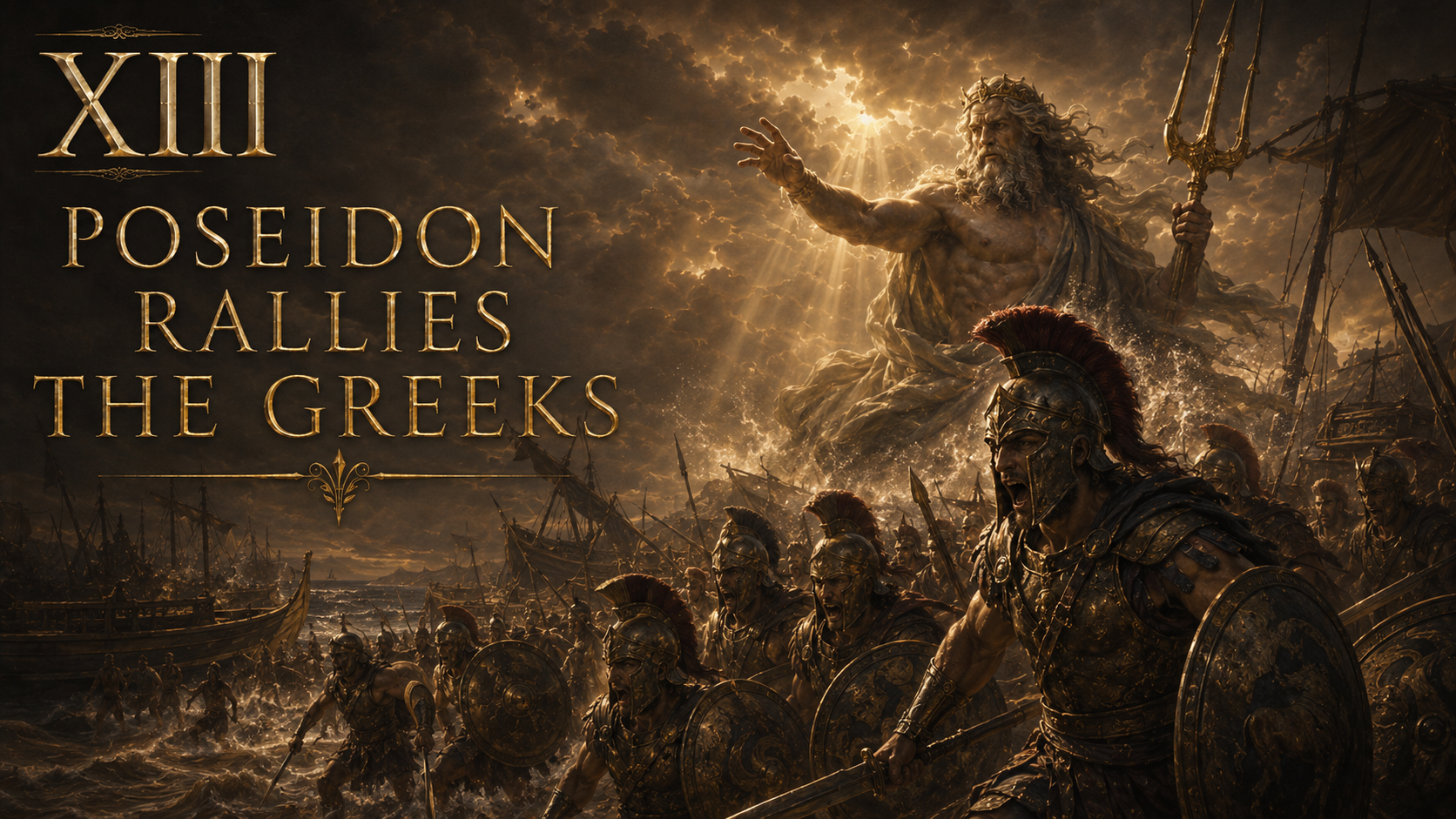
Poseidon walks the shoreline
Poseidon moves unseen
With the sea wind in his mantle
And the salt where fear had been
Poseidon wakes the courage
That the broken wall had drowned
And the Greeks begin to answer
With their feet against the ground
He did not come in splendor
With a crown above the foam
He came like one who knew them
Far from wife and child and home
He moved among the fighters
Where the tired shields were pressed
And touched the failing spirit
In the hollow of the chest
Stand now, sons of hardship
Stand where the waters roar
The ships are not yet burning
The sea is not the door
The wall has fallen from you
But your hands are not undone
A man may lose his shelter
And still face the sun
Poseidon walks the shoreline
Poseidon moves unseen
With the sea wind in his mantle
And the salt where fear had been
Poseidon wakes the courage
That the broken wall had drowned
And the Greeks begin to answer
With their feet against the ground
Sea to shield
Breath to bone
Sea to shield
You are not alone
Stand in the foam
Stand in the cry
Stand for the ships
Do not let them die
The Trojans saw them turning
Where they thought the line would break
They saw the beaten shoulders
Rise like cliffs against the wake
For courage is not silence
And courage is not pride
It is one more breath taken
With destruction at your side
Poseidon walks the shoreline
Poseidon moves unseen
With the sea wind in his mantle
And the salt where fear had been
Poseidon wakes the courage
That the broken wall had drowned
And the Greeks begin to answer
With their feet against the ground
The wall was gone behind them
But the sea began to speak
And strength returned like morning
To the weary and the weak
Translations
Deutsch
Die Mauer lag hinter ihnen nieder, die Schiffe waren zum Greifen nah. Die Griechen atmeten Salzluft, die Fersen im aufgerissenen Sand. Wie ein Unwetter kamen die Trojaner durch das zertrümmerte Tor, und jeder Mast bebte vor dem nahen Schicksal.
Tief unter dem Wasser, wo die Fundamente der Welt schlafen, regte sich lautlos eine Macht. Kein Horn kündigte sie an, kein Donner spaltete den Himmel; nur der Schaum am Ufer begann sich zu heben.
Poseidon geht am Ufer entlang, unsichtbar, mit dem Seewind im Mantel und Salz dort, wo eben noch Furcht war. Er weckt den Mut, den die gefallene Mauer ertränkt hatte, und die Griechen antworten wieder mit festem Boden unter den Füßen.
Er kam nicht in Pracht und nicht mit einer Krone aus Schaum. Er kam wie einer, der sie kannte – fern von Frau, Kind und Heimat. Zwischen den Kämpfern berührte er den versagenden Geist tief in der Brust.
Steht jetzt, Söhne der Mühsal, steht, wo das Wasser brüllt. Die Schiffe brennen noch nicht; das Meer ist noch nicht euer Ausgang. Die Mauer ist gefallen, doch eure Hände sind nicht machtlos. Ein Mann kann seinen Schutz verlieren und dennoch der Sonne entgegentreten.
Meer an Schild, Atem an Knochen. Ihr seid nicht allein. Steht im Schaum und im Geschrei, steht für die Schiffe und lasst sie nicht sterben.
Die Trojaner sahen die Griechen sich wenden, wo die Linie hätte brechen sollen. Geschlagene Schultern erhoben sich wie Klippen gegen die Brandung. Mut ist weder Schweigen noch Stolz; er ist ein weiterer Atemzug, während die Vernichtung neben dir steht.
Poseidon geht am Ufer entlang und weckt den Mut erneut. Hinter ihnen ist die Mauer fort, doch das Meer beginnt zu sprechen, und wie der Morgen kehrt Kraft zu den Müden und Schwachen zurück.
Español
La muralla había caído a sus espaldas y las naves estaban muy cerca. Los griegos respiraban aire salado con los talones hundidos en la arena rota. Los troyanos llegaron como una tormenta por la puerta destrozada, y cada mástil temblaba ante su destino cercano.
Muy debajo del agua, donde duermen los cimientos profundos, una fuerza se movió en silencio. Ninguna trompeta anunció su llegada ni un trueno abrió el cielo; solo la espuma de la orilla empezó a levantarse.
Poseidón camina por la costa, invisible, con el viento del mar en el manto y sal donde antes había miedo. Despierta el valor que la muralla derrumbada había ahogado, y los griegos vuelven a responder afirmando los pies en tierra.
No llegó con esplendor ni con una corona sobre la espuma. Llegó como quien conocía a aquellos hombres lejos de esposa, hijos y hogar. Caminó entre los combatientes y tocó el ánimo que desfallecía en el hueco del pecho.
Alzaos ahora, hijos de la adversidad; permaneced donde rugen las aguas. Las naves aún no arden y el mar no es la puerta. La muralla ha caído, pero vuestras manos no están vencidas. Un hombre puede perder su refugio y todavía mirar al sol.
Mar contra escudo, aliento en los huesos. No estáis solos. Permaneced en la espuma y en el clamor; permaneced por las naves y no dejéis que mueran.
Los troyanos los vieron volverse justo donde esperaban que la línea se quebrara. Los hombros derrotados se alzaron como acantilados contra la ola. El valor no es silencio ni orgullo: es tomar un aliento más con la destrucción al lado.
Poseidón recorre de nuevo la orilla y despierta el valor. La muralla ya no existe, pero el mar empieza a hablar, y la fuerza vuelve como la mañana a los cansados y débiles.
Français
Le mur était tombé derrière eux et les navires se trouvaient tout près. Les Grecs respiraient l’air salé, les talons dans le sable brisé. Les Troyens arrivèrent comme le mauvais temps par la porte fracassée, et chaque mât tremblait devant son destin proche.
Très loin sous l’eau, là où dorment les fondations profondes, une puissance s’éveilla en silence. Aucune trompette n’annonça sa venue, aucun tonnerre ne fendit le ciel ; seule l’écume du rivage commença à se soulever.
Poséidon marche sur la grève, invisible, le vent marin dans son manteau et le sel à la place de la peur. Il ranime le courage que le mur effondré avait noyé, et les Grecs répondent en ancrant leurs pieds dans le sol.
Il ne vint ni dans la splendeur ni couronné d’écume. Il vint comme quelqu’un qui connaissait ces hommes loin de leur femme, de leurs enfants et de leur foyer. Il passa parmi les combattants et toucha l’esprit défaillant au creux de leur poitrine.
Debout maintenant, fils de l’épreuve ; tenez là où les eaux rugissent. Les navires ne brûlent pas encore, la mer n’est pas la porte. Le mur est tombé, mais vos mains ne sont pas défaites. Un homme peut perdre son abri et regarder encore le soleil.
Mer contre bouclier, souffle dans les os. Vous n’êtes pas seuls. Tenez dans l’écume et dans le cri ; tenez pour les navires et ne les laissez pas mourir.
Les Troyens les virent se retourner à l’endroit où la ligne devait rompre. Les épaules vaincues se dressèrent comme des falaises contre la vague. Le courage n’est ni silence ni orgueil : c’est prendre encore un souffle avec la destruction à ses côtés.
Poséidon parcourt encore le rivage et réveille le courage. Le mur a disparu, mais la mer commence à parler, et la force revient comme le matin aux hommes las et faibles.
Reflection
English
The song turns divine intervention into an inward change. Poseidon does not win the battle for the Greeks; he restores their capacity to stand. Courage appears as one more breath and one more human choice at the edge of ruin.
Book XIII answers the Trojan breakthrough with a defense built from many hands. Poseidon’s hidden intervention strengthens the Achaeans, but the line survives through shared courage, exchanged weapons, rescue, and the stubborn refusal to let one collapse become the collapse of all.
Textual basis
Homer, Iliad, Book XIII, lines 1–125: Poseidon leaves the sea, takes the form of Calchas, and rallies the Achaean defense.
Reference edition used
Homer, Ilias. Griechisch–deutsch. Translated into German from the ancient Greek by Hans Rupé, 16th edition, Akademie Verlag, Berlin, 2013.
Deutsch
Das Lied verwandelt göttliches Eingreifen in eine innere Veränderung. Poseidon gewinnt die Schlacht nicht für die Griechen; er gibt ihnen die Fähigkeit zurück, stehen zu bleiben. Mut ist hier ein weiterer Atemzug und eine weitere menschliche Entscheidung am Rand des Untergangs.
Der dreizehnte Gesang beantwortet den trojanischen Durchbruch mit einer Verteidigung vieler Hände. Poseidons verborgenes Eingreifen stärkt die Achaier, doch die Linie hält durch geteilten Mut, weitergereichte Waffen, Rettung und die hartnäckige Weigerung, aus einem Zusammenbruch den Zusammenbruch aller werden zu lassen.
Textgrundlage
Homer, Ilias, 13. Gesang, Verse 1–125: Poseidon das Meer verlässt, die Gestalt des Kalchas annimmt und die achaïsche Verteidigung sammelt.
Verwendete Referenzausgabe
Homer, Ilias. Griechisch–deutsch. Übertragen von Hans Rupé, 16. Auflage, Akademie Verlag, Berlin 2013.
Español
La canción convierte la intervención divina en un cambio interior. Poseidón no gana la batalla por los griegos; les devuelve la capacidad de resistir. El valor es un aliento más y otra decisión humana al borde de la ruina.
El canto XIII responde a la irrupción troyana con una defensa construida por muchas manos. La intervención oculta de Poseidón fortalece a los aqueos, pero la línea resiste gracias al valor compartido, las armas intercambiadas, el rescate y la obstinada negativa a convertir una caída en la caída de todos.
Base textual
Homero, Ilíada, canto XIII, versos 1–125: Poseidón abandona el mar, adopta la figura de Calcante y reanima la defensa aquea.
Edición de referencia utilizada
Homer, Ilias. Griechisch–deutsch. Traducción alemana del griego antiguo de Hans Rupé, 16.ª edición, Akademie Verlag, Berlín, 2013.
Français
La chanson transforme l’intervention divine en changement intérieur. Poséidon ne gagne pas la bataille pour les Grecs ; il leur rend la capacité de tenir. Le courage devient un souffle de plus et un choix humain au bord de la ruine.
Le chant XIII répond à la percée troyenne par une défense portée par de nombreuses mains. L’intervention cachée de Poséidon fortifie les Achéens, mais la ligne tient grâce au courage partagé, aux armes échangées, au secours et au refus obstiné de laisser une chute devenir celle de tous.
Base textuelle
Homère, Iliade, chant XIII, vers 1–125 : Poséidon quitte la mer, prend la forme de Calchas et ranime la défense achéenne.
Édition de référence utilisée
Homer, Ilias. Griechisch–deutsch. Traduction allemande du grec ancien par Hans Rupé, 16e édition, Akademie Verlag, Berlin, 2013.