Lyrics
He should have stayed where lamplight burned
Where cedar smoke held back the night
Where bridal hands had touched his own
And everything still leaned toward life
Fresh from the bed, fresh from the vow
With wedding promise in his chest
He crossed the water into war
And gave the sword what love had left
Iphidamas falls
Too young for the dust, too near to the flame
Iphidamas falls
With a bride in his house and war in his name
One night for the garland
One dawn for the blade
So quickly the world can turn gold into gray
He came with courage, not with boast
A straight-backed son from a guarded hall
He saw the king through bronze and glare
And thought one strike could answer all
His spear drove hard with both hands set
It found the belt, it bit the frame
But metal held and fortune slipped
And battle has no use for shame
Iphidamas falls
Too young for the dust, too near to the flame
Iphidamas falls
With a bride in his house and war in his name
One night for the garland
One dawn for the blade
So quickly the world can turn gold into gray
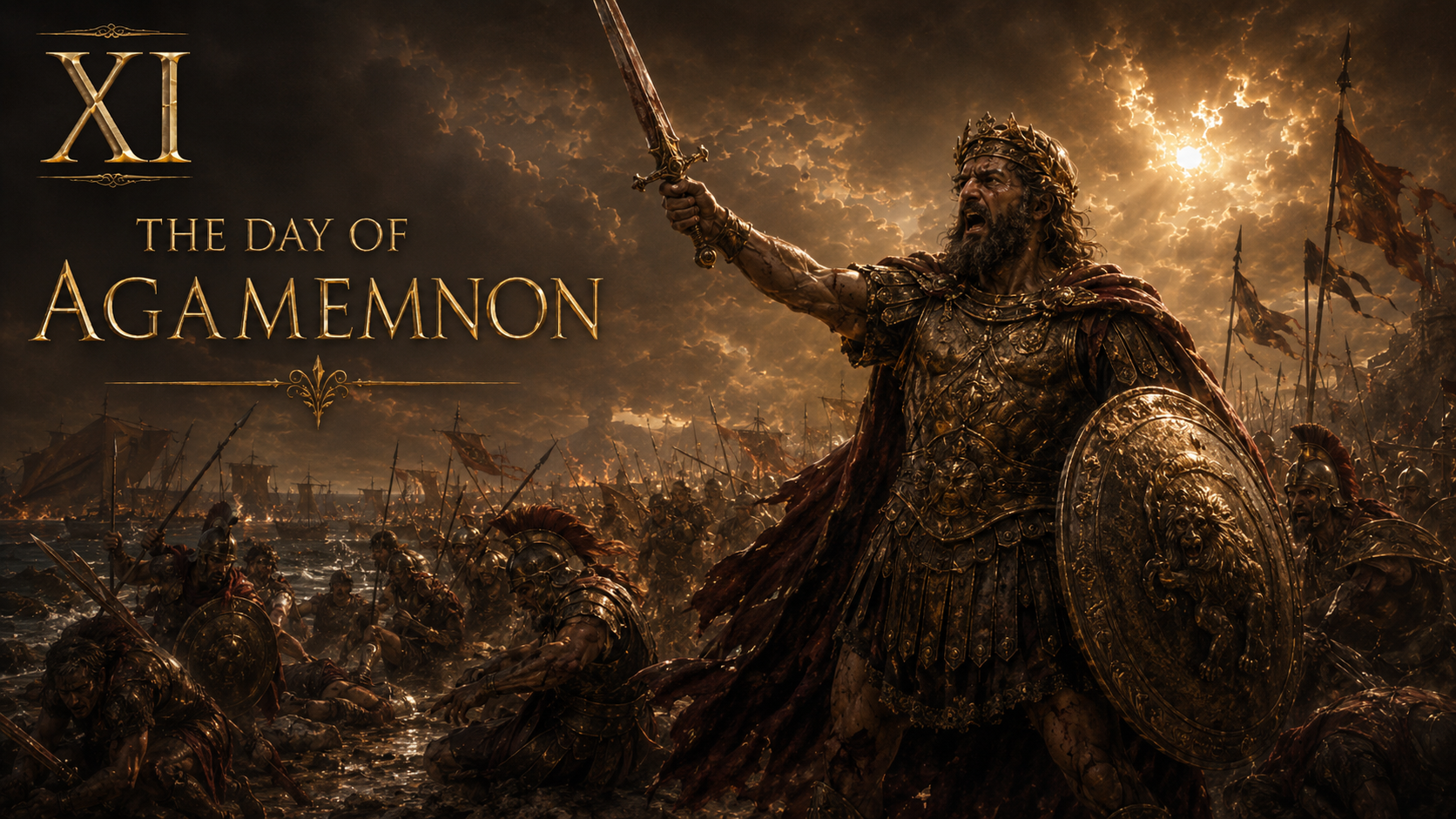
Then Agamemnon closed the space
No courtly pause, no second breath
He tore the spear free from the bind
And sent it back with iron death
The plain received the bridegroom first
Before his house had learned his tread
And all the gifts that should have grown
Lay useless near the newly dead
What did she hear in distant rooms
A cup set down, a door in wind?
Did someone speak his name too soft
As if the truth could still be thinned?
No messenger can carry home
What battle takes before noon’s rise
A husband only just begun
Now shut forever in his eyes
Iphidamas falls
Too young for the dust, too near to the flame
Iphidamas falls
With a bride in his house and war in his name
One night for the garland
One dawn for the blade
So quickly the world can turn gold into gray
A brother saw and grief turned sharp
He bent through shouting, blood, and dread
He caught the body from the trampled field
And called the living by the dead
And somewhere through the crash of shields
A different wound began to wake
For sorrow rarely travels alone
It always leaves another break
Iphidamas falls
Remember the cost, remember the name
Iphidamas falls
Not all of the doomed are seeking fame
Some walk out of love
And are taken by war
And the song reaches home
When the man never will
Translations
Deutsch
Er hätte dort bleiben sollen, wo Lampenlicht brannte und Zedernrauch die Nacht zurückhielt, wo die Hände seiner Braut die seinen berührt hatten. Frisch aus dem Ehebett, das Versprechen noch in der Brust, überquerte er das Wasser zum Krieg und überließ dem Schwert, was die Liebe zurückgelassen hatte.
[Refrain]
Iphidamas fällt – zu jung für den Staub, zu nah an der Flamme, mit einer Braut im Haus und dem Krieg in seinem Namen. Eine Nacht für den Kranz, ein Morgen für die Klinge: So rasch kann die Welt Gold in Grau verwandeln.
Mutig, aber ohne Prahlerei, griff er Agamemnon an. Sein Speer traf Gürtel und Rüstung, doch das Metall hielt. Der König schloss den Abstand und gab ihm den Tod zurück. Die Ebene nahm den Bräutigam auf, bevor sein Haus seinen Schritt gelernt hatte. Was hörte seine Frau in den fernen Räumen? Kein Bote kann heimtragen, was die Schlacht vor Mittag nimmt. Sein Bruder sah es, und die Trauer wurde scharf. Nicht alle Verdammten suchen Ruhm: Manche gehen aus Liebe und werden vom Krieg genommen.
Español
Debió quedarse donde ardía la lámpara y el humo de cedro contenía la noche, donde las manos de su esposa habían tocado las suyas. Recién salido del lecho nupcial, con la promesa en el pecho, cruzó el agua hacia la guerra y entregó a la espada lo que el amor había dejado.
[Estribillo]
Cae Ifidamante, demasiado joven para el polvo y demasiado cerca de la llama, con una esposa en casa y la guerra en su nombre. Una noche para la guirnalda, un amanecer para la hoja: así de rápido el mundo vuelve gris el oro.
Valiente, pero sin jactancia, atacó a Agamenón. Su lanza alcanzó el cinturón y la armadura, pero el metal resistió. El rey cerró la distancia y le devolvió la muerte. La llanura recibió al novio antes de que su casa conociera sus pasos. ¿Qué oyó su esposa en las habitaciones lejanas? Ningún mensajero puede llevar a casa lo que la batalla toma antes del mediodía. Su hermano lo vio y el dolor se volvió afilado. No todos los condenados buscan fama: algunos parten por amor y la guerra se los lleva.
Français
Il aurait dû rester là où brûlait la lampe et où la fumée de cèdre repoussait la nuit, là où les mains de son épouse avaient touché les siennes. À peine sorti du lit nuptial, la promesse encore dans la poitrine, il traversa l’eau vers la guerre et livra à l’épée ce que l’amour avait laissé.
[Refrain]
Iphidamas tombe, trop jeune pour la poussière et trop près de la flamme, avec une épouse à la maison et la guerre dans son nom. Une nuit pour la couronne, une aube pour la lame : si vite le monde change l’or en gris.
Courageux sans vantardise, il frappa Agamemnon. Sa lance atteignit la ceinture et l’armure, mais le métal tint. Le roi referma la distance et lui rendit la mort. La plaine reçut l’époux avant que sa maison n’apprenne son pas. Qu’entendit sa femme dans les pièces lointaines ? Aucun messager ne peut rapporter ce que la bataille prend avant midi. Son frère le vit et le chagrin devint tranchant. Tous les condamnés ne cherchent pas la gloire : certains partent par amour et la guerre les emporte.
Reflection
English
Iphidamas is restored from a battlefield name to a husband whose life had only just begun. By imagining the distant bride, the song makes war’s radius of suffering extend far beyond the place of death.
Book XI exposes the instability of heroic supremacy. Agamemnon’s brilliance dominates the morning, but one wound changes the movement of the whole army; strength passes from warrior to warrior until Patroclus is drawn toward the decision that will shape his fate.
Textual basis
Homer, Iliad, Book XI, lines 218–263: Agamemnon kills Iphidamas, and Coon fights to avenge his brother.
Reference edition used
Homer, Ilias. Griechisch–deutsch. Translated into German from the ancient Greek by Hans Rupé, 16th edition, Akademie Verlag, Berlin, 2013.
Deutsch
Iphidamas wird vom bloßen Namen im Schlachtbericht wieder zu einem Ehemann, dessen Leben gerade erst begonnen hatte. Durch das Bild der fernen Braut reicht der Leidenskreis des Krieges weit über den Ort seines Todes hinaus.
Der elfte Gesang zeigt die Unbeständigkeit heroischer Überlegenheit. Agamemnons Glanz beherrscht den Morgen, doch eine einzige Wunde verändert die Bewegung des ganzen Heeres; die Last wandert von Krieger zu Krieger, bis Patroklos in jene Entscheidung hineingezogen wird, die sein Schicksal bestimmen wird.
Textgrundlage
Homer, Ilias, 11. Gesang, Verse 218–263: Agamemnon Iphidamas tötet und Koon für seinen Bruder Rache sucht.
Verwendete Referenzausgabe
Homer, Ilias. Griechisch–deutsch. Übertragen von Hans Rupé, 16. Auflage, Akademie Verlag, Berlin 2013.
Español
Ifidamante deja de ser un nombre del campo de batalla y vuelve a ser un esposo cuya vida acababa de comenzar. Al imaginar a la novia lejana, la canción extiende el sufrimiento de la guerra mucho más allá del lugar de la muerte.
El canto XI muestra la inestabilidad de la supremacía heroica. El esplendor de Agamenón domina la mañana, pero una sola herida cambia el movimiento de todo el ejército; la carga pasa de guerrero en guerrero hasta que Patroclo es atraído hacia la decisión que marcará su destino.
Base textual
Homero, Ilíada, canto XI, versos 218–263: Agamenón mata a Ifidamante y Coón combate para vengar a su hermano.
Edición de referencia utilizada
Homer, Ilias. Griechisch–deutsch. Traducción alemana del griego antiguo de Hans Rupé, 16.ª edición, Akademie Verlag, Berlín, 2013.
Français
Iphidamas cesse d’être un simple nom du champ de bataille et redevient un époux dont la vie commençait à peine. En imaginant la jeune femme lointaine, la chanson étend la souffrance de la guerre bien au-delà du lieu de la mort.
Le chant XI révèle l’instabilité de la suprématie héroïque. L’éclat d’Agamemnon domine le matin, mais une seule blessure change le mouvement de toute l’armée ; le poids passe d’un guerrier à l’autre jusqu’à ce que Patrocle soit entraîné vers la décision qui fixera son destin.
Base textuelle
Homère, Iliade, chant XI, vers 218–263 : Agamemnon tue Iphidamas et Coon combat pour venger son frère.
Édition de référence utilisée
Homer, Ilias. Griechisch–deutsch. Traduction allemande du grec ancien par Hans Rupé, 16e édition, Akademie Verlag, Berlin, 2013.