Lyrics
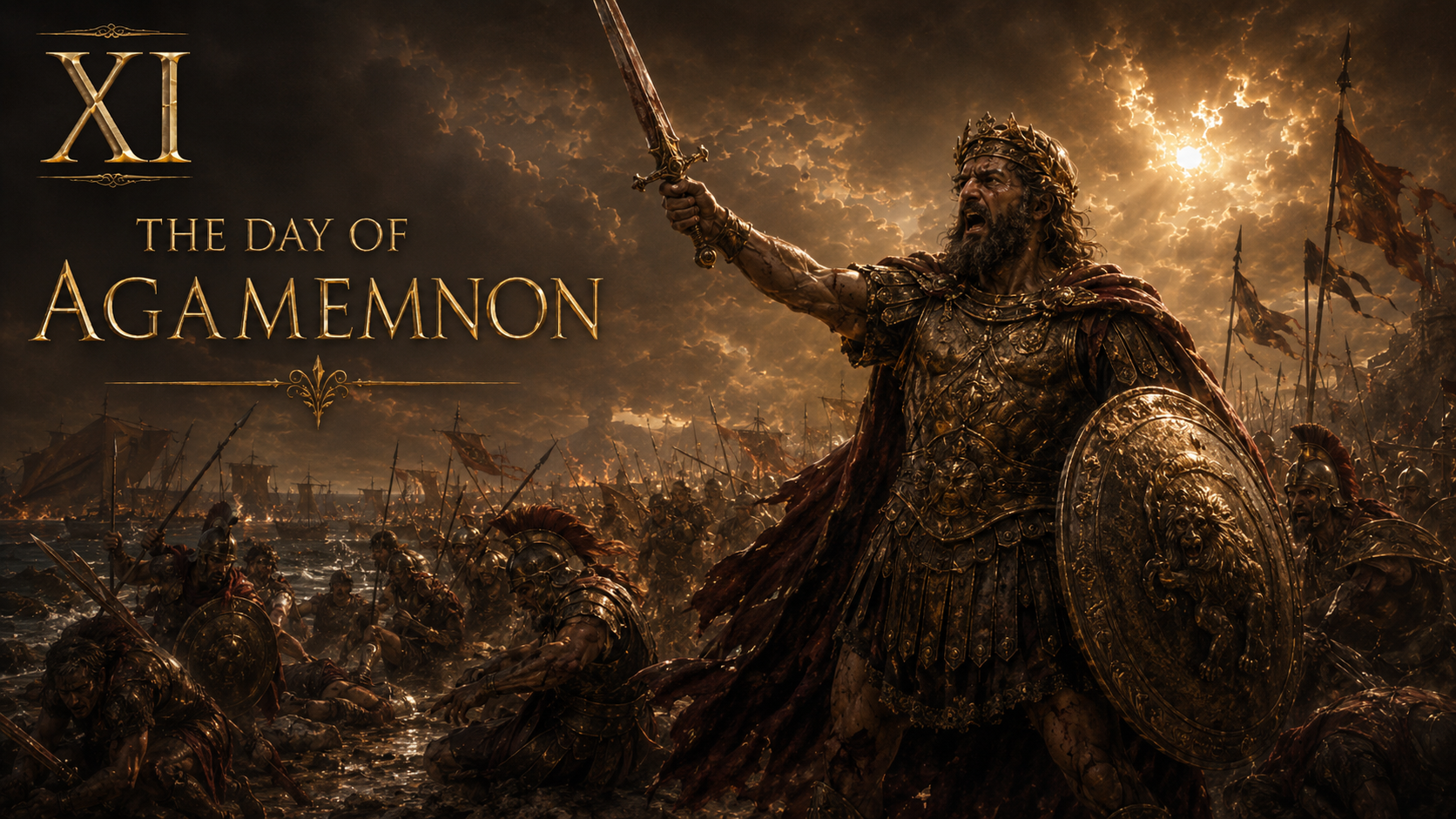
He stood where morning took the flame
And armor answered piece by piece
Not like a man who dressed for life
But one who fastened on the feast
Bronze on chest and bronze on thigh
Bronze that held the newborn sun
Each buckle closed around a vow
That once begun cannot be undone
The king in bronze, the king in bronze
He rose before the battle’s song
Gold at the edge and fire below
A man made tall by what he wore
The king in bronze, the king in bronze
He walked as if the day belonged
But iron splendor never knows
How near it stands to coming loss
Around him moved the shield-borne men
Tight with leather, dust, and will
But he was set apart by gleam
A summit standing cold and still
Worked with figures, beasts, and signs
His armor spoke before his mouth
As though the forge had cast a fate
And riveted it to his house
He did not need to shout his name
The metal said enough for all
It flashed of power, rank, command
Of those too high and doomed to fall
Yet in that hour none dared to ask
What price such brightness always brings
For men will follow what is bright
And call it destiny when it stings
The king in bronze, the king in bronze
He rose before the battle’s song
Gold at the edge and fire below
A man made tall by what he wore
The king in bronze, the king in bronze
He walked as if the day belonged
But iron splendor never knows
How near it stands to coming loss
His horses stamped, the traces rang
The spearshaft settled in his hand
And all the watching shoreline wind
Seemed briefly under his command
A cloak may move, a plume may shine
A breastplate catch the ruthless sky
But none of these can shield a heart
From what the day has kept nearby
Still he stepped into the glare
As kings and fools so often do
Wrapped in labor, pride, and art
In things men build to carry through
And every polished plate declared
That fear itself had been denied
Though somewhere underneath the bronze
A mortal pulse still had to hide
The king in bronze, the king in bronze
Now let the waiting plain respond
Let hoof and wheel and spearpoint speak
Let daylight test what splendor means
The king in bronze, the king in bronze
No metal keeps a kingdom whole
It only gives the eye a flame
While time keeps reaching for the soul
Translations
Deutsch
Er stand dort, wo der Morgen Feuer fing, und die Rüstung antwortete Stück für Stück. Bronze lag auf Brust und Schenkeln und hielt die neugeborene Sonne fest. Jede Schnalle schloss sich um ein Gelübde, das nach seinem Beginn nicht mehr rückgängig zu machen war.
[Refrain]
Der König in Bronze erhob sich vor dem Lied der Schlacht: Gold am Rand, Feuer darunter, ein Mann, erhöht durch das, was er trug. Doch eiserner Glanz weiß nie, wie nah der kommende Verlust bereits steht.
Um ihn bewegten sich die Schildträger, doch sein Leuchten sonderte ihn ab. Tiere, Zeichen und Kunstwerke auf der Rüstung sprachen noch vor seinem Mund von Macht, Rang und Befehl. Männer folgen dem Hellen und nennen es Schicksal, wenn es sie verwundet. Pferde stampften, Riemen klirrten, der Speer lag in seiner Hand. Mantel, Federbusch und Brustpanzer können glänzen, aber kein Metall schützt das Herz vor dem, was der Tag bereithält. Unter der Bronze musste noch immer ein sterblicher Puls verborgen bleiben.
Español
Permaneció donde la mañana prendía fuego y la armadura respondió pieza por pieza. Bronce sobre el pecho y los muslos, bronce que guardaba el sol recién nacido. Cada hebilla se cerraba sobre un juramento que, una vez comenzado, ya no podía deshacerse.
[Estribillo]
El rey de bronce se alzó antes del canto de la batalla: oro en los bordes, fuego debajo, un hombre engrandecido por lo que llevaba. Pero el esplendor de hierro nunca sabe cuán cerca está la pérdida.
A su alrededor se movían los hombres de los escudos, pero su brillo lo separaba. Figuras, bestias y signos hablaban antes que su boca de poder, rango y mando. Los hombres siguen lo que resplandece y lo llaman destino cuando hiere. Los caballos patearon, sonaron los arreos y la lanza descansó en su mano. Manto, penacho y coraza pueden brillar, pero ningún metal protege el corazón de lo que el día guarda. Bajo el bronce seguía oculto un pulso mortal.
Français
Il se tenait là où le matin prenait feu, et l’armure répondit pièce après pièce. Du bronze sur la poitrine et les cuisses, du bronze retenant le soleil nouveau-né. Chaque boucle se refermait sur un serment qu’on ne pouvait plus défaire.
[Refrain]
Le roi de bronze se leva avant le chant de la bataille : de l’or aux bords, du feu dessous, un homme grandi par ce qu’il portait. Mais la splendeur du fer ignore toujours combien la perte est proche.
Autour de lui avançaient les porteurs de boucliers, mais son éclat l’isolait. Figures, bêtes et signes parlaient avant sa bouche de puissance, de rang et de commandement. Les hommes suivent ce qui brille et l’appellent destin lorsque cela les blesse. Les chevaux frappèrent le sol, les harnais sonnèrent et la lance se posa dans sa main. Manteau, panache et cuirasse peuvent luire, mais aucun métal ne protège le cœur de ce que le jour réserve. Sous le bronze battait toujours un pouls mortel.
Reflection
English
Agamemnon’s armor is both protection and theatre. It turns authority into a visible spectacle, while the song keeps reminding us that magnificence cannot abolish vulnerability.
Book XI exposes the instability of heroic supremacy. Agamemnon’s brilliance dominates the morning, but one wound changes the movement of the whole army; strength passes from warrior to warrior until Patroclus is drawn toward the decision that will shape his fate.
Textual basis
Homer, Iliad, Book XI, lines 15–46: Homer describes Agamemnon’s ornate armor and the terror of his appearance.
Reference edition used
Homer, Ilias. Griechisch–deutsch. Translated into German from the ancient Greek by Hans Rupé, 16th edition, Akademie Verlag, Berlin, 2013.
Deutsch
Agamemnons Rüstung ist Schutz und Inszenierung zugleich. Sie macht Herrschaft zu einem sichtbaren Schauspiel, während das Lied daran erinnert, dass Pracht die Verletzlichkeit nicht aufheben kann.
Der elfte Gesang zeigt die Unbeständigkeit heroischer Überlegenheit. Agamemnons Glanz beherrscht den Morgen, doch eine einzige Wunde verändert die Bewegung des ganzen Heeres; die Last wandert von Krieger zu Krieger, bis Patroklos in jene Entscheidung hineingezogen wird, die sein Schicksal bestimmen wird.
Textgrundlage
Homer, Ilias, 11. Gesang, Verse 15–46: Homer Agamemnons kunstvolle Rüstung und den Schrecken seiner Erscheinung beschreibt.
Verwendete Referenzausgabe
Homer, Ilias. Griechisch–deutsch. Übertragen von Hans Rupé, 16. Auflage, Akademie Verlag, Berlin 2013.
Español
La armadura de Agamenón es protección y teatro al mismo tiempo. Convierte la autoridad en espectáculo visible, mientras la canción recuerda que la magnificencia no elimina la vulnerabilidad.
El canto XI muestra la inestabilidad de la supremacía heroica. El esplendor de Agamenón domina la mañana, pero una sola herida cambia el movimiento de todo el ejército; la carga pasa de guerrero en guerrero hasta que Patroclo es atraído hacia la decisión que marcará su destino.
Base textual
Homero, Ilíada, canto XI, versos 15–46: Homero describe la armadura ornamentada de Agamenón y el terror de su presencia.
Edición de referencia utilizada
Homer, Ilias. Griechisch–deutsch. Traducción alemana del griego antiguo de Hans Rupé, 16.ª edición, Akademie Verlag, Berlín, 2013.
Français
L’armure d’Agamemnon est à la fois protection et mise en scène. Elle transforme l’autorité en spectacle visible, tandis que la chanson rappelle que la magnificence n’abolit pas la vulnérabilité.
Le chant XI révèle l’instabilité de la suprématie héroïque. L’éclat d’Agamemnon domine le matin, mais une seule blessure change le mouvement de toute l’armée ; le poids passe d’un guerrier à l’autre jusqu’à ce que Patrocle soit entraîné vers la décision qui fixera son destin.
Base textuelle
Homère, Iliade, chant XI, vers 15–46 : Homère décrit l’armure ouvragée d’Agamemnon et la terreur de son apparence.
Édition de référence utilisée
Homer, Ilias. Griechisch–deutsch. Traduction allemande du grec ancien par Hans Rupé, 16e édition, Akademie Verlag, Berlin, 2013.