Lyrics
The night lay cold
on rope and sail
the fires bent low
the moon was pale
A king walked out
without a crown
where sleeping men
were scattered down
No shield was struck
no spear was bright
only footsteps
through the night
Between the tents
between the names
he carried fear
like hidden flames
Footsteps between the tents
soft on the sand
one man’s doubt
in a commander’s hand
Footsteps between the tents
where no one sings
the dark hears more
than the words of kings
His brother rose
before the call
already dressed
beneath it all
No dream had held
his restless head
he too had heard
what silence said
They did not speak
like men of gold
their breath was thin
their hands were cold
For blood may roar
when daylight burns
but night is where
the truth returns
Footsteps between the tents
soft on the sand
one man’s doubt
in a commander’s hand
Footsteps between the tents
where no one sings
the dark hears more
than the words of kings
Past sleeping boys
with open hands
past broken wheels
and empty stands
Past horses shifting
in their sleep
past wounded men
too tired to weep
The sea behind
the foe ahead
the living trapped
among the dead
And every rope
and every mast
held whispers
from the day that passed
Footsteps between the tents
soft on the sand
one man’s doubt
in a commander’s hand
Footsteps between the tents
where no one sings
the dark hears more
than the words of kings
They went to wake
the ancient voice
the man who still
could shape a choice
Old Nestor’s fire
would not be gone
before the edge
of bitter dawn
For when the young
are lost in sleep
the old remember
what to keep
And fear itself
must bend its knee
to counsel born
from memory
Footsteps between the tents
soft on the sand
one man’s doubt
in a commander’s hand
Footsteps between the tents
where no one sings
the dark hears more
than the words of kings
No god had spoken
from the sky
no eagle crossed
the moon on high
Only two men
beneath the stars
walking through
the breath of wars
And in that hour
before the blade
before the spy
before the raid
The camp lay still
the sea was wide
and fear walked with them
side by side
Footsteps between the tents
soft on the sand
one man’s doubt
in a commander’s hand
Footsteps between the tents
where no one sings
the dark hears more
than the words of kings
Translations
Deutsch
[Strophe 1]
Die Nacht lag kalt
auf Seil und Segel,
die Feuer beugten sich niedrig,
der Mond war bleich.
Ein König ging hinaus
ohne Krone,
wo schlafende Männer
verstreut lagen.
Kein Schild wurde geschlagen,
kein Speer glänzte,
nur Schritte
durch die Nacht.
Zwischen den Zelten,
zwischen den Namen,
trug er die Furcht
wie verborgene Flammen.
[Refrain]
Schritte zwischen den Zelten,
leise auf dem Sand,
der Zweifel eines Mannes
in der Hand eines Heerführers.
Schritte zwischen den Zelten,
wo niemand singt;
das Dunkel hört mehr
als die Worte der Könige.
[Strophe 2]
Sein Bruder erhob sich
noch vor dem Ruf,
bereits gerüstet
unter allem anderen.
Kein Traum hatte
seinen ruhelosen Kopf gehalten;
auch er hatte gehört,
was das Schweigen sagte.
Sie sprachen nicht
wie Männer aus Gold,
ihr Atem war dünn,
ihre Hände kalt.
Denn Blut mag brüllen,
wenn der Tag brennt,
doch in der Nacht
kehrt die Wahrheit zurück.
[Refrain wiederholt]
[Strophe 3]
Vorbei an schlafenden Jungen
mit offenen Händen,
vorbei an zerbrochenen Rädern
und leeren Gestellen.
Vorbei an Pferden,
die sich im Schlaf bewegten,
vorbei an Verwundeten,
zu müde zum Weinen.
Das Meer hinter ihnen,
der Feind voraus,
die Lebenden gefangen
unter den Toten.
Und jedes Seil,
jeder Mast
hielt Flüstern
vom vergangenen Tag.
[Refrain wiederholt]
[Strophe 4]
Sie gingen, um
die alte Stimme zu wecken,
den Mann, der noch immer
eine Wahl formen konnte.
Nestors altes Feuer
würde nicht verlöschen
vor der Schneide
der bitteren Morgenröte.
Denn wenn die Jungen
im Schlaf verloren sind,
erinnern sich die Alten,
was zu bewahren ist.
Und selbst die Furcht
muss ihr Knie beugen
vor Rat,
der aus Erinnerung geboren ist.
[Refrain wiederholt]
[Strophe 5]
Kein Gott hatte
vom Himmel gesprochen,
kein Adler kreuzte
hoch oben den Mond.
Nur zwei Männer
unter den Sternen,
die durch den Atem
des Krieges gingen.
Und in dieser Stunde
vor der Klinge,
vor dem Späher,
vor dem Überfall,
lag das Lager still,
das Meer war weit,
und die Furcht ging mit ihnen
Seite an Seite.
[Refrain wiederholt]
Español
[Estrofa 1]
La noche yacía fría
sobre cuerda y vela,
los fuegos se inclinaban bajos,
la luna estaba pálida.
Un rey salió
sin corona,
por donde los hombres dormían
esparcidos.
Ningún escudo golpeó,
ninguna lanza brilló,
solo pasos
a través de la noche.
Entre las tiendas,
entre los nombres,
llevaba el miedo
como llamas ocultas.
[Estribillo]
Pasos entre las tiendas,
suaves sobre la arena,
la duda de un hombre
en la mano de un comandante.
Pasos entre las tiendas,
donde nadie canta;
la oscuridad oye más
que las palabras de los reyes.
[Estrofa 2]
Su hermano se levantó
antes de la llamada,
ya vestido
bajo todo lo demás.
Ningún sueño había sostenido
su cabeza inquieta;
él también había oído
lo que decía el silencio.
No hablaron
como hombres de oro;
su aliento era tenue,
sus manos frías.
Porque la sangre puede rugir
cuando arde el día,
pero la noche es donde
regresa la verdad.
[Estribillo repetido]
[Estrofa 3]
Pasaron junto a muchachos dormidos
con las manos abiertas,
junto a ruedas rotas
y puestos vacíos.
Junto a caballos que se movían
en sueños,
junto a heridos
demasiado cansados para llorar.
El mar detrás,
el enemigo delante,
los vivos atrapados
entre los muertos.
Y cada cuerda,
cada mástil,
guardaba susurros
del día pasado.
[Estribillo repetido]
[Estrofa 4]
Fueron a despertar
la voz antigua,
al hombre que aún podía
dar forma a una elección.
El viejo fuego de Néstor
no se apagaría
antes del filo
del alba amarga.
Porque cuando los jóvenes
se pierden en el sueño,
los viejos recuerdan
qué debe conservarse.
Y el miedo mismo
debe doblar la rodilla
ante el consejo
nacido de la memoria.
[Estribillo repetido]
[Estrofa 5]
Ningún dios había hablado
desde el cielo,
ningún águila cruzó
la luna en lo alto.
Solo dos hombres
bajo las estrellas,
caminando por
el aliento de las guerras.
Y en aquella hora,
antes de la espada,
antes del espía,
antes de la incursión,
el campamento quedó quieto,
el mar era ancho,
y el miedo caminó con ellos
lado a lado.
[Estribillo repetido]
Français
[Couplet 1]
La nuit reposait froide
sur la corde et la voile,
les feux se courbaient bas,
la lune était pâle.
Un roi sortit
sans couronne,
parmi les hommes endormis
dispersés au sol.
Aucun bouclier ne frappa,
aucune lance ne brilla,
seulement des pas
dans la nuit.
Entre les tentes,
entre les noms,
il portait la peur
comme des flammes cachées.
[Refrain]
Des pas entre les tentes,
doucement sur le sable,
le doute d’un homme
dans la main d’un chef.
Des pas entre les tentes,
là où nul ne chante ;
l’obscurité entend plus
que les paroles des rois.
[Couplet 2]
Son frère se leva
avant l’appel,
déjà vêtu
sous tout le reste.
Aucun rêve n’avait retenu
sa tête inquiète ;
lui aussi avait entendu
ce que disait le silence.
Ils ne parlèrent pas
comme des hommes d’or ;
leur souffle était mince,
leurs mains froides.
Car le sang peut rugir
quand le jour brûle,
mais c’est la nuit
que revient la vérité.
[Refrain repris]
[Couplet 3]
Ils passèrent les jeunes endormis
aux mains ouvertes,
les roues brisées
et les postes vides.
Les chevaux remuant
dans leur sommeil,
les blessés
trop las pour pleurer.
La mer derrière,
l’ennemi devant,
les vivants prisonniers
parmi les morts.
Et chaque corde,
chaque mât,
gardait les murmures
du jour passé.
[Refrain repris]
[Couplet 4]
Ils allèrent réveiller
la voix ancienne,
l’homme qui pouvait encore
donner forme à un choix.
Le vieux feu de Nestor
ne s’éteindrait pas
avant le tranchant
de l’aube amère.
Car lorsque les jeunes
sont perdus dans le sommeil,
les anciens se souviennent
de ce qu’il faut garder.
Et la peur elle-même
doit plier le genou
devant le conseil
né de la mémoire.
[Refrain repris]
[Couplet 5]
Aucun dieu n’avait parlé
du haut du ciel,
aucun aigle ne traversa
la lune en hauteur.
Seulement deux hommes
sous les étoiles,
marchant dans
le souffle des guerres.
Et à cette heure,
avant la lame,
avant l’espion,
avant le raid,
le camp resta immobile,
la mer était vaste,
et la peur marcha avec eux,
côte à côte.
[Refrain repris]
Reflection
English
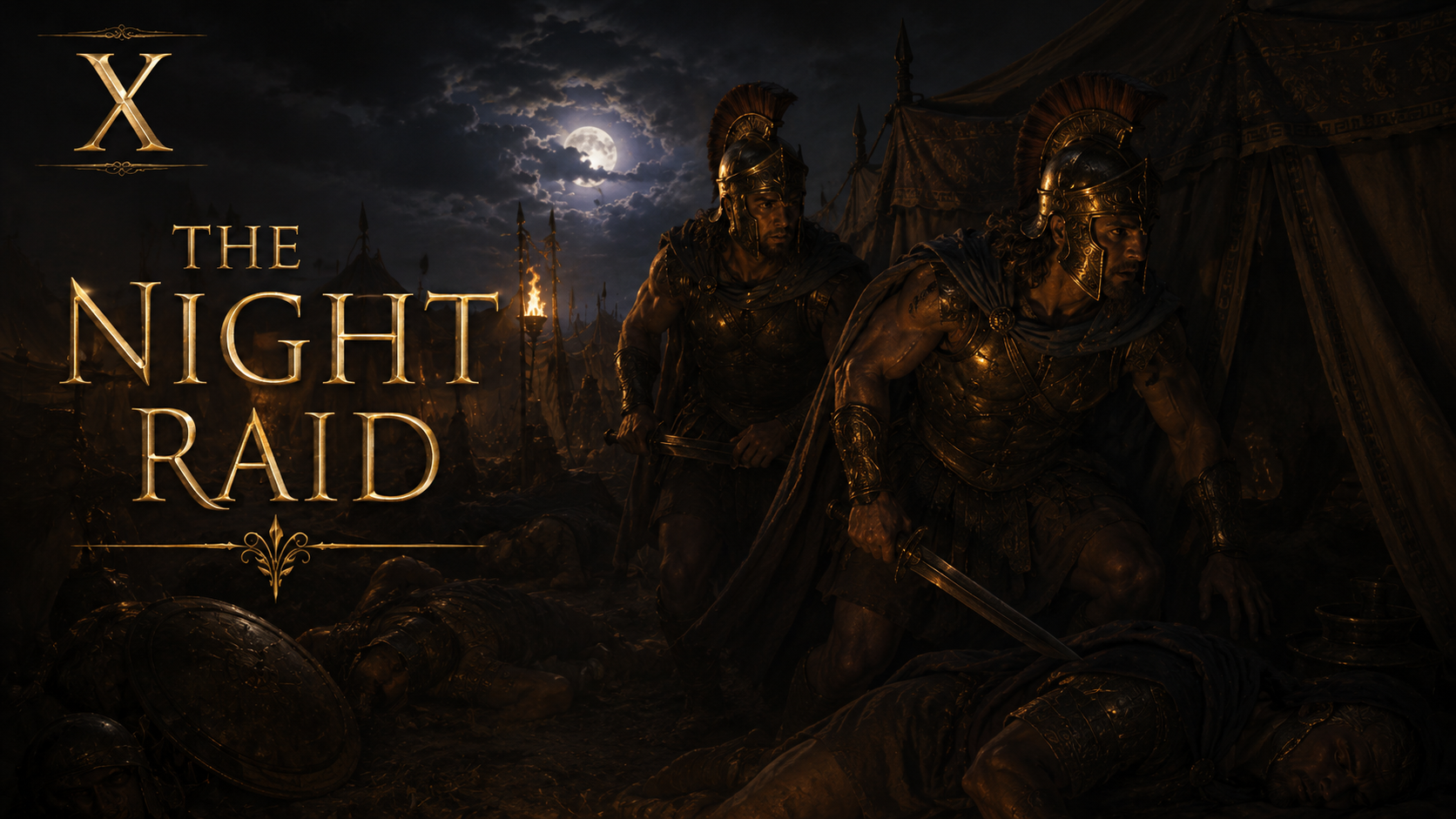
The brothers’ walk shows authority without ceremony. Their footsteps pass the human evidence of war, turning strategy into an ethical obligation toward sleepers, wounded men and the dead.
Book X moves through darkness, where courage depends on listening, disguise, memory, and judgment rather than open display. The night raid produces a tactical success, but its secrecy and ruthlessness leave moral unease beside the captured horses.
Textual basis
Homer, Iliad, Book X, lines 25–100: Agamemnon and Menelaus move among the tents to summon the leaders.
Reference edition used
Homer, Ilias. Griechisch–deutsch. Translated into German from the ancient Greek by Hans Rupé, 16th edition, Akademie Verlag, Berlin, 2013.
Deutsch
Der Weg der Brüder zeigt Autorität ohne Zeremoniell. Ihre Schritte führen an den menschlichen Zeugnissen des Krieges vorbei und machen Strategie zur ethischen Pflicht gegenüber Schlafenden, Verwundeten und Toten.
Der zehnte Gesang bewegt sich durch die Dunkelheit, in der Mut nicht von offener Schaustellung, sondern von Lauschen, Verstellung, Erinnerung und Urteilskraft abhängt. Der nächtliche Streifzug bringt einen taktischen Erfolg, doch seine Heimlichkeit und Härte lassen neben den erbeuteten Pferden moralisches Unbehagen zurück.
Textgrundlage
Homer, Ilias, 10. Gesang, Verse 25–100: Agamemnon und Menelaos durch die Zelte gehen, um die Anführer zu versammeln.
Verwendete Referenzausgabe
Homer, Ilias. Griechisch–deutsch. Übertragen von Hans Rupé, 16. Auflage, Akademie Verlag, Berlin 2013.
Español
El recorrido de los hermanos muestra autoridad sin ceremonia. Sus pasos atraviesan las pruebas humanas de la guerra y convierten la estrategia en una obligación ética hacia los dormidos, los heridos y los muertos.
El canto X avanza por la oscuridad, donde el valor depende de escuchar, ocultarse, recordar y juzgar más que de exhibirse abiertamente. La incursión nocturna logra un éxito táctico, pero su secreto y su crueldad dejan una inquietud moral junto a los caballos capturados.
Base textual
Homero, Ilíada, canto X, versos 25–100: Agamenón y Menelao recorren las tiendas para convocar a los jefes.
Edición de referencia utilizada
Homer, Ilias. Griechisch–deutsch. Traducción alemana del griego antiguo de Hans Rupé, 16.ª edición, Akademie Verlag, Berlín, 2013.
Français
La marche des frères montre une autorité sans cérémonie. Leurs pas longent les preuves humaines de la guerre et font de la stratégie une obligation envers les dormeurs, les blessés et les morts.
Le chant X traverse l’obscurité, où le courage dépend de l’écoute, du déguisement, de la mémoire et du jugement plutôt que de l’éclat public. Le raid nocturne apporte un succès tactique, mais son secret et sa dureté laissent un malaise moral auprès des chevaux capturés.
Base textuelle
Homère, Iliade, chant X, vers 25–100 : Agamemnon et Ménélas parcourent les tentes afin de convoquer les chefs.
Édition de référence utilisée
Homer, Ilias. Griechisch–deutsch. Traduction allemande du grec ancien par Hans Rupé, 16e édition, Akademie Verlag, Berlin, 2013.