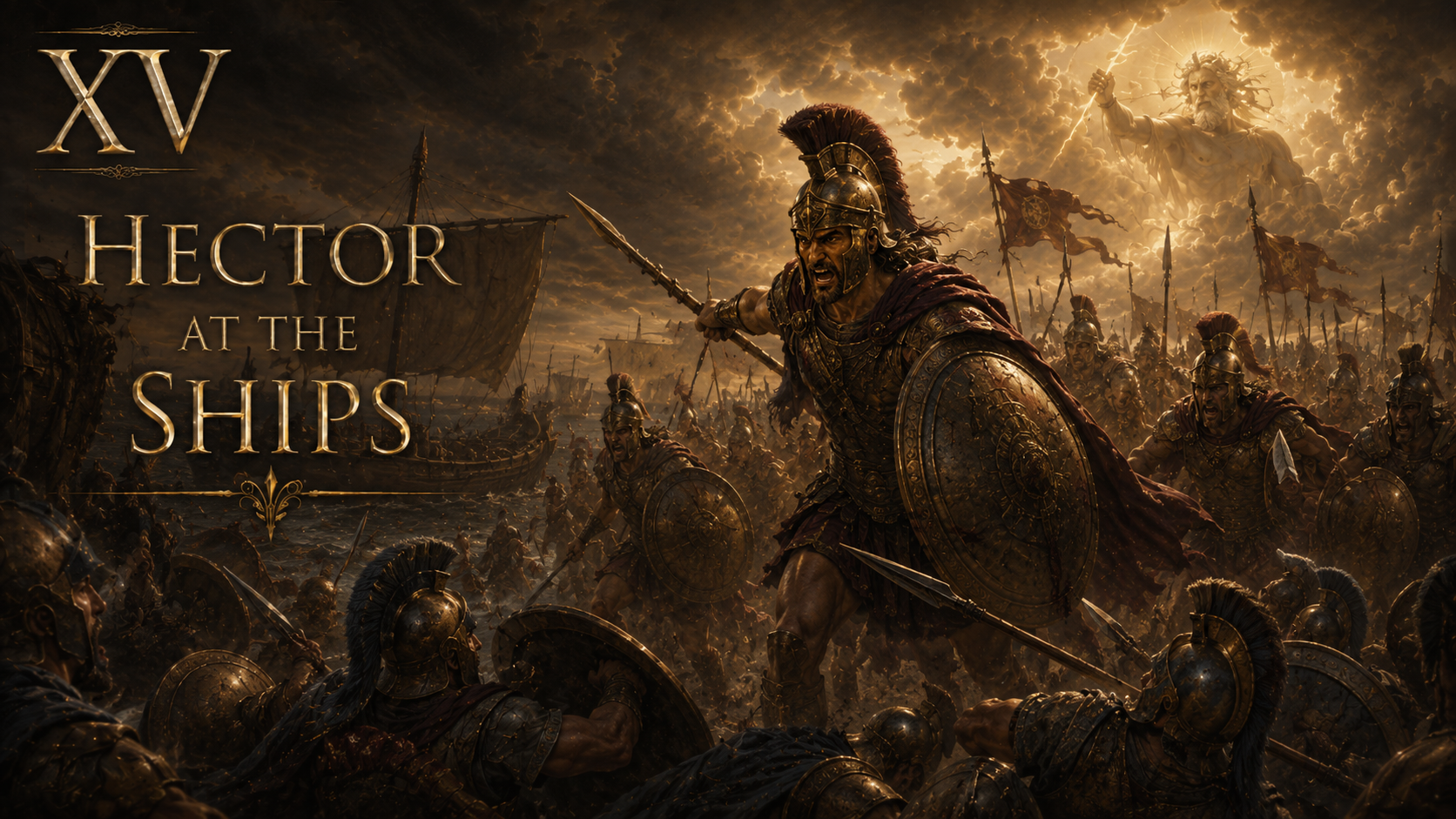
Lyrics
Dust in the mouth,
iron in the hand,
horses screaming sideways
at the broken edge of land.
The Greeks fell back in thunder,
shield against shield they ran.
The wall that once had held them
looked smaller than a man.
The ditch yawned wide before them,
dark teeth under clay.
And every wheel that struck it
had to choose its way.
Behind them came the Trojans,
before them waited fear.
The ground itself was asking
who would disappear.
Panic at the ditch,
panic at the wall.
No room left for glory,
no clean place to fall.
Panic at the ditch,
dust choking the sun.
When Hector drives the battle,
there is nowhere left to run.
Apollo shook the terror
like a banner in the air.
The Greeks looked up and felt it
move cold through every prayer.
The horses reared and twisted,
the chariots cracked and swung.
Men called out for brothers
with blood upon the tongue.
The bronze rang without rhythm,
the spears flew without names.
And all the songs of honor
were swallowed up by flames.
Panic at the ditch,
panic at the wall.
No room left for glory,
no clean place to fall.
Panic at the ditch,
dust choking the sun.
When Hector drives the battle,
there is nowhere left to run.
This was not the feast of heroes,
not the shining tale they told.
This was breath and mud and terror,
this was hands losing hold.
This was a king without answer,
this was a captain gone blind.
This was a god in the dust cloud
breaking the courage of mind.
The trench they dug for safety
became a mouth of dread.
The wall they raised for shelter
leaned heavy on the dead.
Then Hector came like wildfire
with Apollo at his side.
The Trojans poured behind him
like a flood no ditch could hide.
The Greeks were pressed to timber,
to ropes and masts and cries.
The sea wind turned against them
and blew fear into their eyes.
The ships were not a harbor now,
not home, not hope, not rest.
They were the last thin border
between death and the west.
Panic at the ditch,
panic at the wall.
No room left for glory,
no clean place to fall.
Panic at the ditch,
dust choking the sun.
When Hector drives the battle,
there is nowhere left to run.
Dust in the mouth,
iron in the hand,
horses screaming sideways
at the broken edge of land.
Translations
Deutsch
Staub im Mund, Eisen in der Hand, seitwärts schreiende Pferde am gebrochenen Rand des Landes. Die Griechen weichen donnernd zurück und stoßen Schild an Schild. Die Mauer, die sie einst geschützt hatte, wirkt plötzlich kleiner als ein Mensch.
Vor ihnen gähnt der Graben mit dunklen Zähnen unter dem Lehm; jedes Rad, das ihn trifft, muss seinen Weg erzwingen. Hinter ihnen kommen die Trojaner, vor ihnen wartet die Furcht. Am Graben und an der Mauer bleibt kein Raum für Ruhm und kein sauberer Ort zum Fallen.
Apollon schwenkt den Schrecken wie ein Banner. Die Griechen spüren, wie er kalt durch jedes Gebet zieht. Pferde bäumen sich, Wagen brechen aus, Männer rufen mit Blut auf der Zunge nach ihren Brüdern. Bronze klingt ohne Rhythmus, Speere fliegen ohne Namen.
Dies ist kein Fest der Helden und keine glänzende Erzählung, sondern Atem, Schlamm, Terror und Hände, die den Halt verlieren. Ein Gott in der Staubwolke zerbricht den Mut im Geist. Der zum Schutz ausgehobene Graben wird zum Rachen der Angst, die Mauer zur Last über den Toten.
Dann kommt Hektor wie ein Flächenbrand, Apollon an seiner Seite, und die Trojaner strömen wie eine Flut hinterher. Die Griechen werden bis an Holz, Seile und Masten gedrängt. Die Schiffe sind kein Hafen mehr, sondern die letzte dünne Grenze zwischen Tod und Westen.
Español
Polvo en la boca, hierro en la mano, caballos que gritan de costado en el borde roto de la tierra. Los griegos retroceden con estruendo, chocando escudo contra escudo. La muralla que antes los protegía parece de pronto más pequeña que un hombre.
Ante ellos se abre el foso, con dientes oscuros bajo el barro; cada rueda que lo golpea debe buscar su salida. Detrás llegan los troyanos y delante espera el miedo. En el foso y en la muralla ya no queda espacio para la gloria ni un lugar limpio donde caer.
Apolo agita el terror como un estandarte. Los griegos sienten que atraviesa frío cada plegaria. Los caballos se encabritan, los carros se quiebran y los hombres llaman a sus hermanos con sangre en la lengua. El bronce suena sin ritmo y las lanzas vuelan sin nombre.
Esto no es un banquete de héroes ni la historia brillante que contaban, sino aliento, barro, terror y manos que pierden el agarre. Un dios dentro de la nube de polvo rompe el valor de la mente. El foso excavado para proteger se convierte en boca de espanto y la muralla pesa sobre los muertos.
Entonces llega Héctor como un incendio, con Apolo a su lado, y los troyanos se derraman detrás como una inundación. Los griegos son empujados hasta la madera, las cuerdas y los mástiles. Las naves ya no son puerto, sino la última frontera delgada entre la muerte y el oeste.
Français
De la poussière dans la bouche, du fer dans la main, des chevaux hurlant de côté au bord brisé du terrain. Les Grecs reculent dans le fracas, bouclier contre bouclier. Le rempart qui les protégeait paraît soudain plus petit qu’un homme.
Devant eux, le fossé bâille, montrant des dents sombres sous l’argile ; chaque roue qui le frappe doit trouver sa voie. Derrière arrivent les Troyens, devant attend la peur. Au fossé et au mur, il ne reste aucune place pour la gloire ni aucun endroit propre où tomber.
Apollon agite la terreur comme une bannière. Les Grecs la sentent passer, froide, à travers chaque prière. Les chevaux se cabrent, les chars se brisent et les hommes appellent leurs frères avec du sang sur la langue. Le bronze sonne sans rythme et les lances volent sans nom.
Ce n’est pas le festin des héros ni le récit lumineux qu’ils racontaient, mais le souffle, la boue, la terreur et des mains qui lâchent prise. Un dieu dans le nuage de poussière brise le courage de l’esprit. Le fossé creusé pour la sécurité devient une gueule d’effroi, le rempart pèse sur les morts.
Alors Hector arrive comme un incendie, Apollon à ses côtés, et les Troyens déferlent derrière lui comme une crue. Les Grecs sont poussés jusqu’au bois, aux cordages et aux mâts. Les navires ne sont plus un port, mais la dernière frontière fragile entre la mort et l’ouest.
Reflection
English
Panic strips war of its ceremonial language. Glory, command and strategy collapse into bodies trying not to be crushed. Most bitterly, the defenses built for safety become obstacles in retreat—a reminder that protection designed for one danger can create another.
Book XV restores Zeus’s command and drives the battle toward the ships with frightening speed. Divine orders pass from messenger to god to warrior, yet on the shore every command becomes human exhaustion, panic, endurance, and the approaching necessity of Patroclus.
Textual basis
Homer, Iliad, Book XV, lines 343–389: Apollo levels the ditch and wall, and panic opens the way for the Trojans.
Reference edition used
Homer, Ilias. Griechisch–deutsch. Translated into German from the ancient Greek by Hans Rupé, 16th edition, Akademie Verlag, Berlin, 2013.
Deutsch
Panik nimmt dem Krieg seine feierliche Sprache. Ruhm, Befehl und Strategie zerfallen zu Körpern, die nicht zermalmt werden wollen. Besonders bitter wird der Schutz selbst zum Hindernis: Was gegen eine Gefahr gebaut wurde, kann in einer anderen zur Falle werden.
Der fünfzehnte Gesang stellt den Befehl des Zeus wieder her und treibt die Schlacht mit erschreckender Geschwindigkeit zu den Schiffen. Göttliche Weisungen wandern vom Boten zum Gott und zum Krieger; doch am Ufer wird jeder Befehl zu menschlicher Erschöpfung, Panik, Ausdauer und zur nahenden Notwendigkeit des Patroklos.
Textgrundlage
Homer, Ilias, 15. Gesang, Verse 343–389: Apollon Graben und Mauer einebnet und die Panik den Trojanern den Weg öffnet.
Verwendete Referenzausgabe
Homer, Ilias. Griechisch–deutsch. Übertragen von Hans Rupé, 16. Auflage, Akademie Verlag, Berlin 2013.
Español
El pánico despoja a la guerra de su lenguaje ceremonial. Gloria, mando y estrategia se reducen a cuerpos que intentan no ser aplastados. Lo más amargo es que las defensas construidas para proteger se vuelven obstáculos: la seguridad frente a un peligro puede crear otro.
El canto XV restablece el mandato de Zeus y empuja la batalla hacia las naves con una velocidad aterradora. Las órdenes divinas pasan del mensajero al dios y al guerrero; pero en la orilla cada mandato se convierte en agotamiento humano, pánico, resistencia y en la necesidad cada vez más cercana de Patroclo.
Base textual
Homero, Ilíada, canto XV, versos 343–389: Apolo allana el foso y la muralla, y el pánico abre el camino a los troyanos.
Edición de referencia utilizada
Homer, Ilias. Griechisch–deutsch. Traducción alemana del griego antiguo de Hans Rupé, 16.ª edición, Akademie Verlag, Berlín, 2013.
Français
La panique dépouille la guerre de son langage cérémoniel. Gloire, commandement et stratégie se réduisent à des corps qui cherchent à ne pas être écrasés. Plus amèrement encore, les défenses construites pour protéger deviennent des obstacles : la sécurité contre un danger peut en créer un autre.
Le chant XV rétablit le commandement de Zeus et pousse la bataille vers les nefs avec une vitesse terrifiante. Les ordres divins passent du messager au dieu puis au guerrier ; mais sur le rivage, chaque ordre devient épuisement humain, panique, endurance et nécessité croissante de Patrocle.
Base textuelle
Homère, Iliade, chant XV, vers 343–389 : Apollon aplanit le fossé et le rempart, et la panique ouvre la voie aux Troyens.
Édition de référence utilisée
Homer, Ilias. Griechisch–deutsch. Traduction allemande du grec ancien par Hans Rupé, 16e édition, Akademie Verlag, Berlin, 2013.