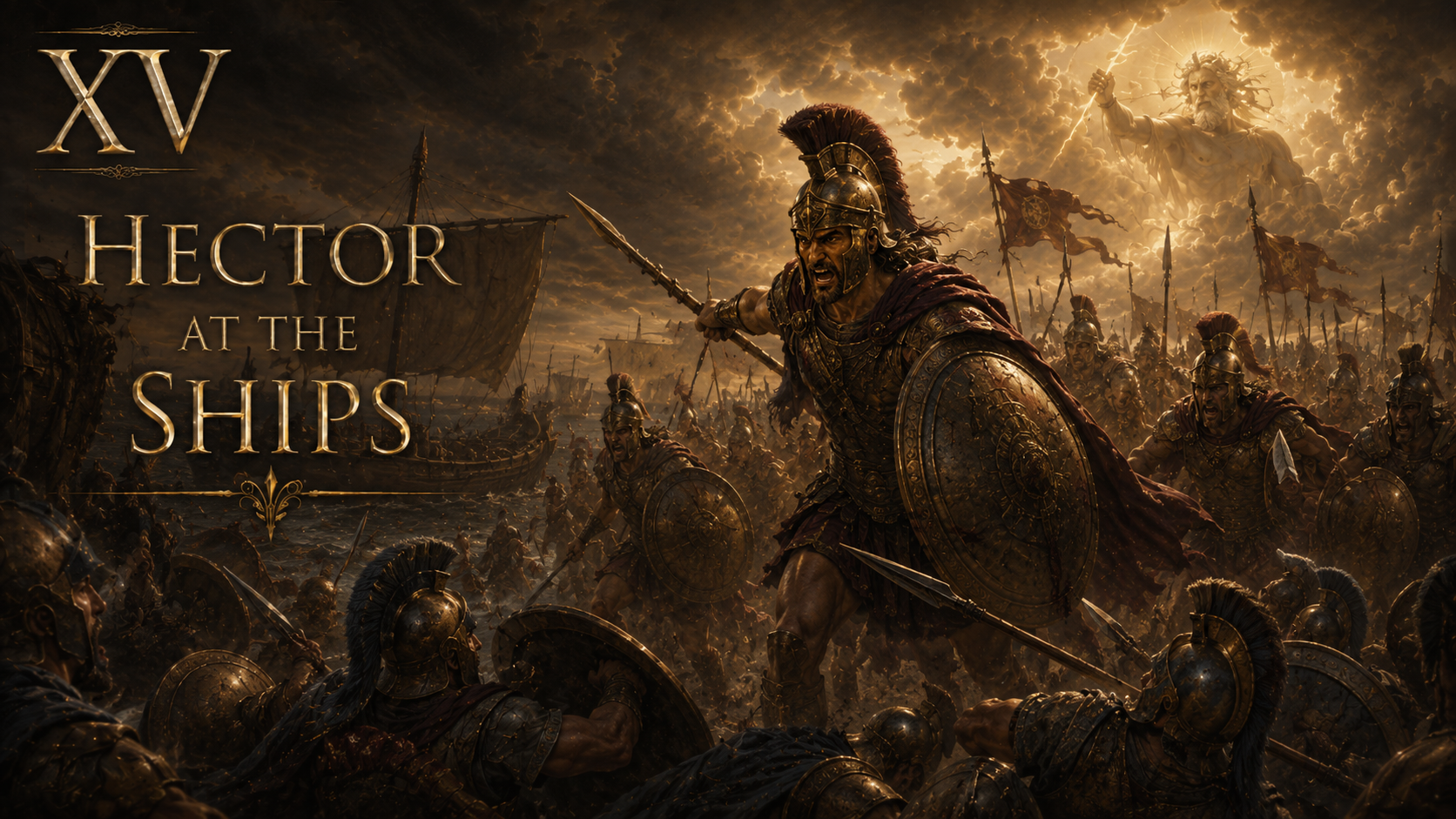
Lyrics
He lay where the dust was bitter,
where the broken shields had cried.
A prince beneath the shadow,
with the battle passing by.
Hector’s breath was shallow,
his strength was nearly gone.
The thunder of the chariots
rolled over him and on.
The Trojans looked behind them,
the Greeks began to rise.
For one dark shining moment,
hope returned to Argive eyes.
But hope is thin as morning frost
when gods walk through the field.
A golden hand came near him,
and the wound began to yield.
Hector rises again,
fire in the bone.
Hector rises again,
no longer flesh alone.
The dust runs from his shoulders,
the fear runs through the plain.
With Apollo at his breathing,
Hector rises again.
The shining god stood over him,
not gentle, not mild.
He spoke like light through iron,
and called the warrior child.
Stand up, breaker of horses,
stand up, son of Troy.
The hour has not released you,
the gods have more to destroy.
Then breath came back like burning oil,
then blood remembered flame.
The man who almost vanished
stood upright in his name.
Hector rises again,
fire in the bone.
Hector rises again,
no longer flesh alone.
The dust runs from his shoulders,
the fear runs through the plain.
With Apollo at his breathing,
Hector rises again.
Not healed for peace,
not raised for rest,
not saved from death,
but driven west.
Toward the black ships waiting,
toward the ropes and masts,
toward the hour of Patroclus,
toward the shadow coming fast.
For every godly favor
has a hook beneath the light.
The hand that lifts a hero
may lead him deeper into night.
He called the Trojans forward,
his voice was bronze and smoke.
Men who had lost their courage
felt their sleeping fury wake.
The Greeks saw something coming
that no shield could explain.
A man, a flame, a judgment,
riding back across the plain.
And far away Achilles
still guarded his wounded pride,
while fate moved through the dust clouds
with Hector at its side.
Hector rises again,
fire in the bone.
Hector rises again,
no longer flesh alone.
The dust runs from his shoulders,
the fear runs through the plain.
With Apollo at his breathing,
Hector rises again.
He lay where the dust was bitter,
then stood where the bright god came.
And every heart that saw him rise
knew war had changed its name.
Translations
Deutsch
Hektor lag im bitteren Staub, wo die zerbrochenen Schilde geschrien hatten. Sein Atem war flach, seine Kraft fast verschwunden, und der Donner der Wagen rollte an ihm vorbei. Die Trojaner blickten zurück, die Griechen schöpften für einen kurzen dunklen Augenblick Hoffnung.
Doch Hoffnung ist dünn wie Morgenfrost, wenn Götter durch das Feld gehen. Eine goldene Hand nähert sich, und die Wunde gibt nach. Hektor erhebt sich wieder, Feuer im Knochen, nicht länger nur Fleisch; mit Apollon in seinem Atem läuft die Furcht über die Ebene.
Der strahlende Gott steht über ihm und ruft ihn nicht sanft, sondern wie Licht durch Eisen: Steh auf, Pferdebändiger, Sohn Trojas. Deine Stunde hat dich noch nicht freigegeben; die Götter haben noch mehr zu zerstören. Der Atem kehrt wie brennendes Öl zurück, und das Blut erinnert sich an die Flamme.
Hektor ist nicht für den Frieden geheilt, nicht zur Ruhe erhoben und nicht vor dem Tod gerettet. Er wird nach Westen getrieben, zu den schwarzen Schiffen, zu Seilen und Masten und zur Stunde des Patroklos. Unter jeder göttlichen Gunst sitzt ein Haken.
Mit einer Stimme aus Bronze und Rauch ruft Hektor die Trojaner vorwärts. Die Griechen sehen einen Mann, eine Flamme, ein Urteil kommen. In der Ferne bewacht Achilleus noch seinen verletzten Stolz, während das Schicksal neben Hektor durch die Staubwolken zieht.
Español
Héctor yacía en el polvo amargo donde habían gritado los escudos rotos. Respiraba apenas, su fuerza casi había desaparecido y el trueno de los carros pasaba de largo. Los troyanos miraban atrás y, durante un instante oscuro, la esperanza volvió a los ojos aqueos.
Pero la esperanza es fina como la escarcha cuando los dioses caminan por el campo. Una mano dorada se acerca y la herida cede. Héctor vuelve a levantarse, con fuego en los huesos, ya no solo carne; con Apolo en su aliento, el miedo atraviesa la llanura.
El dios brillante se alza sobre él y habla como luz a través del hierro: levántate, domador de caballos, hijo de Troya. Tu hora aún no te ha liberado; los dioses tienen más que destruir. El aliento vuelve como aceite ardiente y la sangre recuerda la llama.
Héctor no ha sido curado para la paz, alzado para el descanso ni salvado de la muerte. Es empujado hacia el oeste, hacia las naves negras, las cuerdas, los mástiles y la hora de Patroclo. Bajo todo favor divino hay un anzuelo.
Con voz de bronce y humo, Héctor llama a los troyanos. Los griegos ven acercarse a un hombre, una llama, un juicio. A lo lejos, Aquiles aún custodia su orgullo herido mientras el destino avanza entre el polvo al lado de Héctor.
Français
Hector gisait dans la poussière amère où avaient crié les boucliers brisés. Son souffle était faible, sa force presque éteinte, et le tonnerre des chars roulait au-delà de lui. Les Troyens regardaient derrière eux et, pendant un instant sombre, l’espoir revint dans les yeux achéens.
Mais l’espoir est mince comme le givre lorsque les dieux traversent le champ. Une main d’or approche et la blessure cède. Hector se relève, le feu dans les os, n’étant plus seulement chair ; avec Apollon dans son souffle, la peur court sur la plaine.
Le dieu lumineux se tient au-dessus de lui et parle comme la lumière à travers le fer : lève-toi, dompteur de chevaux, fils de Troie. Ton heure ne t’a pas encore libéré ; les dieux ont encore à détruire. Le souffle revient comme une huile en feu et le sang se souvient de la flamme.
Hector n’est pas guéri pour la paix, relevé pour le repos ni sauvé de la mort. Il est poussé vers l’ouest, vers les navires noirs, les cordages, les mâts et l’heure de Patrocle. Sous toute faveur divine se cache un crochet.
D’une voix de bronze et de fumée, Hector appelle les Troyens en avant. Les Grecs voient venir un homme, une flamme, un jugement. Au loin, Achille garde encore son orgueil blessé tandis que le destin marche dans la poussière aux côtés d’Hector.
Reflection
English
Hector’s restoration is deliberately double-edged. Apollo gives him strength, but not freedom from the design that uses that strength. The scene asks whether rescue is still rescue when it returns a person to the road that will destroy him.
Book XV restores Zeus’s command and drives the battle toward the ships with frightening speed. Divine orders pass from messenger to god to warrior, yet on the shore every command becomes human exhaustion, panic, endurance, and the approaching necessity of Patroclus.
Textual basis
Homer, Iliad, Book XV, lines 239–280: Hector rises renewed and returns to the front under Apollo’s protection.
Reference edition used
Homer, Ilias. Griechisch–deutsch. Translated into German from the ancient Greek by Hans Rupé, 16th edition, Akademie Verlag, Berlin, 2013.
Deutsch
Hektors Wiederherstellung ist bewusst doppeldeutig. Apollon gibt ihm Kraft, aber keine Freiheit von dem Plan, der diese Kraft benutzt. Die Szene fragt, ob Rettung noch Rettung ist, wenn sie einen Menschen auf den Weg zurückführt, der ihn vernichten wird.
Der fünfzehnte Gesang stellt den Befehl des Zeus wieder her und treibt die Schlacht mit erschreckender Geschwindigkeit zu den Schiffen. Göttliche Weisungen wandern vom Boten zum Gott und zum Krieger; doch am Ufer wird jeder Befehl zu menschlicher Erschöpfung, Panik, Ausdauer und zur nahenden Notwendigkeit des Patroklos.
Textgrundlage
Homer, Ilias, 15. Gesang, Verse 239–280: Hektor mit erneuerter Kraft aufsteht und unter Apollons Schutz an die Front zurückkehrt.
Verwendete Referenzausgabe
Homer, Ilias. Griechisch–deutsch. Übertragen von Hans Rupé, 16. Auflage, Akademie Verlag, Berlin 2013.
Español
La restauración de Héctor tiene un doble filo. Apolo le devuelve la fuerza, pero no la libertad frente al plan que utiliza esa fuerza. La escena pregunta si un rescate sigue siéndolo cuando devuelve a alguien al camino que lo destruirá.
El canto XV restablece el mandato de Zeus y empuja la batalla hacia las naves con una velocidad aterradora. Las órdenes divinas pasan del mensajero al dios y al guerrero; pero en la orilla cada mandato se convierte en agotamiento humano, pánico, resistencia y en la necesidad cada vez más cercana de Patroclo.
Base textual
Homero, Ilíada, canto XV, versos 239–280: Héctor se levanta renovado y regresa al frente bajo la protección de Apolo.
Edición de referencia utilizada
Homer, Ilias. Griechisch–deutsch. Traducción alemana del griego antiguo de Hans Rupé, 16.ª edición, Akademie Verlag, Berlín, 2013.
Français
Le rétablissement d’Hector est à double tranchant. Apollon lui rend la force, mais non la liberté face au dessein qui utilise cette force. La scène demande si un sauvetage reste un sauvetage lorsqu’il remet quelqu’un sur la route qui le détruira.
Le chant XV rétablit le commandement de Zeus et pousse la bataille vers les nefs avec une vitesse terrifiante. Les ordres divins passent du messager au dieu puis au guerrier ; mais sur le rivage, chaque ordre devient épuisement humain, panique, endurance et nécessité croissante de Patrocle.
Base textuelle
Homère, Iliade, chant XV, vers 239–280 : Hector se relève, revigoré, et retourne au front sous la protection d’Apollon.
Édition de référence utilisée
Homer, Ilias. Griechisch–deutsch. Traduction allemande du grec ancien par Hans Rupé, 16e édition, Akademie Verlag, Berlin, 2013.