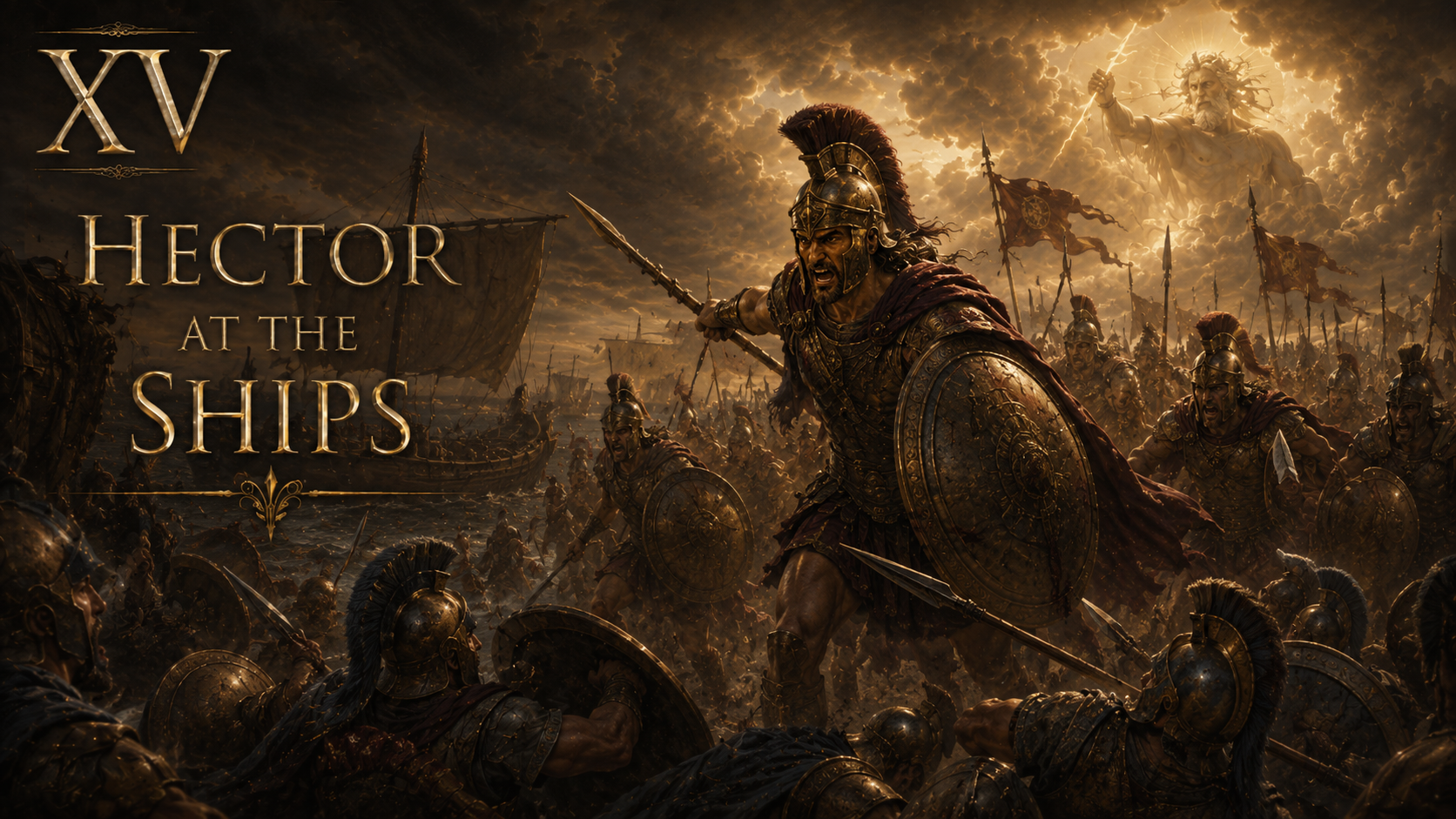
Lyrics
Light came down with a blade inside,
gold on the edge of fear.
The mountain gave its order,
and the shining one drew near.
Zeus spoke from Ida’s thunder,
and Apollo heard the call.
Take the shield that shakes the spirit,
go where broken heroes fall.
The field below was breathing dust,
the Greeks still held the line.
But heaven had turned its face again,
and war received a sign.
Not every light brings mercy,
not every dawn brings peace.
Some brightness comes like iron
and commands the knees to cease.
Apollo takes the aegis,
and the plain begins to shake.
Apollo takes the aegis,
and the hearts of heroes break.
Gold in the air,
fire in the eyes,
the god comes down laughing
where mortal courage dies.
He moved like summer lightning,
too beautiful to trust.
His feet did not disturb the earth,
but fear rose from the dust.
The bronze grew cold on Greekmen’s arms,
their horses tossed and cried.
For no man wins by muscle
when a god walks at his side.
The ditch, the wall, the crowded ships,
the cries beside the sea,
all waited for the shining hand
that bends what men call free.
Apollo takes the aegis,
and the plain begins to shake.
Apollo takes the aegis,
and the hearts of heroes break.
Gold in the air,
fire in the eyes,
the god comes down laughing
where mortal courage dies.
He was no healer here,
no singer soft and kind.
He came with Zeus behind him
and terror in the mind.
The aegis flashed before them,
not steel, not wood, not hide,
but something older than battle,
something no wound could divide.
Men who had stood through spear and stone
felt darkness in their breath.
They saw no blade before them,
yet they stepped back from death.
Then Hector heard the brightness,
felt breath return like flame.
The broken man within him
stood upright in his name.
Apollo cleared the pathway,
Apollo shook the ground.
And every Greek who saw him
felt the world turn round.
The sea was at their shoulders,
the ships behind their cries.
And over them the golden god
held panic in his eyes.
Apollo takes the aegis,
and the plain begins to shake.
Apollo takes the aegis,
and the hearts of heroes break.
Gold in the air,
fire in the eyes,
the god comes down laughing
where mortal courage dies.
Light came down with a blade inside,
gold on the edge of fear.
The mountain gave its order,
and the shining one was here.
Translations
Deutsch
Licht kam herab, doch in ihm lag eine Klinge; Gold glänzte am Rand der Furcht. Der Berg gab seinen Befehl, und der Strahlende näherte sich. Zeus sprach aus dem Donner des Ida: Apollon sollte den Schild nehmen, der den Geist erschüttert, und dorthin gehen, wo gebrochene Helden fallen.
Unten atmete das Feld Staub, und die Griechen hielten noch die Linie. Doch der Himmel hatte sein Gesicht wieder gewendet. Nicht jedes Licht bringt Gnade und nicht jede Morgenröte Frieden; manche Helligkeit kommt wie Eisen und zwingt die Knie zum Nachgeben.
Apollon nimmt die Aigis, und die Ebene bebt. Er bewegt sich wie ein Sommerblitz, zu schön, um ihm zu trauen. Seine Füße berühren die Erde kaum, doch Furcht steigt aus dem Staub. Die Bronze wird an den Armen der Griechen kalt, und die Pferde bäumen sich.
Hier ist Apollon weder Heiler noch sanfter Sänger. Die Aigis vor ihm ist nicht bloß Stahl, Holz oder Haut, sondern etwas Älteres als der Kampf. Männer, die Speer und Stein standgehalten haben, spüren Dunkelheit in ihrem Atem und weichen vor einer Klinge zurück, die sie nicht sehen.
Hektor hört die Helligkeit und fühlt den Atem wie Feuer zurückkehren. Apollon räumt ihm den Weg frei und erschüttert den Boden. Das Meer liegt den Griechen im Rücken, die Schiffe hinter ihren Schreien, und über ihnen trägt der goldene Gott die Panik im Blick.
Español
La luz descendió con una hoja dentro; el oro brillaba en el borde del miedo. La montaña dio su orden y el resplandeciente se acercó. Zeus habló desde el trueno del Ida: Apolo debía tomar el escudo que sacude el espíritu e ir adonde caen los héroes quebrados.
Abajo, el campo respiraba polvo y los griegos aún sostenían la línea. Pero el cielo había vuelto el rostro. No toda luz trae misericordia ni toda aurora paz; cierto resplandor llega como hierro y obliga a las rodillas a ceder.
Apolo toma la égida y la llanura tiembla. Se mueve como un relámpago de verano, demasiado hermoso para inspirar confianza. Sus pies apenas tocan la tierra, pero el miedo nace del polvo. El bronce se enfría en los brazos griegos y los caballos se encabritan.
Aquí Apolo no es sanador ni cantor amable. La égida que fulgura ante ellos no es acero, madera ni piel, sino algo más antiguo que la batalla. Hombres que resistieron lanzas y piedras sienten oscuridad en el aliento y retroceden ante una espada que no ven.
Héctor oye el resplandor y siente volver el aliento como fuego. Apolo despeja el camino y sacude la tierra. El mar queda a la espalda de los griegos, las naves detrás de sus gritos, y sobre ellos el dios dorado sostiene el pánico en los ojos.
Français
La lumière descendit avec une lame en elle ; l’or brillait au bord de la peur. La montagne donna son ordre et le dieu rayonnant approcha. Zeus parla depuis le tonnerre de l’Ida : Apollon devait prendre le bouclier qui ébranle l’esprit et aller là où tombent les héros brisés.
En bas, le champ respirait la poussière et les Grecs tenaient encore la ligne. Mais le ciel avait de nouveau tourné son visage. Toute lumière n’apporte pas la grâce et toute aube n’apporte pas la paix ; certaines clartés viennent comme le fer et forcent les genoux à céder.
Apollon prend l’égide et la plaine tremble. Il se meut comme un éclair d’été, trop beau pour inspirer confiance. Ses pieds troublent à peine la terre, mais la peur monte de la poussière. Le bronze refroidit sur les bras grecs et les chevaux se cabrent.
Ici, Apollon n’est ni guérisseur ni doux chanteur. L’égide qui flamboie devant eux n’est ni acier, ni bois, ni peau, mais quelque chose de plus ancien que la bataille. Des hommes qui ont résisté aux lances et aux pierres sentent les ténèbres dans leur souffle et reculent devant une lame invisible.
Hector entend la lumière et sent son souffle revenir comme une flamme. Apollon lui ouvre la route et ébranle le sol. La mer est dans le dos des Grecs, les navires derrière leurs cris, et au-dessus d’eux le dieu d’or porte la panique dans son regard.
Reflection
English
The aegis attacks perception before it attacks bodies. Courage depends on a shared sense that the world remains intelligible; Apollo destroys that foundation. The song turns beauty into menace and reminds us that terror is most powerful when it makes resistance feel meaningless.
Book XV restores Zeus’s command and drives the battle toward the ships with frightening speed. Divine orders pass from messenger to god to warrior, yet on the shore every command becomes human exhaustion, panic, endurance, and the approaching necessity of Patroclus.
Textual basis
Homer, Iliad, Book XV, lines 220–280: Apollo takes the aegis, restores Hector’s strength, and leads the Trojan advance.
Reference edition used
Homer, Ilias. Griechisch–deutsch. Translated into German from the ancient Greek by Hans Rupé, 16th edition, Akademie Verlag, Berlin, 2013.
Deutsch
Die Aigis greift zuerst die Wahrnehmung und erst dann die Körper an. Mut braucht das gemeinsame Vertrauen, dass die Welt noch verstehbar ist; Apollon zerstört dieses Fundament. Der Song verwandelt Schönheit in Bedrohung und zeigt: Schrecken ist am stärksten, wenn Widerstand sinnlos erscheint.
Der fünfzehnte Gesang stellt den Befehl des Zeus wieder her und treibt die Schlacht mit erschreckender Geschwindigkeit zu den Schiffen. Göttliche Weisungen wandern vom Boten zum Gott und zum Krieger; doch am Ufer wird jeder Befehl zu menschlicher Erschöpfung, Panik, Ausdauer und zur nahenden Notwendigkeit des Patroklos.
Textgrundlage
Homer, Ilias, 15. Gesang, Verse 220–280: Apollon die Aigis nimmt, Hektors Kraft wiederherstellt und den trojanischen Vormarsch führt.
Verwendete Referenzausgabe
Homer, Ilias. Griechisch–deutsch. Übertragen von Hans Rupé, 16. Auflage, Akademie Verlag, Berlin 2013.
Español
La égida ataca la percepción antes que los cuerpos. El valor necesita la confianza compartida en que el mundo sigue siendo comprensible; Apolo destruye esa base. La canción convierte la belleza en amenaza y recuerda que el terror es más poderoso cuando la resistencia parece inútil.
El canto XV restablece el mandato de Zeus y empuja la batalla hacia las naves con una velocidad aterradora. Las órdenes divinas pasan del mensajero al dios y al guerrero; pero en la orilla cada mandato se convierte en agotamiento humano, pánico, resistencia y en la necesidad cada vez más cercana de Patroclo.
Base textual
Homero, Ilíada, canto XV, versos 220–280: Apolo toma la égida, devuelve la fuerza a Héctor y conduce el avance troyano.
Edición de referencia utilizada
Homer, Ilias. Griechisch–deutsch. Traducción alemana del griego antiguo de Hans Rupé, 16.ª edición, Akademie Verlag, Berlín, 2013.
Français
L’égide attaque la perception avant les corps. Le courage suppose la conviction commune que le monde reste intelligible ; Apollon détruit ce fondement. La chanson change la beauté en menace et rappelle que la terreur est la plus forte lorsqu’elle rend toute résistance vaine.
Le chant XV rétablit le commandement de Zeus et pousse la bataille vers les nefs avec une vitesse terrifiante. Les ordres divins passent du messager au dieu puis au guerrier ; mais sur le rivage, chaque ordre devient épuisement humain, panique, endurance et nécessité croissante de Patrocle.
Base textuelle
Homère, Iliade, chant XV, vers 220–280 : Apollon prend l’égide, rend sa force à Hector et conduit l’avance troyenne.
Édition de référence utilisée
Homer, Ilias. Griechisch–deutsch. Traduction allemande du grec ancien par Hans Rupé, 16e édition, Akademie Verlag, Berlin, 2013.