Lyrics
She came down through the weather,
through the torn and ringing air,
with the color of a warning
burning bright around her hair.
Iris crossed the shaken heavens,
swift as fear and clear as flame.
Zeus had spoken from the mountain,
and she carried down his name.
Far below, the sea was breathing
through the bronze and dust of war,
where Poseidon moved among them
like a tide against the shore.
The earth still held his footprint,
the horses knew his hand.
But thunder from the mountain
had drawn a harder line in sand.
Iris to Poseidon,
leave the battle, leave the plain.
Iris to Poseidon,
do not wake the storm again.
The sky has sent its answer,
the mountain has replied.
Iris to Poseidon,
step back from mortal pride.
The Earthshaker turned in anger,
and the sea rose in his chest.
Was he born to bow in silence?
Was his power less than rest?
Brother stood against brother,
though no blade was in the air.
The battlefield grew smaller
than the quarrel hidden there.
For gods can wound with silence,
and kings can strike with breath.
A word sent down from Ida
can walk the field like death.
Iris to Poseidon,
leave the battle, leave the plain.
Iris to Poseidon,
do not wake the storm again.
The sky has sent its answer,
the mountain has replied.
Iris to Poseidon,
step back from mortal pride.
He spoke of ancient portions,
of the sea, the sky, the dead,
of the honors given long ago,
of the shares the brothers held.
Why should one command the others?
Why should thunder rule the deep?
Why should waves be called to silence
while the mountain wakes from sleep?
But Iris did not tremble,
and Iris did not bend.
She carried not persuasion,
but the edge before the end.
Then wisdom, cold and bitter,
moved beneath his storming face.
Not fear, and not surrender,
but the measure of his place.
For if the gods broke open
and their anger split the world,
what would mortal shields be worth
when divine war was unfurled?
So the sea pulled back its shadow,
though its heart still struck the stone.
The field remained to mortals,
but no man stood alone.
Iris to Poseidon,
leave the battle, leave the plain.
Iris to Poseidon,
do not wake the storm again.
The sky has sent its answer,
the mountain has replied.
Iris to Poseidon,
step back from mortal pride.
She rose back through the weather,
through the torn and ringing air.
And the sea kept all its anger
in the darkness of its lair.
Translations
Deutsch
Iris kam durch Wetter und zerrissene, klingende Luft herab; die Farbe einer Warnung brannte um ihr Haar. Schnell wie Furcht und klar wie eine Flamme trug sie den Namen und Befehl des Zeus vom Ida hinunter.
Unten atmete das Meer durch Bronze und Kriegsstaub, wo Poseidon sich wie eine Flut unter den Kämpfern bewegte. Die Erde trug noch seinen Fußabdruck und die Pferde kannten seine Hand, doch der Donner vom Berg hatte eine härtere Grenze in den Sand gezogen.
Iris fordert ihn auf, Schlacht und Ebene zu verlassen und den Sturm nicht erneut zu wecken. Poseidon wendet sich zornig um; das Meer steigt in seiner Brust. Er erinnert an die uralte Teilung von Himmel, Meer und Unterwelt und fragt, weshalb ein Bruder über die anderen gebieten dürfe.
Iris zittert nicht und weicht nicht. Sie bringt keine Überredung, sondern die Schneide vor dem Ende. Da bewegt sich kalte, bittere Weisheit unter Poseidons stürmischem Gesicht: nicht Furcht und nicht Kapitulation, sondern das Wissen um die Folgen eines offenen Götterkriegs.
Das Meer zieht seinen Schatten vom Schlachtfeld zurück, obwohl sein Herz weiter gegen den Stein schlägt. Das Feld bleibt den Sterblichen überlassen, doch keiner von ihnen steht jemals ganz allein.
Español
Iris descendió a través del temporal y del aire desgarrado y sonoro; el color de una advertencia ardía alrededor de su cabello. Rápida como el miedo y clara como una llama, llevó desde el Ida el nombre y la orden de Zeus.
Abajo, el mar respiraba entre el bronce y el polvo, donde Poseidón se movía como una marea. La tierra aún guardaba su huella y los caballos conocían su mano, pero el trueno de la montaña había trazado una frontera más dura en la arena.
Iris le exige abandonar la batalla y no despertar otra vez la tormenta. Poseidón se vuelve airado; el mar sube en su pecho. Recuerda la antigua división del cielo, el mar y el mundo de los muertos, y pregunta por qué un hermano habría de mandar sobre los demás.
Iris no tiembla ni cede. No trae persuasión, sino el filo anterior al final. Entonces una sabiduría fría y amarga atraviesa el rostro tempestuoso de Poseidón: no es miedo ni rendición, sino conciencia de lo que significaría una guerra abierta entre dioses.
El mar retira su sombra del campo, aunque su corazón siga golpeando la piedra. La batalla queda en manos de los mortales, pero ninguno de ellos está completamente solo.
Français
Iris descendit à travers l’orage et l’air déchiré, vibrant ; la couleur d’un avertissement brûlait autour de ses cheveux. Rapide comme la peur et claire comme une flamme, elle porta depuis l’Ida le nom et l’ordre de Zeus.
En bas, la mer respirait parmi le bronze et la poussière, là où Poséidon se mouvait comme une marée. La terre gardait son empreinte et les chevaux connaissaient sa main, mais le tonnerre de la montagne avait tracé dans le sable une limite plus dure.
Iris lui ordonne de quitter la bataille et de ne pas réveiller de nouveau la tempête. Poséidon se tourne avec colère ; la mer monte dans sa poitrine. Il rappelle l’ancien partage du ciel, de la mer et du monde des morts, et demande pourquoi un frère commanderait aux autres.
Iris ne tremble pas et ne cède pas. Elle n’apporte pas la persuasion, mais le tranchant qui précède la fin. Une sagesse froide et amère traverse alors le visage orageux de Poséidon : ni peur ni soumission, mais conscience de ce qu’une guerre ouverte entre dieux infligerait au monde.
La mer retire son ombre du champ, bien que son cœur frappe encore la pierre. La bataille reste aux mortels, mais aucun d’eux n’est jamais entièrement seul.
Reflection
English
Iris embodies the difference between negotiation and a final boundary. Poseidon’s grievance is not dismissed as false, yet being right does not remove consequences. His withdrawal becomes an act of restraint: power proves itself by refusing the catastrophe it could unleash.
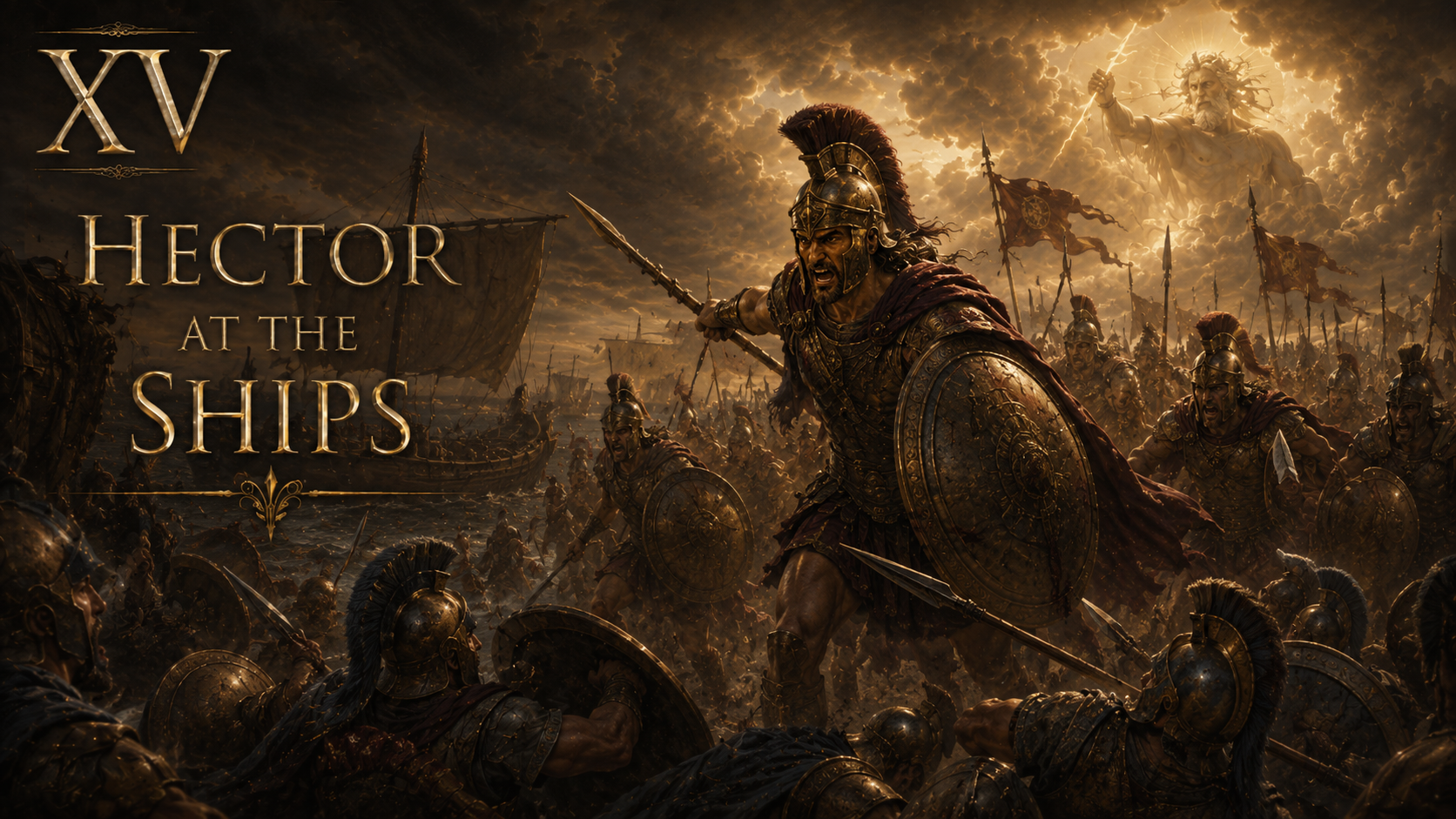
Book XV restores Zeus’s command and drives the battle toward the ships with frightening speed. Divine orders pass from messenger to god to warrior, yet on the shore every command becomes human exhaustion, panic, endurance, and the approaching necessity of Patroclus.
Textual basis
Homer, Iliad, Book XV, lines 157–219: Iris carries Zeus’s command to Poseidon and demands his withdrawal from battle.
Reference edition used
Homer, Ilias. Griechisch–deutsch. Translated into German from the ancient Greek by Hans Rupé, 16th edition, Akademie Verlag, Berlin, 2013.
Deutsch
Iris verkörpert den Unterschied zwischen Verhandlung und letzter Grenze. Poseidons Kränkung wird nicht als unbegründet abgetan, doch Recht zu haben hebt Folgen nicht auf. Sein Rückzug wird zur Selbstbegrenzung: Macht beweist sich, indem sie die mögliche Katastrophe nicht entfesselt.
Der fünfzehnte Gesang stellt den Befehl des Zeus wieder her und treibt die Schlacht mit erschreckender Geschwindigkeit zu den Schiffen. Göttliche Weisungen wandern vom Boten zum Gott und zum Krieger; doch am Ufer wird jeder Befehl zu menschlicher Erschöpfung, Panik, Ausdauer und zur nahenden Notwendigkeit des Patroklos.
Textgrundlage
Homer, Ilias, 15. Gesang, Verse 157–219: Iris Poseidon den Befehl des Zeus überbringt und seinen Rückzug aus der Schlacht verlangt.
Verwendete Referenzausgabe
Homer, Ilias. Griechisch–deutsch. Übertragen von Hans Rupé, 16. Auflage, Akademie Verlag, Berlin 2013.
Español
Iris encarna la diferencia entre negociar y fijar un límite final. El agravio de Poseidón no se declara falso, pero tener razón no elimina las consecuencias. Su retirada se convierte en dominio propio: el poder se demuestra al no desatar la catástrofe posible.
El canto XV restablece el mandato de Zeus y empuja la batalla hacia las naves con una velocidad aterradora. Las órdenes divinas pasan del mensajero al dios y al guerrero; pero en la orilla cada mandato se convierte en agotamiento humano, pánico, resistencia y en la necesidad cada vez más cercana de Patroclo.
Base textual
Homero, Ilíada, canto XV, versos 157–219: Iris lleva a Poseidón la orden de Zeus y exige que se retire de la batalla.
Edición de referencia utilizada
Homer, Ilias. Griechisch–deutsch. Traducción alemana del griego antiguo de Hans Rupé, 16.ª edición, Akademie Verlag, Berlín, 2013.
Français
Iris incarne la différence entre négociation et limite ultime. Le grief de Poséidon n’est pas déclaré faux, mais avoir raison n’abolit pas les conséquences. Son retrait devient maîtrise de soi : le pouvoir se prouve en refusant de déchaîner la catastrophe possible.
Le chant XV rétablit le commandement de Zeus et pousse la bataille vers les nefs avec une vitesse terrifiante. Les ordres divins passent du messager au dieu puis au guerrier ; mais sur le rivage, chaque ordre devient épuisement humain, panique, endurance et nécessité croissante de Patrocle.
Base textuelle
Homère, Iliade, chant XV, vers 157–219 : Iris porte à Poséidon l’ordre de Zeus et exige son retrait du combat.
Édition de référence utilisée
Homer, Ilias. Griechisch–deutsch. Traduction allemande du grec ancien par Hans Rupé, 16e édition, Akademie Verlag, Berlin, 2013.