Lyrics
Hector in the dust
Hector in the dust
the fire ran forward
then broke in the dust
The Trojans came like burning wind
with Hector at their head
the ships were close
the smoke was thick
the sand was dark with red
He drove them on with iron breath
he called them through the flame
and every Greek who saw him come
felt terror speak his name
But Ajax stood beside the ships
wide as a tower wall
with sea wind in his tangled hair
and rage enough for all
Hector in the dust
Hector in the dust
the bronze kept shouting
then fell into dust
Hector in the dust
Hector in the dust
one stone from the shoreline
one crack in the trust
There lay a stone beside the hulls
black with the weight of war
a mooring stone, a shipman’s stone
half buried by the shore
Ajax lifted up that rock
as if the earth gave way
and all the strength of broken men
was gathered in that clay
He hurled it through the screaming air
where spear and arrow crossed
and Hector saw the shadow come
one heartbeat before he lost
Hector in the dust
Hector in the dust
the breaker of armies
went down in the dust
Hector in the dust
Hector in the dust
the Trojans cried out
and the Greeks found trust
It struck him where the shield strap lay
it crushed the breath inside
the knees that carried Troy’s great hope
gave way beneath his pride
He fell as falls an oak in storm
when thunder splits the crown
the roots still grip the wounded earth
but all the height comes down
The Trojans closed around their lord
with fear in every hand
they lifted him from blood and bronze
and bore him from the sand
No song of joy
no clean release
no ending written clear
only a giant on the ground
and war changing gear
Hector in the dust
Hector in the dust
the flame pulled backward
the shields bit the dust
Hector in the dust
Hector in the dust
not dead, not broken forever
but gone from the thrust
Then Greek hearts rose like evening waves
when wind returns to sea
Poseidon’s power moved through the line
like old authority
The spears went forward, rank by rank
the Trojans bent and reeled
the smoke was torn apart awhile
above the bitter field
Men who had thought the ships would burn
now saw the Trojans yield
men who had tasted flight and shame
came roaring through the shield
Hector in the dust
Hector in the dust
the sea remembered
the fire lost trust
Hector in the dust
Hector in the dust
the day turned over
in blood and dust
They carried him toward the river
where cool dark waters ran
his breath came back in broken pulls
half god and half a man
He opened up his clouded eyes
then sank again in pain
and blackness folded over him
like night across the plain
But back beside the hollow ships
the Argive line drove on
not whole
not clean
not innocent
but standing before dawn
Hector in the dust
Hector in the dust
one stone had spoken
through smoke and dust
Hector in the dust
Hector in the dust
the war was not ended
but the fire lost its lust
The ships still waited by the sea
the dead still held the ground
and somewhere high on Ida’s ridge
the sleeping storm lay bound
For while the lord of thunder dreamed
and Hera held the night
the Greeks came back from breaking
and dragged the day toward light
Hector in the dust
Hector in the dust
remember the hour
when terror lost trust
Hector in the dust
Hector in the dust
not victory yet
but the turning in the dust
Translations
Deutsch
Hektor im Staub: Das Feuer lief vorwärts und brach dann im Staub. Die Trojaner kamen wie brennender Wind mit Hektor an der Spitze; die Schiffe waren nah, der Rauch dick und der Sand dunkelrot.
Er trieb sie mit eisernem Atem durch die Flamme. Jeder Grieche, der ihn kommen sah, hörte die Furcht seinen Namen sprechen. Doch Ajax stand bei den Schiffen, breit wie eine Turmmauer, den Seewind im Haar und Zorn genug für alle.
Neben den Schiffsrümpfen lag ein schwarzer Vertäuungsstein, halb im Ufer begraben. Ajax hob den Fels, als gäbe die Erde nach und als sammelte sich darin alle Kraft der gebrochenen Männer.
Er schleuderte ihn durch die schreiende Luft, wo Pfeile und Speere sich kreuzten. Hektor sah den Schatten einen Herzschlag, bevor ihm alles entglitt. Der Brecher der Heere ging zu Boden; die Trojaner schrien, und die Griechen fanden Vertrauen.
Der Stein traf ihn dort, wo der Schildriemen lag, und zerdrückte den Atem. Die Knie, die Trojas Hoffnung getragen hatten, gaben unter seinem Stolz nach. Er fiel wie eine Eiche im Sturm, deren Krone der Donner spaltet, während die Wurzeln noch die verwundete Erde greifen.
Die Trojaner schlossen sich voller Angst um ihren Herrn, hoben ihn aus Blut und Bronze und trugen ihn vom Sand. Kein Jubellied, keine reine Befreiung und kein klares Ende – nur ein Riese am Boden und ein Krieg, der den Gang wechselt.
Hektor war nicht tot und nicht für immer gebrochen, aber aus dem Stoß genommen. Da erhoben sich griechische Herzen wie Abendwellen, wenn Wind zum Meer zurückkehrt. Poseidons Macht ging wie alte Autorität durch die Linie.
Rang für Rang gingen die Speere vor; die Trojaner wankten und bogen sich. Für eine Weile riss der Rauch über dem bitteren Feld auf. Männer, die ihre Schiffe schon brennen sahen, erblickten nun die Trojaner weichen; Männer, die Flucht und Scham gekostet hatten, brüllten durch den Schildwall.
Sie trugen Hektor zum Fluss, wo kühles dunkles Wasser floss. Sein Atem kehrte in gebrochenen Zügen zurück, halb Gott und halb Mensch. Er öffnete trübe Augen, sank wieder in Schmerz, und Schwärze legte sich wie Nacht über ihn.
Bei den hohlen Schiffen drängte die argivische Linie weiter – nicht unversehrt, nicht rein, nicht unschuldig, aber vor dem Morgen aufrecht. Der Krieg war nicht beendet, doch das Feuer hatte seine Gier verloren.
Die Schiffe warteten am Meer, die Toten hielten den Boden, und hoch auf dem Ida lag der schlafende Sturm gebunden. Während Zeus träumte und Hera die Nacht hielt, kehrten die Griechen vom Brechen zurück und zogen den Tag zum Licht.
Erinnert euch an die Stunde, in der der Schrecken sein Vertrauen verlor: noch kein Sieg, aber die Wende im Staub.
Español
Héctor en el polvo: el fuego avanzó y luego se quebró en el polvo. Los troyanos llegaron como viento ardiente con Héctor al frente; las naves estaban cerca, el humo espeso y la arena oscura de rojo.
Los empujó por la llama con aliento de hierro. Cada griego que lo vio oyó al terror decir su nombre. Pero Áyax estaba junto a las naves, ancho como muralla de torre, con viento marino en el cabello y furia suficiente para todos.
Junto a los cascos había una piedra negra de amarre, medio enterrada en la costa. Áyax levantó la roca como si cediera la tierra y toda la fuerza de los hombres quebrados se reuniera en ella.
La lanzó por el aire lleno de gritos, donde se cruzaban flechas y lanzas. Héctor vio la sombra un latido antes de perderlo todo. El destructor de ejércitos cayó; gritaron los troyanos y los griegos recuperaron la confianza.
La piedra lo golpeó donde pasaba la correa del escudo y aplastó su aliento. Las rodillas que sostenían la esperanza de Troya cedieron bajo su orgullo. Cayó como roble en tormenta cuando el trueno parte la copa, aunque las raíces aún aferran la tierra herida.
Los troyanos rodearon a su señor con miedo en las manos, lo alzaron entre sangre y bronce y lo sacaron de la arena. No hubo canto de alegría, liberación limpia ni final claro: solo un gigante en el suelo y la guerra cambiando de marcha.
Héctor no estaba muerto ni roto para siempre, pero había salido del empuje. Entonces los corazones griegos subieron como olas al atardecer cuando vuelve el viento al mar. El poder de Poseidón cruzó la línea como autoridad antigua.
Fila tras fila avanzaron las lanzas; los troyanos se doblaron y tambalearon. Durante un momento se rasgó el humo sobre el campo amargo. Hombres que habían imaginado arder las naves vieron ceder a los troyanos; quienes habían probado huida y vergüenza rugieron a través del muro de escudos.
Llevaron a Héctor hacia el río de aguas oscuras y frescas. Su aliento regresó a tirones, mitad dios y mitad hombre. Abrió ojos nublados, volvió a hundirse en el dolor y la oscuridad lo cubrió como noche sobre la llanura.
Junto a las naves huecas siguió avanzando la línea argiva, no entera, limpia ni inocente, pero en pie antes del amanecer. La guerra no había terminado, pero el fuego perdió su apetito.
Las naves esperaban junto al mar, los muertos guardaban el suelo y en lo alto del Ida permanecía atada la tormenta dormida. Mientras Zeus soñaba y Hera sostenía la noche, los griegos regresaron del borde de romperse y arrastraron el día hacia la luz.
Recordad la hora en que el terror perdió su confianza: todavía no era victoria, pero sí el giro en el polvo.
Français
Hector dans la poussière : le feu courut en avant puis se brisa dans la poussière. Les Troyens vinrent comme un vent brûlant, Hector à leur tête ; les navires étaient proches, la fumée épaisse et le sable sombre de rouge.
Il les poussa dans la flamme avec un souffle de fer. Chaque Grec qui le vit venir entendit la terreur prononcer son nom. Mais Ajax se tenait près des vaisseaux, large comme le mur d’une tour, le vent marin dans les cheveux et assez de rage pour tous.
Près des coques reposait une pierre noire d’amarrage, à demi enfouie dans la rive. Ajax souleva ce roc comme si la terre cédait et que toute la force des hommes brisés s’y rassemblait.
Il le lança dans l’air hurlant où flèches et lances se croisaient. Hector vit l’ombre un battement avant de tout perdre. Le briseur d’armées tomba ; les Troyens crièrent et les Grecs retrouvèrent confiance.
La pierre le frappa au passage de la courroie du bouclier et écrasa son souffle. Les genoux qui portaient l’espoir de Troie cédèrent sous son orgueil. Il tomba comme un chêne sous l’orage lorsque le tonnerre fend la cime, les racines agrippant encore la terre blessée.
Les Troyens entourèrent leur maître, la peur dans chaque main, le relevèrent du sang et du bronze et l’emportèrent loin du sable. Nul chant de joie, nulle délivrance pure, nulle fin nette : seulement un géant à terre et la guerre qui change de vitesse.
Hector n’était ni mort ni brisé pour toujours, mais retiré de l’élan. Alors les cœurs grecs montèrent comme les vagues du soir lorsque le vent revient à la mer. La puissance de Poséidon traversa la ligne comme une vieille autorité.
Rang après rang, les lances avancèrent ; les Troyens plièrent et chancelèrent. Un moment, la fumée se déchira au-dessus du champ amer. Les hommes qui avaient cru voir brûler leurs navires virent les Troyens céder ; ceux qui avaient goûté la fuite et la honte rugirent à travers le mur des boucliers.
Ils portèrent Hector vers le fleuve aux eaux sombres et fraîches. Son souffle revint par saccades, moitié dieu et moitié homme. Il ouvrit des yeux voilés, retomba dans la douleur et l’obscurité le couvrit comme la nuit sur la plaine.
Près des vaisseaux creux, la ligne argienne poursuivit son avance, ni entière, ni pure, ni innocente, mais debout avant l’aube. La guerre n’était pas finie, pourtant le feu avait perdu son appétit.
Les navires attendaient près de la mer, les morts gardaient le sol, et très haut sur l’Ida l’orage endormi restait lié. Tandis que Zeus rêvait et qu’Héra tenait la nuit, les Grecs revinrent de la rupture et tirèrent le jour vers la lumière.
Souvenez-vous de l’heure où la terreur perdit sa confiance : pas encore la victoire, mais le tournant dans la poussière.
Reflection
English
Hector’s fall is a reversal, not a resolution. The stone strips terror of its momentum and reminds both armies that even the dominant hero is embodied and vulnerable. Book XIV ends in the unstable space between survival and victory.
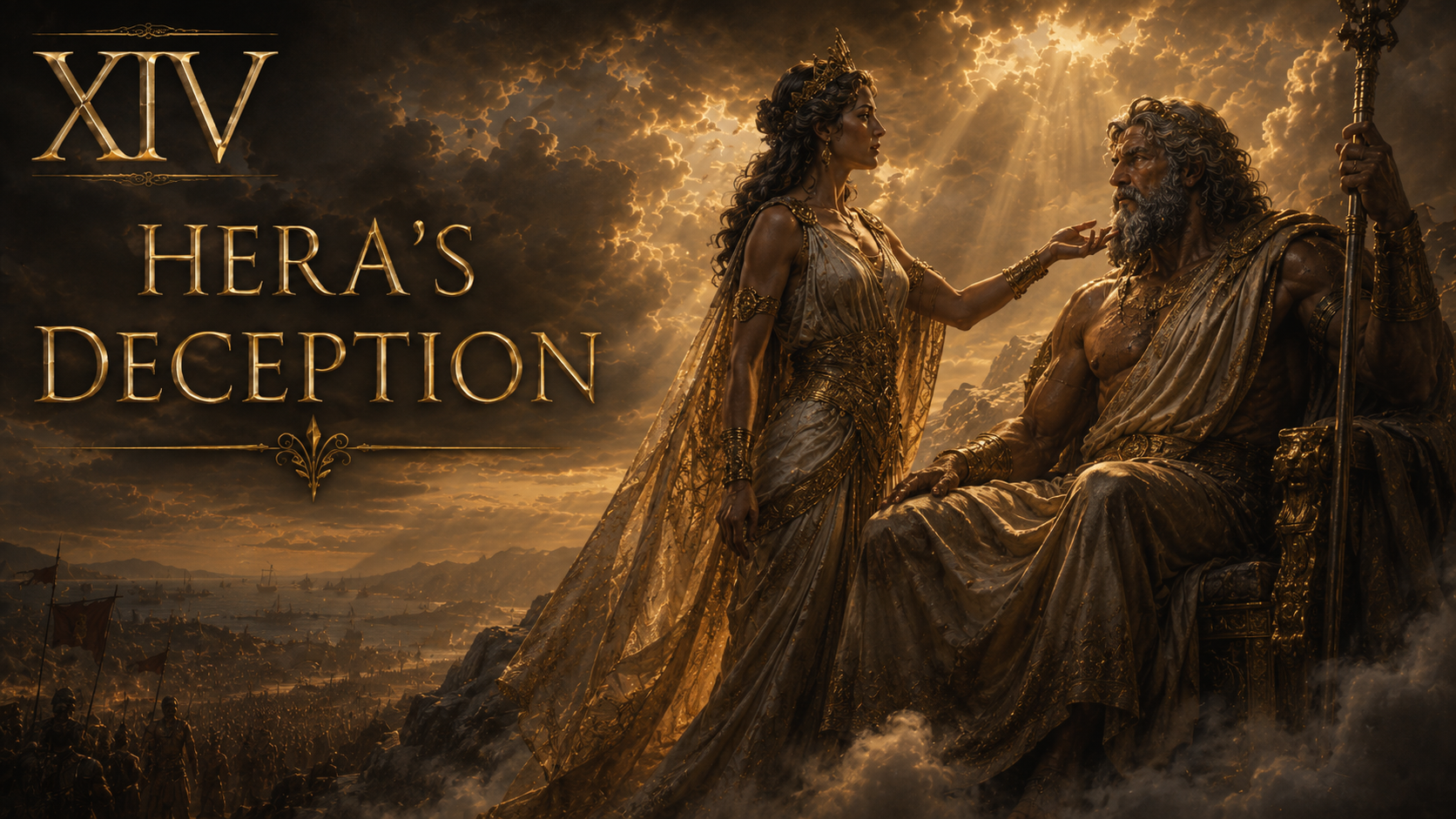
Book XIV makes strategy depend on wounded bodies, persuasion, disguise, desire, and sleep. Hera’s deception gives the Achaeans breathing space, but the rescue is morally unstable: tenderness becomes a weapon, and mortal survival turns on a quarrel among immortals.
Textual basis
Homer, Iliad, Book XIV, lines 402–507: Ajax strikes Hector with a great stone and leaves him collapsed in the dust.
Reference edition used
Homer, Ilias. Griechisch–deutsch. Translated into German from the ancient Greek by Hans Rupé, 16th edition, Akademie Verlag, Berlin, 2013.
Deutsch
Hektors Fall ist eine Wende, keine Lösung. Der Stein nimmt dem Schrecken seinen Schwung und erinnert beide Heere daran, dass auch der übermächtige Held einen verletzlichen Körper besitzt. Gesang XIV endet im unsicheren Raum zwischen Überleben und Sieg.
Der vierzehnte Gesang lässt Strategie von verwundeten Körpern, Überredung, Verstellung, Begehren und Schlaf abhängen. Heras Täuschung verschafft den Achaiern Luft, doch die Rettung bleibt moralisch instabil: Zärtlichkeit wird zur Waffe, und sterbliches Überleben hängt vom Streit der Unsterblichen ab.
Textgrundlage
Homer, Ilias, 14. Gesang, Verse 402–507: Aias Hektor mit einem gewaltigen Stein trifft und ihn im Staub zusammenbrechen lässt.
Verwendete Referenzausgabe
Homer, Ilias. Griechisch–deutsch. Übertragen von Hans Rupé, 16. Auflage, Akademie Verlag, Berlin 2013.
Español
La caída de Héctor es giro, no desenlace. La piedra quita impulso al terror y recuerda a ambos ejércitos que incluso el héroe dominante tiene cuerpo vulnerable. El libro XIV termina en el espacio inestable entre supervivencia y victoria.
El canto XIV hace que la estrategia dependa de cuerpos heridos, persuasión, disfraz, deseo y sueño. El engaño de Hera concede un respiro a los aqueos, pero el rescate es moralmente inestable: la ternura se convierte en arma y la supervivencia mortal depende de una disputa entre inmortales.
Base textual
Homero, Ilíada, canto XIV, versos 402–507: Áyax golpea a Héctor con una gran piedra y lo deja desplomado en el polvo.
Edición de referencia utilizada
Homer, Ilias. Griechisch–deutsch. Traducción alemana del griego antiguo de Hans Rupé, 16.ª edición, Akademie Verlag, Berlín, 2013.
Français
La chute d’Hector est un retournement, non une résolution. La pierre retire son élan à la terreur et rappelle aux deux armées que même le héros dominant possède un corps vulnérable. Le livre XIV s’achève dans l’espace instable entre survie et victoire.
Le chant XIV fait dépendre la stratégie des corps blessés, de la persuasion, du déguisement, du désir et du sommeil. La tromperie d’Héra offre un répit aux Achéens, mais ce secours demeure moralement instable : la tendresse devient une arme et la survie des mortels dépend d’une querelle entre immortels.
Base textuelle
Homère, Iliade, chant XIV, vers 402–507 : Ajax frappe Hector d’une pierre énorme et le laisse effondré dans la poussière.
Édition de référence utilisée
Homer, Ilias. Griechisch–deutsch. Traduction allemande du grec ancien par Hans Rupé, 16e édition, Akademie Verlag, Berlin, 2013.