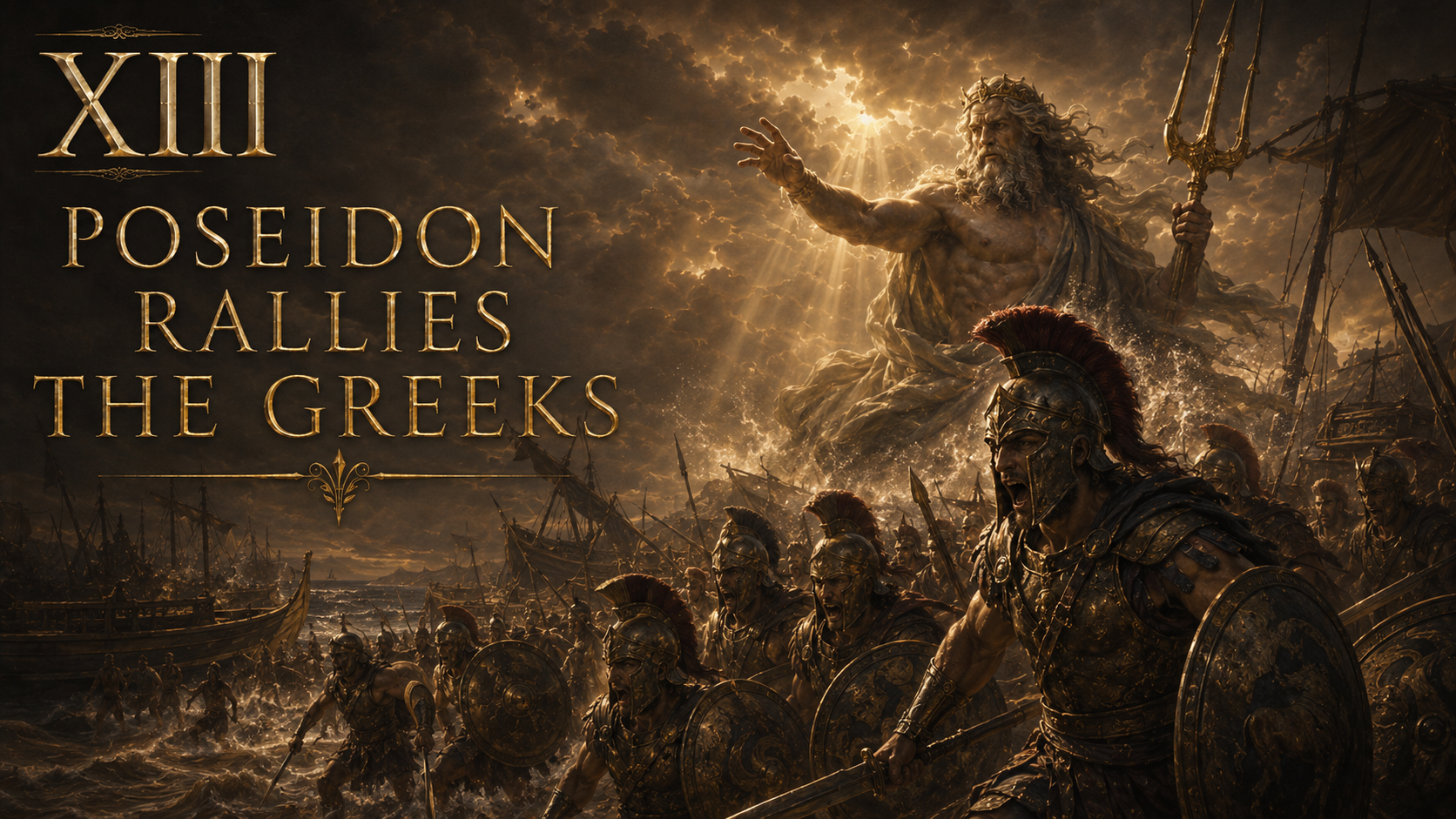
Lyrics
The sea holds the line
Where the wall could not
Where the gate fell open
And the timbers rot
The sea holds the line
With a salt-wind hand
And the Greeks stand breathing
In the broken sand
The Trojans came like wildfire
With Hector in their cry
They saw the black ships waiting
Under smoke and sky
But Poseidon moved beneath them
In the foam and in the air
And the men who almost vanished
Found their courage there
The sea holds the line
The ships are not yet flame
The sea holds the line
And no man leaves the same
The sea holds the line
Where the bronze winds blow
At the edge of ruin
Still the answer is no
Ajax stood like timber
Cut from some older tree
Idomeneus struck forward
By the breathing of the sea
Meriones moved sharply
Where the crowded spearheads crossed
And every small survival
Had the weight of what was lost
Aeneas brought the thunder
The Trojan captains came
But the sand before the vessels
Would not give itself to flame
There was no song of victory
No shining end to pain
Only men still standing
In the salt and dust and rain
The sea holds the line
The ships are not yet flame
The sea holds the line
And no man leaves the same
The sea holds the line
Where the bronze winds blow
At the edge of ruin
Still the answer is no
Hold by the mast
Hold by the foam
Hold for the road
That may lead home
Hold by the shield
Hold by the cry
Hold one more breath
Before goodbye
The wall was only memory
The gate was splintered wide
But not all broken shelters
Mean the heart has died
For courage is not thunder
And courage is not light
Sometimes it is a tired man
Still standing in the fight
The sea holds the line
The ships are not yet flame
The sea holds the line
And no man leaves the same
The sea holds the line
Where the bronze winds blow
At the edge of ruin
Still the answer is no
The sea holds the line
Till the dark turns pale
The war is not over
But the fire did not sail
The sea holds the line
By the ships and the shore
And the thirteenth book closes
With the Greeks breathing once more
Translations
Deutsch
Das Meer hält die Linie, wo die Mauer es nicht konnte, wo das Tor offenbrach und die Balken verrotteten. Mit einer Hand aus Salzwind hält es stand, und die Griechen atmen im zerbrochenen Sand.
Die Trojaner kamen wie ein Lauffeuer, Hektor in ihrem Ruf. Sie sahen die schwarzen Schiffe unter Rauch und Himmel warten. Doch Poseidon bewegte sich unter ihnen, im Schaum und in der Luft, und die beinahe verschwundenen Männer fanden dort ihren Mut.
Das Meer hält die Linie. Die Schiffe stehen noch nicht in Flammen, und kein Mann geht unverändert fort. Wo die Bronzewinde wehen, lautet die Antwort am Rand des Untergangs noch immer Nein.
Ajax stand wie Holz aus einem uralten Baum. Idomeneus stieß im Atem des Meeres vor. Meriones bewegte sich scharf, wo die dichten Speerspitzen sich kreuzten, und jedes kleine Überleben trug das Gewicht dessen, was verloren war.
Aeneas brachte den Donner, die trojanischen Hauptleute kamen. Doch der Sand vor den Schiffen gab sich dem Feuer nicht preis. Es gab kein Siegeslied und kein glänzendes Ende des Schmerzes – nur Männer, die in Salz, Staub und Regen noch standen.
Haltet bei Mast und Schaum, haltet für den Weg, der nach Hause führen könnte. Haltet bei Schild und Ruf, haltet einen Atemzug länger vor dem Abschied.
Die Mauer war nur noch Erinnerung, das Tor weit gesplittert. Doch nicht jeder zerbrochene Schutz bedeutet, dass auch das Herz gestorben ist. Mut ist nicht Donner und nicht Licht; manchmal ist er ein müder Mann, der noch immer im Kampf steht.
Das Meer hält die Linie, bis die Dunkelheit bleich wird. Der Krieg ist nicht vorbei, aber das Feuer ist nicht hinausgesegelt. Bei Schiffen und Ufer schließt der dreizehnte Gesang, während die Griechen noch einmal Atem holen.
Español
El mar guarda la línea donde la muralla no pudo, donde la puerta se abrió y las vigas se pudrieron. La sostiene con una mano de viento salado, y los griegos respiran en la arena rota.
Los troyanos llegaron como incendio, con Héctor en su grito. Vieron esperar las naves negras bajo humo y cielo. Pero Poseidón se movía bajo ellos, en la espuma y en el aire, y los hombres casi borrados encontraron allí su valor.
El mar sostiene la línea. Las naves aún no arden y ningún hombre se marcha igual. Donde soplan vientos de bronce, al borde de la ruina, la respuesta sigue siendo no.
Áyax se alzó como madera de un árbol antiguo. Idomeneo atacó al ritmo del mar. Meríones se movió con precisión donde se cruzaban las lanzas apretadas, y cada pequeña supervivencia llevaba el peso de lo perdido.
Eneas trajo el trueno y llegaron los capitanes troyanos. Pero la arena ante las naves no se entregó al fuego. No hubo canto de victoria ni final brillante del dolor, solo hombres todavía en pie entre sal, polvo y lluvia.
Resistid junto al mástil y la espuma; resistid por el camino que quizá lleve a casa. Resistid junto al escudo y al grito; guardad un aliento más antes del adiós.
La muralla era solo memoria y la puerta estaba hecha astillas. Pero no todo refugio roto significa que el corazón haya muerto. El valor no es trueno ni luz; a veces es un hombre cansado que continúa en la lucha.
El mar sostiene la línea hasta que la oscuridad palidece. La guerra no ha terminado, pero el fuego no zarpó. Junto a las naves y la costa termina el libro decimotercero, mientras los griegos vuelven a respirar.
Français
La mer tient la ligne là où le mur n’a pas pu, là où la porte s’est ouverte et où les poutres ont pourri. Elle la tient d’une main de vent salé, et les Grecs respirent dans le sable brisé.
Les Troyens vinrent comme un incendie, Hector dans leur cri. Ils virent les navires noirs attendre sous la fumée et le ciel. Mais Poséidon se mouvait sous eux, dans l’écume et dans l’air, et les hommes presque effacés retrouvèrent là leur courage.
La mer tient la ligne. Les navires ne sont pas encore en flammes et nul homme ne repart identique. Là où soufflent les vents de bronze, au bord de la ruine, la réponse demeure non.
Ajax se dressa comme le bois d’un arbre ancien. Idoménée avança au souffle de la mer. Mérion bougea avec précision là où se croisaient les pointes serrées, et chaque petite survie portait le poids de ce qui avait été perdu.
Énée apporta le tonnerre, les chefs troyens arrivèrent. Mais le sable devant les vaisseaux ne se livra pas au feu. Nul chant de victoire, nulle fin brillante à la douleur, seulement des hommes encore debout dans le sel, la poussière et la pluie.
Tenez près du mât et de l’écume ; tenez pour la route qui pourrait mener au foyer. Tenez près du bouclier et du cri ; gardez un souffle de plus avant l’adieu.
Le mur n’était plus qu’un souvenir et la porte largement brisée. Mais tout abri détruit ne signifie pas que le cœur soit mort. Le courage n’est ni tonnerre ni lumière ; parfois, c’est un homme épuisé encore debout dans le combat.
La mer tient la ligne jusqu’à ce que l’obscurité pâlisse. La guerre n’est pas finie, mais le feu n’a pas pris la mer. Près des navires et du rivage, le treizième livre se ferme tandis que les Grecs respirent encore une fois.
Reflection
English
The closing song gathers the book’s images into one answer: no. The line is held not by the ruined wall but by sea, god, memory, and exhausted bodies acting together. Its ending is deliberately provisional—the war continues, yet survival has purchased another dawn.
Book XIII answers the Trojan breakthrough with a defense built from many hands. Poseidon’s hidden intervention strengthens the Achaeans, but the line survives through shared courage, exchanged weapons, rescue, and the stubborn refusal to let one collapse become the collapse of all.
Textual basis
Homer, Iliad, Book XIII, lines 1–125, 721–837: Poseidon’s encouragement and the Achaean shield line preserve the shore through the day.
Reference edition used
Homer, Ilias. Griechisch–deutsch. Translated into German from the ancient Greek by Hans Rupé, 16th edition, Akademie Verlag, Berlin, 2013.
Deutsch
Das Schlusslied bündelt die Bilder des Buches in einer Antwort: Nein. Nicht die zerstörte Mauer hält die Linie, sondern Meer, Gott, Erinnerung und erschöpfte Körper gemeinsam. Das Ende bleibt bewusst vorläufig: Der Krieg dauert an, doch das Überleben hat einen weiteren Morgen erkauft.
Der dreizehnte Gesang beantwortet den trojanischen Durchbruch mit einer Verteidigung vieler Hände. Poseidons verborgenes Eingreifen stärkt die Achaier, doch die Linie hält durch geteilten Mut, weitergereichte Waffen, Rettung und die hartnäckige Weigerung, aus einem Zusammenbruch den Zusammenbruch aller werden zu lassen.
Textgrundlage
Homer, Ilias, 13. Gesang, Verse 1–125, 721–837: Poseidons Ermutigung und die achaïsche Schildreihe das Ufer durch den Tag hindurch bewahren.
Verwendete Referenzausgabe
Homer, Ilias. Griechisch–deutsch. Übertragen von Hans Rupé, 16. Auflage, Akademie Verlag, Berlin 2013.
Español
La canción final reúne las imágenes del libro en una respuesta: no. La línea no la guarda la muralla destruida, sino el mar, el dios, la memoria y los cuerpos agotados unidos. El final es provisional: la guerra sigue, pero sobrevivir ha comprado otro amanecer.
El canto XIII responde a la irrupción troyana con una defensa construida por muchas manos. La intervención oculta de Poseidón fortalece a los aqueos, pero la línea resiste gracias al valor compartido, las armas intercambiadas, el rescate y la obstinada negativa a convertir una caída en la caída de todos.
Base textual
Homero, Ilíada, canto XIII, versos 1–125, 721–837: el ánimo de Poseidón y la línea de escudos aquea conservan la orilla durante la jornada.
Edición de referencia utilizada
Homer, Ilias. Griechisch–deutsch. Traducción alemana del griego antiguo de Hans Rupé, 16.ª edición, Akademie Verlag, Berlín, 2013.
Français
Le chant final rassemble les images du livre en une réponse : non. La ligne n’est pas tenue par le mur détruit, mais par la mer, le dieu, la mémoire et les corps épuisés réunis. La fin reste provisoire : la guerre continue, mais la survie a gagné une autre aube.
Le chant XIII répond à la percée troyenne par une défense portée par de nombreuses mains. L’intervention cachée de Poséidon fortifie les Achéens, mais la ligne tient grâce au courage partagé, aux armes échangées, au secours et au refus obstiné de laisser une chute devenir celle de tous.
Base textuelle
Homère, Iliade, chant XIII, vers 1–125, 721–837 : l’encouragement de Poséidon et la ligne de boucliers achéenne préservent le rivage durant la journée.
Édition de référence utilisée
Homer, Ilias. Griechisch–deutsch. Traduction allemande du grec ancien par Hans Rupé, 16e édition, Akademie Verlag, Berlin, 2013.