Lyrics
Not all the turning happens where
The loudest bronze and shouting meet
Some changes start beside the ships
With wounded men and dragging feet
The day had torn its bright names open
One by one from front to rear
And through the smoke of failing battle
A different summons drew near
Patroclus hears the call
Not as trumpet, not as fame
Patroclus hears the call
In broken bodies, blood, and names
No crown, no spear raised high
No victory to enthrall
Just the first dark thread of fate
When Patroclus hears the call
Machaon came from out the dust
No longer healer, now the torn
Brought away from iron weather
Like grain cut down before the corn
Nestor saw what others missed
How wars are changed by who is borne
Not only by the men who strike
But by the ones too hurt to warn
Inside the tent the old man spoke
While outside daylight burned itself thin
The field was still devouring lives
But thought had entered there within
And Patroclus, sent to look
Stood nearer now than he had known
To that hard road which starts in pity
And ends with ruin not his own
Patroclus hears the call
Not as trumpet, not as fame
Patroclus hears the call
In broken bodies, blood, and names
No crown, no spear raised high
No victory to enthrall
Just the first dark thread of fate
When Patroclus hears the call
Eurypylus came bleeding too
One more good man split by the day
And gentle hands bent down to help
Where stronger hands had lost their way
There in the wound, there in the tending
There in the pause from battle’s cry
Something opened without armor
Beneath the unrelenting sky
For some are drawn by wrath and glory
Some by insult, rank, and pride
But he was pulled by human sorrow
Walking where the wounded hide
And no one hearing such a moment
Can fully know what has begun
A heart may move toward mercy first
Then still be driven toward the sun
Patroclus hears the call
Not as trumpet, not as fame
Patroclus hears the call
In broken bodies, blood, and names
No crown, no spear raised high
No victory to enthrall
Just the first dark thread of fate
When Patroclus hears the call
The old king’s voice, the healer’s silence
The torn flesh, the gathering dread
The sense that all the war was shifting
From the living to the nearly dead
These were not yet the final footfalls
Not yet the armor, not yet the plea
But every great and fatal turning
Begins in what one man can see
And far away Achilles waited
Still apart inside his fire
But through Patroclus passed the first spark
Of another man’s desire
Not for glory at the outset
Not to make the singers call
Only to answer suffering
When it leaned against the wall
Patroclus hears the call
And the whole long future stirs
Patroclus hears the call
Before the steel, before the curse
No one standing in that tent
Could read the shape of all
Yet Troy had already heard
When Patroclus heard the call
So end this song not with a triumph
But with a door left half ajar
A wounded camp, an old man speaking
And mercy walking toward a war
For many think that doom comes shouting
With banners bright and towers that fall
But sometimes it begins in quiet
When one kind soul
Hears the call
Translations
Deutsch
Nicht jede Wendung beginnt dort, wo Bronze am lautesten schlägt. Manche beginnt bei den Schiffen, zwischen Verwundeten und schleifenden Füßen. Der Tag hatte die großen Namen aufgerissen, und durch den Rauch kam ein anderer Ruf.
[Refrain]
Patroklos hört den Ruf – nicht als Trompete und nicht als Ruhm, sondern in gebrochenen Körpern, Blut und Namen. Noch keine erhobene Lanze, nur der erste dunkle Faden des Schicksals.
Machaon kam verwundet aus dem Staub. Nestor erkannte, dass Kriege nicht nur durch die Schlagenden verändert werden, sondern auch durch jene, die zu schwer verletzt sind, um zu warnen. Patroklos stand im Zelt näher an jenem Weg, der im Mitleid beginnt und in einem fremden Verderben endet. Auch Eurypylos kam blutend, und sanfte Hände halfen dort, wo stärkere versagt hatten. Andere treibt Zorn oder Rang; ihn zog menschliches Leid. Noch waren da weder Rüstung noch Bitte – nur eine halb offene Tür, ein alter Mann und Barmherzigkeit auf dem Weg in den Krieg.
Español
No todos los giros comienzan donde el bronce golpea con más ruido. Algunos nacen junto a las naves, entre heridos y pies que se arrastran. El día había abierto los grandes nombres, y entre el humo llegó otra llamada.
[Estribillo]
Patroclo oye la llamada, no como trompeta ni como gloria, sino en cuerpos rotos, sangre y nombres. Aún no hay lanza levantada: solo el primer hilo oscuro del destino.
Macaón salió herido del polvo. Néstor comprendió que las guerras no cambian solo por quienes golpean, sino también por aquellos demasiado heridos para advertir. En la tienda, Patroclo quedó más cerca del camino que empieza en la compasión y termina en una ruina que no era suya. Eurípilo también llegó sangrando y unas manos suaves ayudaron donde manos más fuertes habían fallado. A otros los mueve la ira o el rango; a él lo atrajo el sufrimiento humano. Todavía no estaban la armadura ni la súplica: solo una puerta entreabierta, un anciano y la misericordia caminando hacia la guerra.
Français
Tous les tournants ne commencent pas là où le bronze frappe le plus fort. Certains naissent près des navires, parmi les blessés et les pieds qui traînent. Le jour avait déchiré les grands noms, et dans la fumée vint un autre appel.
[Refrain]
Patrocle entend l’appel, non comme une trompette ou une gloire, mais dans les corps brisés, le sang et les noms. Pas encore de lance levée : seulement le premier fil sombre du destin.
Machaon sortit blessé de la poussière. Nestor comprit que les guerres changent non seulement par ceux qui frappent, mais aussi par ceux qui sont trop blessés pour avertir. Dans la tente, Patrocle s’approcha du chemin qui commence par la compassion et s’achève dans un malheur qui n’était pas le sien. Eurypyle arriva lui aussi en sang, et des mains douces aidèrent là où des mains plus fortes avaient échoué. D’autres sont mus par la colère ou le rang ; lui fut attiré par la souffrance humaine. Il n’y avait pas encore l’armure ni la supplication : seulement une porte entrouverte, un vieil homme et la pitié marchant vers la guerre.
Reflection
English
This closing song locates destiny in compassion rather than ambition. Patroclus begins to move because he sees suffering, which makes the coming tragedy more painful: his fatal road opens through kindness.
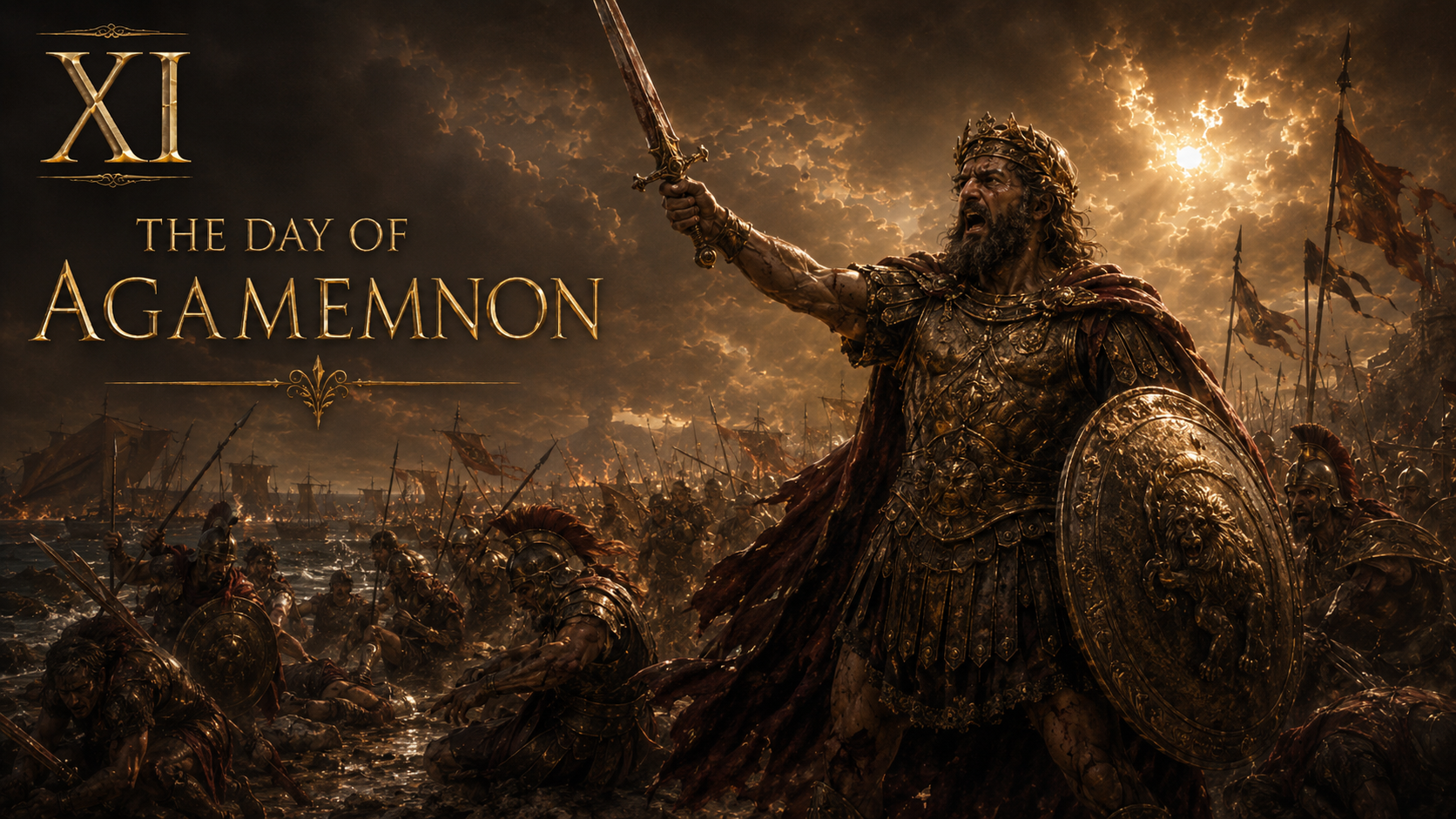
Book XI exposes the instability of heroic supremacy. Agamemnon’s brilliance dominates the morning, but one wound changes the movement of the whole army; strength passes from warrior to warrior until Patroclus is drawn toward the decision that will shape his fate.
Textual basis
Homer, Iliad, Book XI, lines 596–848: Achilles sends Patroclus to question Nestor, who urges action for the wounded Achaeans.
Reference edition used
Homer, Ilias. Griechisch–deutsch. Translated into German from the ancient Greek by Hans Rupé, 16th edition, Akademie Verlag, Berlin, 2013.
Deutsch
Dieses Schlusslied verortet das Schicksal im Mitgefühl statt im Ehrgeiz. Patroklos setzt sich in Bewegung, weil er Leid sieht; gerade deshalb wird die kommende Tragödie schmerzhafter: Sein tödlicher Weg öffnet sich durch Güte.
Der elfte Gesang zeigt die Unbeständigkeit heroischer Überlegenheit. Agamemnons Glanz beherrscht den Morgen, doch eine einzige Wunde verändert die Bewegung des ganzen Heeres; die Last wandert von Krieger zu Krieger, bis Patroklos in jene Entscheidung hineingezogen wird, die sein Schicksal bestimmen wird.
Textgrundlage
Homer, Ilias, 11. Gesang, Verse 596–848: Achilles Patroklos zu Nestor schickt, der zum Handeln für die verwundeten Achaier drängt.
Verwendete Referenzausgabe
Homer, Ilias. Griechisch–deutsch. Übertragen von Hans Rupé, 16. Auflage, Akademie Verlag, Berlin 2013.
Español
La canción final sitúa el destino en la compasión y no en la ambición. Patroclo empieza a moverse porque ve el sufrimiento; por eso la tragedia futura duele más: su camino mortal se abre mediante la bondad.
El canto XI muestra la inestabilidad de la supremacía heroica. El esplendor de Agamenón domina la mañana, pero una sola herida cambia el movimiento de todo el ejército; la carga pasa de guerrero en guerrero hasta que Patroclo es atraído hacia la decisión que marcará su destino.
Base textual
Homero, Ilíada, canto XI, versos 596–848: Aquiles envía a Patroclo ante Néstor, que lo impulsa a actuar por los aqueos heridos.
Edición de referencia utilizada
Homer, Ilias. Griechisch–deutsch. Traducción alemana del griego antiguo de Hans Rupé, 16.ª edición, Akademie Verlag, Berlín, 2013.
Français
Cette chanson finale place le destin dans la compassion plutôt que dans l’ambition. Patrocle commence à agir parce qu’il voit la souffrance ; la tragédie à venir en devient plus douloureuse : son chemin mortel s’ouvre par la bonté.
Le chant XI révèle l’instabilité de la suprématie héroïque. L’éclat d’Agamemnon domine le matin, mais une seule blessure change le mouvement de toute l’armée ; le poids passe d’un guerrier à l’autre jusqu’à ce que Patrocle soit entraîné vers la décision qui fixera son destin.
Base textuelle
Homère, Iliade, chant XI, vers 596–848 : Achille envoie Patrocle auprès de Nestor, qui l’exhorte à agir pour les Achéens blessés.
Édition de référence utilisée
Homer, Ilias. Griechisch–deutsch. Traduction allemande du grec ancien par Hans Rupé, 16e édition, Akademie Verlag, Berlin, 2013.