Lyrics
The man beside him had gone back
Lamed by the far-shot from the bow
And where two fighters held the field
One single shadow stood there now
No king in sight, no surging line
No strong support from shield to shield
Only the sound of closing feet
And one mind left upon the field
Odysseus left alone
With the dust at his throat and the bronze all around
Odysseus left alone
While the day pressed in and the line gave ground
No feast-song courage, no bright parade
Just a hard soul trying not to yield
Odysseus left alone
At the center of the breaking field
He saw the turn before it closed
He knew too much to call it fate
A man like him can read the drift
The narrowing ring, the pressure’s weight
Still he did not give the ground
Still he set his spear and stayed
For some are built to leave in time
And some refuse though they are flayed
Odysseus left alone
With the dust at his throat and the bronze all around
Odysseus left alone
While the day pressed in and the line gave ground
No feast-song courage, no bright parade
Just a hard soul trying not to yield
Odysseus left alone
At the center of the breaking field
They came at him from more than one side
Like men who smell a failing wall
Thinking one more push, one more cry
And the last defender has to fall
But he turned sharp where others broke
Not huge in rage, not blind with pride
He fought the way a trapped blade fights
With wit and fury bound inside
He struck one down and faced the next
He bought himself another breath
Not to be saved, not yet to win
But to make a cost of death
And every man who pressed too near
Learned that a cornered mind can kill
There is a kind of lonely strength
That grows when all the rest stand still
Odysseus left alone
With the dust at his throat and the bronze all around
Odysseus left alone
While the day pressed in and the line gave ground
No feast-song courage, no bright parade
Just a hard soul trying not to yield
Odysseus left alone
At the center of the breaking field
Then pain came in where flesh gives way
Not with thunder, not with sign
A spear found blood, a wound ran warm
And daylight blurred along the line
Still he would not drop at once
Still he answered blow for blow
As if the body could be argued with
As if the blood would not yet know
But even the sharpest will must bend
When too many hands and too much steel
Have made one body bear the weight
No living strength can wholly seal
So he gave the cry that warriors give
Not to beg, but to be heard
And through the roar of failing ground
Help came running toward his word
Odysseus left alone
But not forever in the dust
Odysseus left alone
Long enough to prove what stands in us
When the line breaks wide and the proud ride past
And no bright answer is revealed
Some men are known by how they stay
When they are left alone on the field
So tell it not as easy glory
Not as a shining hero’s frame
Tell it as one hard hour of iron
With danger closing on a name
For wisdom is no cloak from wounds
And cunning does not soften pain
Yet something in him would not yield
Though all the plain had turned against him
Odysseus left alone
With the dust at his throat and the bronze all around
Odysseus left alone
And the whole dark hour leaned on that ground
No feast-song courage, no bright parade
Just a hard soul trying not to yield
Odysseus left alone
At the center of the breaking field
Translations
Deutsch
Der Mann an seiner Seite war verwundet zurückgegangen. Wo zwei gekämpft hatten, stand nur noch ein Schatten: kein König, keine geschlossene Linie, nur näher kommende Schritte und ein wacher Geist.
[Refrain]
Odysseus allein, Staub im Hals und Bronze ringsum, während der Tag sich schließt und die Linie zurückweicht. Kein Festgesang, keine Parade – nur eine harte Seele, die nicht nachgeben will.
Er erkannte die Gefahr, bevor sich der Ring schloss, und wusste zu viel, um sie Schicksal zu nennen. Dennoch blieb er. Von mehreren Seiten kamen sie wie Männer, die eine fallende Mauer wittern. Er kämpfte nicht blind, sondern mit gebundener Klugheit und Wut; jeder gefallene Gegner kaufte einen weiteren Atemzug. Dann fand ein Speer sein Blut. Auch der schärfste Wille muss sich beugen, wenn ein Körper zu viel Stahl tragen soll. Er rief – nicht um zu betteln, sondern um gehört zu werden. Hilfe kam. Weisheit ist kein Mantel gegen Wunden, doch etwas in ihm weigerte sich zu weichen.
Español
El hombre a su lado se había retirado herido. Donde luchaban dos quedó una sola sombra: ningún rey, ninguna línea cerrada, solo pasos que se acercaban y una mente despierta.
[Estribillo]
Odiseo solo, con polvo en la garganta y bronce alrededor, mientras el día se cierra y la línea cede. Ningún canto de banquete ni desfile: solo un alma dura que se niega a rendirse.
Vio el peligro antes de que se cerrara el círculo y sabía demasiado para llamarlo destino. Aun así permaneció. Vinieron de varios lados como hombres que huelen un muro a punto de caer. No luchó ciego, sino con inteligencia y furia unidas; cada adversario abatido compró otro aliento. Después una lanza encontró su sangre. Hasta la voluntad más aguda debe doblarse cuando un cuerpo soporta demasiado acero. Gritó, no para suplicar, sino para ser oído. Llegó ayuda. La sabiduría no es un manto contra las heridas, pero algo en él se negó a ceder.
Français
L’homme à ses côtés s’était retiré, blessé. Là où deux combattaient, il ne resta qu’une ombre : aucun roi, aucune ligne solide, seulement des pas qui se rapprochaient et un esprit éveillé.
[Refrain]
Ulysse seul, la poussière dans la gorge et le bronze tout autour, tandis que le jour se referme et que la ligne cède. Aucun chant de banquet, aucune parade : seulement une âme dure refusant de plier.
Il vit le danger avant que le cercle ne se ferme et en savait trop pour l’appeler destin. Pourtant il resta. Ils vinrent de plusieurs côtés comme des hommes qui sentent un mur sur le point de tomber. Il ne combattit pas aveuglément, mais avec intelligence et fureur liées ; chaque adversaire abattu achetait un souffle. Puis une lance trouva son sang. Même la volonté la plus aiguisée doit plier lorsqu’un corps porte trop d’acier. Il cria, non pour supplier, mais pour être entendu. L’aide arriva. La sagesse n’est pas un manteau contre les blessures, mais quelque chose en lui refusa de céder.
Reflection
English
Odysseus’ intelligence does not remove him from bodily danger; it helps him inhabit that danger without surrendering to it. His cry for help is not weakness but the final intelligent act of survival.
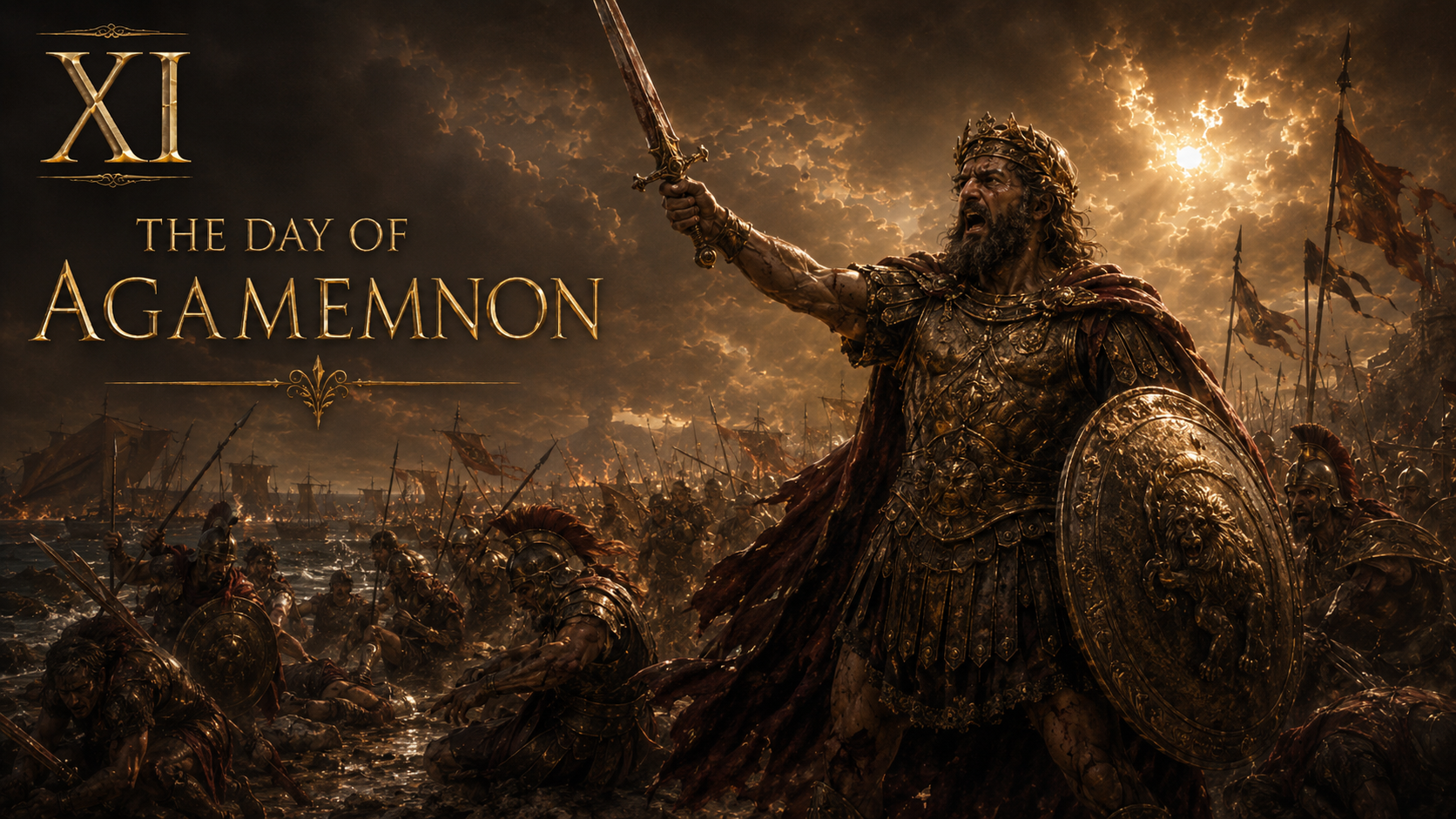
Book XI exposes the instability of heroic supremacy. Agamemnon’s brilliance dominates the morning, but one wound changes the movement of the whole army; strength passes from warrior to warrior until Patroclus is drawn toward the decision that will shape his fate.
Textual basis
Homer, Iliad, Book XI, lines 401–488: Odysseus is isolated, wounded, and nearly surrounded before help reaches him.
Reference edition used
Homer, Ilias. Griechisch–deutsch. Translated into German from the ancient Greek by Hans Rupé, 16th edition, Akademie Verlag, Berlin, 2013.
Deutsch
Odysseus’ Klugheit hebt die körperliche Gefahr nicht auf; sie hilft ihm, in ihr zu bestehen, ohne sich ihr auszuliefern. Sein Hilferuf ist keine Schwäche, sondern der letzte kluge Akt des Überlebens.
Der elfte Gesang zeigt die Unbeständigkeit heroischer Überlegenheit. Agamemnons Glanz beherrscht den Morgen, doch eine einzige Wunde verändert die Bewegung des ganzen Heeres; die Last wandert von Krieger zu Krieger, bis Patroklos in jene Entscheidung hineingezogen wird, die sein Schicksal bestimmen wird.
Textgrundlage
Homer, Ilias, 11. Gesang, Verse 401–488: Odysseus isoliert und verwundet beinahe eingeschlossen wird, bevor Hilfe eintrifft.
Verwendete Referenzausgabe
Homer, Ilias. Griechisch–deutsch. Übertragen von Hans Rupé, 16. Auflage, Akademie Verlag, Berlin 2013.
Español
La inteligencia de Odiseo no lo aparta del peligro físico; le permite habitarlo sin rendirse. Su llamada de auxilio no es debilidad, sino el último acto inteligente de supervivencia.
El canto XI muestra la inestabilidad de la supremacía heroica. El esplendor de Agamenón domina la mañana, pero una sola herida cambia el movimiento de todo el ejército; la carga pasa de guerrero en guerrero hasta que Patroclo es atraído hacia la decisión que marcará su destino.
Base textual
Homero, Ilíada, canto XI, versos 401–488: Odiseo queda aislado y herido, casi rodeado, antes de recibir ayuda.
Edición de referencia utilizada
Homer, Ilias. Griechisch–deutsch. Traducción alemana del griego antiguo de Hans Rupé, 16.ª edición, Akademie Verlag, Berlín, 2013.
Français
L’intelligence d’Ulysse ne le soustrait pas au danger physique ; elle lui permet d’y demeurer sans s’y abandonner. Son appel au secours n’est pas une faiblesse, mais le dernier acte intelligent de survie.
Le chant XI révèle l’instabilité de la suprématie héroïque. L’éclat d’Agamemnon domine le matin, mais une seule blessure change le mouvement de toute l’armée ; le poids passe d’un guerrier à l’autre jusqu’à ce que Patrocle soit entraîné vers la décision qui fixera son destin.
Base textuelle
Homère, Iliade, chant XI, vers 401–488 : Ulysse, isolé et blessé, manque d’être encerclé avant que l’aide ne lui parvienne.
Édition de référence utilisée
Homer, Ilias. Griechisch–deutsch. Traduction allemande du grec ancien par Hans Rupé, 16e édition, Akademie Verlag, Berlin, 2013.