Lyrics
They had held where others wavered
They had stood and bought the day
Bronze and breath against the breaking
Keeping fear itself at bay
Then from farther than a spear can answer
From the edge no shield can read
Came a feather through the uproar
And a different kind of deed
Paris’ arrow
Thin and sudden in the light
Paris’ arrow
Finds the seam, not face to face in fight
Not the crash of shield on shield
Not the oath that warriors know
Just a hard and hidden answer
In the flight of Paris’ arrow
Diomedes drove like winter iron
Still not emptied, still not done
Though the field had stripped its heroes
He was holding into sun
Then the shaft bit through the moving
Through the dust and through the stride
Found the foot that kept him standing
Turned his fury to the side
Paris’ arrow
Thin and sudden in the light
Paris’ arrow
Finds the seam, not face to face in fight
Not the crash of shield on shield
Not the oath that warriors know
Just a hard and hidden answer
In the flight of Paris’ arrow
Pain can humble even courage
Not by honor, not by shame
But by entering where motion lives
And changing how a man can claim
All his weight against the battle
All his will against the press
One small wound can tilt the balance
One small wound can make it less
He did not fall in ruined terror
Did not beg the field to spare
He turned and gave his bitter answer
To the hand that struck from elsewhere
But blood was real and ground was distant
And the fight was not his now
So the line lost more than muscle
It lost another iron vow
Paris’ arrow
Thin and sudden in the light
Paris’ arrow
Leaves its wound and leaves the fight
Not the glory sung at feasts
Not the clean and open blow
But the war is changed all the same
By the flight of Paris’ arrow
And those who watched it felt it quickly
How the day kept shedding names
First the king and now another
Drawn away from dust and flame
So it happens in long battles
Not by thunder every time
Sometimes fate prefers a whisper
With a feathered edge and spine
Let the brave still praise the spearpoint
Let the strong still test the shield
Yet never mock the distant weapon
That can thin the hardest field
For the hour was turning darker
And the plain had learned to know
How a whole line starts to weaken
With the flight of one more bow
Paris’ arrow
Thin and sudden in the light
Paris’ arrow
Cuts the thread, then leaves the sight
And the men who still remain
Feel the silence under noise
When the day is being broken
By a wound that makes the choice
Translations
Deutsch
Sie hatten standgehalten, wo andere schwankten, und mit Bronze und Atem den Tag erkauft. Dann kam von weiter her, als ein Speer antworten konnte, eine Feder durch den Lärm – eine andere Art der Tat.
[Refrain]
Der Pfeil des Paris, dünn und plötzlich im Licht, findet die Naht statt des offenen Kampfes. Kein Schild prallt auf Schild; nur eine harte, verborgene Antwort im Flug des Pfeils.
Diomedes kämpfte noch wie Wintereisen, bis der Schaft durch Staub und Bewegung drang und den Fuß traf, der ihn trug. Schmerz demütigt auch den Mut, nicht durch Ehre oder Schande, sondern indem er dort eindringt, wo Bewegung lebt. Er fiel nicht in Panik, sondern gab eine bittere Antwort. Doch Blut und Entfernung waren wirklich; nun war es nicht mehr sein Kampf. Die Griechen verloren nicht nur Kraft, sondern ein weiteres Gelübde aus Eisen. Lange Schlachten wenden sich nicht immer durch Donner – manchmal flüstert das Schicksal mit Feder, Spitze und Sehne.
Español
Habían resistido donde otros vacilaron y habían comprado el día con bronce y aliento. Entonces, desde más lejos de lo que una lanza podía responder, llegó una pluma entre el estruendo: otra clase de acción.
[Estribillo]
La flecha de Paris, fina y repentina en la luz, encuentra la juntura en vez del combate abierto. No hay choque de escudos; solo una respuesta dura y escondida en el vuelo de la flecha.
Diomedes seguía luchando como hierro de invierno hasta que el asta atravesó polvo y movimiento y encontró el pie que lo sostenía. El dolor humilla incluso al valor, no por honor o vergüenza, sino entrando donde vive el movimiento. No cayó aterrorizado, sino que respondió con amargura. Pero la sangre y la distancia eran reales; la lucha ya no era suya. Los griegos no perdieron solo fuerza, sino otro juramento de hierro. Las batallas largas no cambian siempre con truenos: a veces el destino susurra con pluma, punta y cuerda.
Français
Ils avaient tenu là où d’autres vacillaient et acheté le jour avec le bronze et le souffle. Puis, de plus loin qu’une lance ne pouvait répondre, une plume traversa le tumulte : une autre sorte d’action.
[Refrain]
La flèche de Pâris, fine et soudaine dans la lumière, trouve la jointure au lieu du combat face à face. Aucun bouclier ne heurte un autre ; seulement une réponse dure et cachée dans le vol de la flèche.
Diomède combattait encore comme un fer d’hiver lorsque le trait traversa poussière et mouvement pour trouver le pied qui le portait. La douleur humilie même le courage, non par honneur ou honte, mais en entrant là où vit le mouvement. Il ne tomba pas de terreur et répondit avec amertume. Mais le sang et la distance étaient réels ; le combat n’était plus le sien. Les Grecs perdirent plus qu’une force : un autre serment de fer. Les longues batailles ne tournent pas toujours dans le tonnerre ; parfois le destin murmure avec plume, pointe et corde.
Reflection
English
The arrow exposes the gap between heroic ideals and actual warfare. Distance may deny the ritual of face-to-face combat, but its consequences are no less decisive.
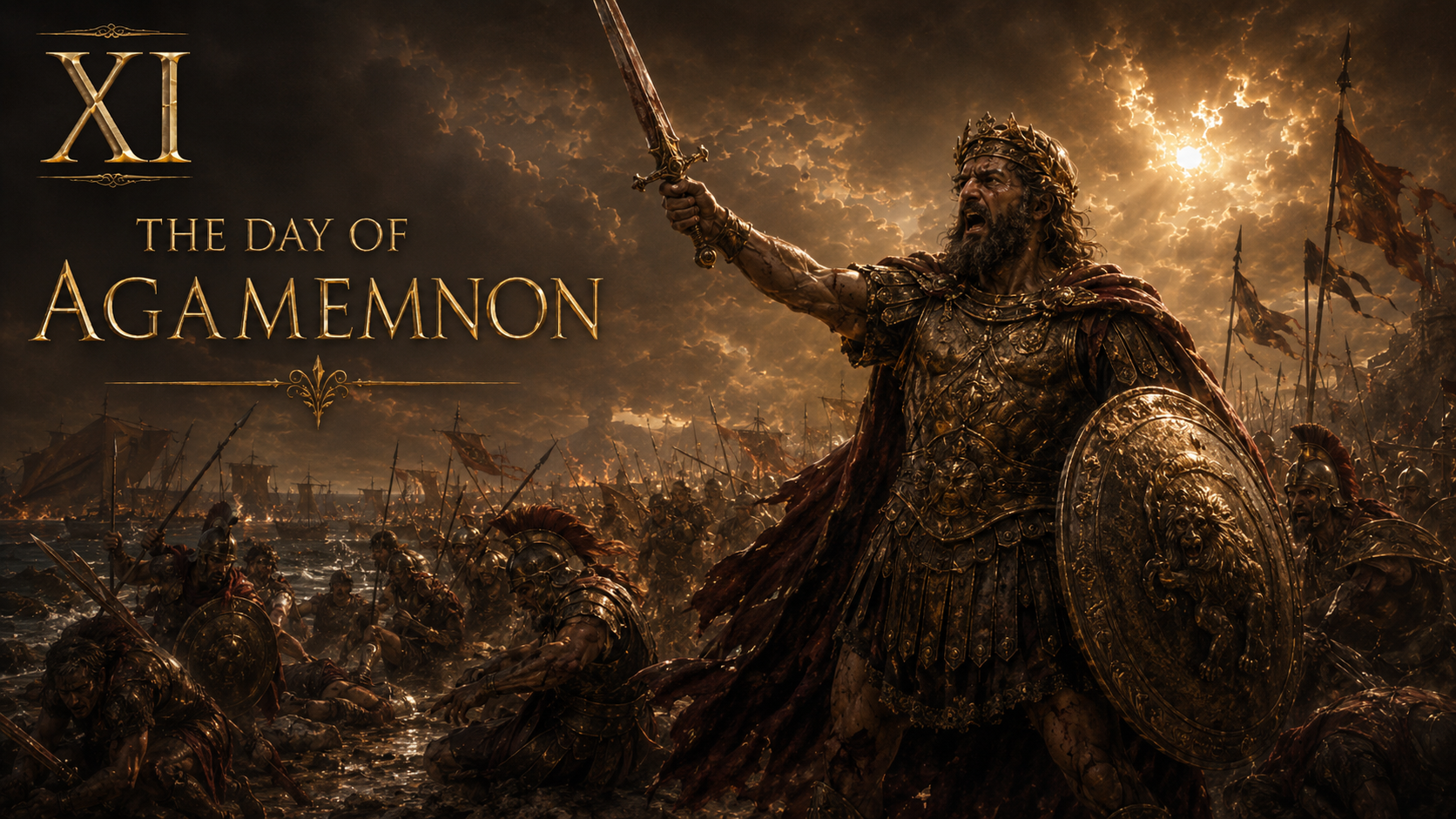
Book XI exposes the instability of heroic supremacy. Agamemnon’s brilliance dominates the morning, but one wound changes the movement of the whole army; strength passes from warrior to warrior until Patroclus is drawn toward the decision that will shape his fate.
Textual basis
Homer, Iliad, Book XI, lines 369–400: Paris wounds Diomedes with an arrow and forces him to leave the fighting.
Reference edition used
Homer, Ilias. Griechisch–deutsch. Translated into German from the ancient Greek by Hans Rupé, 16th edition, Akademie Verlag, Berlin, 2013.
Deutsch
Der Pfeil legt die Lücke zwischen heroischem Ideal und wirklichem Krieg offen. Die Entfernung verweigert das Ritual des offenen Zweikampfs, doch ihre Folgen sind nicht weniger entscheidend.
Der elfte Gesang zeigt die Unbeständigkeit heroischer Überlegenheit. Agamemnons Glanz beherrscht den Morgen, doch eine einzige Wunde verändert die Bewegung des ganzen Heeres; die Last wandert von Krieger zu Krieger, bis Patroklos in jene Entscheidung hineingezogen wird, die sein Schicksal bestimmen wird.
Textgrundlage
Homer, Ilias, 11. Gesang, Verse 369–400: Paris Diomedes mit einem Pfeil verwundet und ihn zum Verlassen des Kampfes zwingt.
Verwendete Referenzausgabe
Homer, Ilias. Griechisch–deutsch. Übertragen von Hans Rupé, 16. Auflage, Akademie Verlag, Berlin 2013.
Español
La flecha revela la distancia entre el ideal heroico y la guerra real. La lejanía niega el ritual del combate cara a cara, pero sus consecuencias no son menos decisivas.
El canto XI muestra la inestabilidad de la supremacía heroica. El esplendor de Agamenón domina la mañana, pero una sola herida cambia el movimiento de todo el ejército; la carga pasa de guerrero en guerrero hasta que Patroclo es atraído hacia la decisión que marcará su destino.
Base textual
Homero, Ilíada, canto XI, versos 369–400: Paris hiere a Diomedes con una flecha y lo obliga a abandonar el combate.
Edición de referencia utilizada
Homer, Ilias. Griechisch–deutsch. Traducción alemana del griego antiguo de Hans Rupé, 16.ª edición, Akademie Verlag, Berlín, 2013.
Français
La flèche révèle l’écart entre l’idéal héroïque et la guerre réelle. La distance refuse le rituel du face-à-face, mais ses conséquences n’en sont pas moins décisives.
Le chant XI révèle l’instabilité de la suprématie héroïque. L’éclat d’Agamemnon domine le matin, mais une seule blessure change le mouvement de toute l’armée ; le poids passe d’un guerrier à l’autre jusqu’à ce que Patrocle soit entraîné vers la décision qui fixera son destin.
Base textuelle
Homère, Iliade, chant XI, vers 369–400 : Pâris blesse Diomède d’une flèche et l’oblige à quitter le combat.
Édition de référence utilisée
Homer, Ilias. Griechisch–deutsch. Traduction allemande du grec ancien par Hans Rupé, 16e édition, Akademie Verlag, Berlin, 2013.