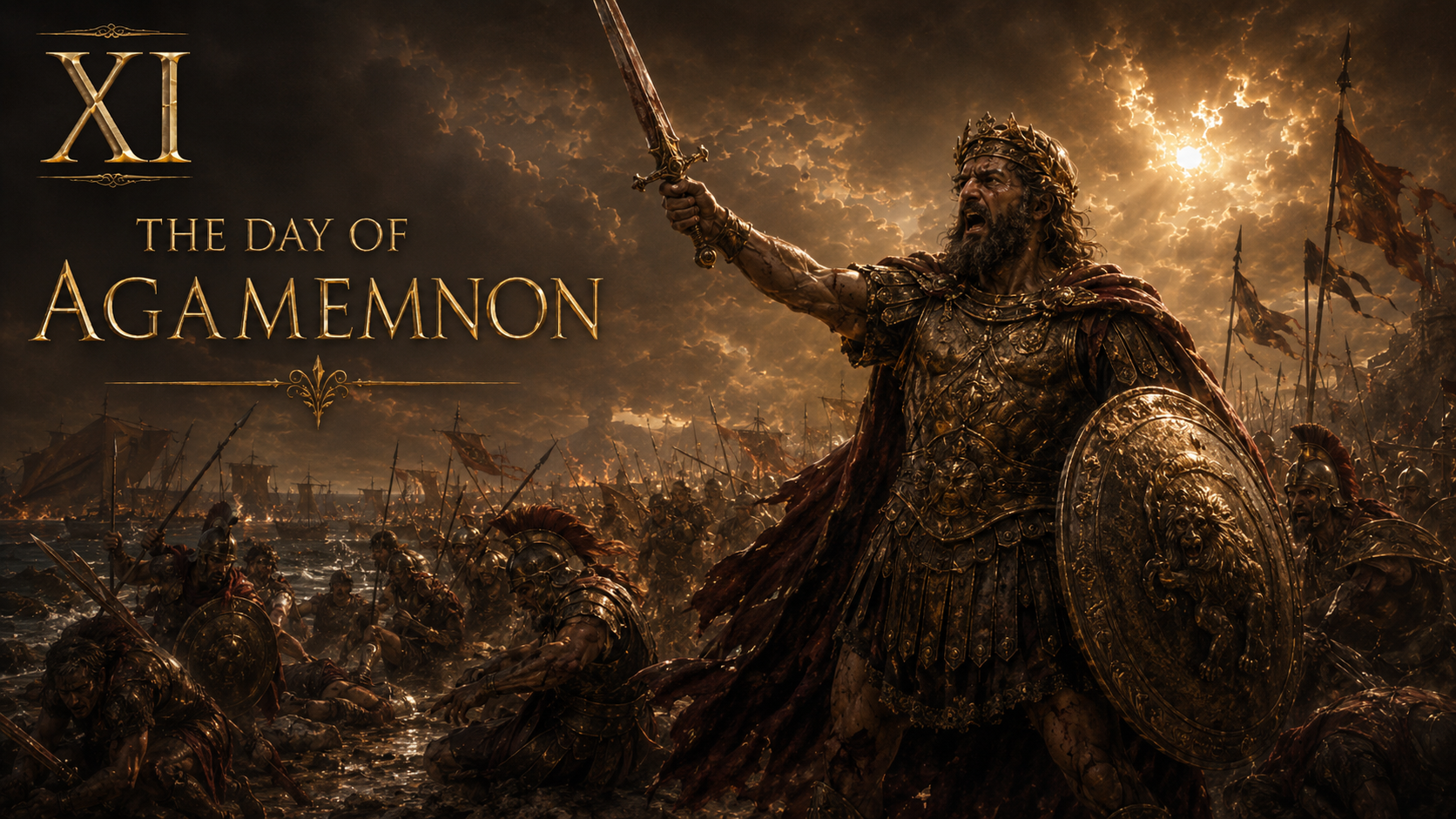
Lyrics
He had driven hard through shield and cry
With daylight burning on his frame
Still red with triumph, still upright
Still answering every blow with flame
Then grief came back with a brother’s hand
Not loud, not grand, not crowned with fame
A sudden thrust through bronze and flesh
And war itself spoke out his name
When the king bleeds
Even iron learns to sway
When the king bleeds
The field forgets the shape of day
Gold can flash and plumes can rise
But one dark thread can change the scene
When the king bleeds
All the shouting turns and leans
At first he stood and fought it down
As proud men do before the line
He would not yield the watching ground
He would not bow before a sign
So still he cut and still he roared
Still sent his answer through the press
But blood runs warm and truth runs slow
And pain keeps widening underneath the chest
When the king bleeds
Even iron learns to sway
When the king bleeds
The field forgets the shape of day
Gold can flash and plumes can rise
But one dark thread can change the scene
When the king bleeds
All the shouting turns and leans
Down his legs the brightness ran
A darker red than dawn had shown
No forge can seal a mortal seam
No throne can make the body stone
The hand still gripped, the mouth still gave
Command enough to hold the air
But now each step he forced from himself
Was dragged through fire and hidden fear
And those who saw it felt it first
Before a word was ever cast
How quickly courage changes weight
When the tallest figure does not last
The Trojans saw, and lifted breath
The Achaeans saw, and felt it freeze
For battle shifts on little signs
A cry, a turn, a pair of knees
When the king bleeds
Even iron learns to sway
When the king bleeds
The field forgets the shape of day
Gold can flash and plumes can rise
But one dark thread can change the scene
When the king bleeds
All the shouting turns and leans
Then to the chariot, hard and grim
He gave the ground he would not name
Not broken yet, but forced to yield
Not emptied yet, but not the same
He called to those still locked in dust
Hold the line and do not bend
But the sound of leaving carries far
And every heart can hear that end
So let them praise the bronze he wore
And all the men he drove before him
But remember too the wounded hour
When power stood and blood tore through him
For kings may shine like hammered suns
And stride as if the day were theirs
Yet one red wound before the ranks
Can unmake more than metal bears
When the king bleeds
The plain remembers what is true
That no man walks above the blade
However bright the gold may do
When the king bleeds
The tide begins to turn unseen
And all the war that crowned his strength
Starts slipping through the wound between
Translations
Deutsch
Agamemnon hatte sich durch Schilde und Schreie getrieben, noch aufrecht und vom Triumph gerötet. Dann kam die Trauer in der Hand eines Bruders zurück: ein plötzlicher Stoß durch Bronze und Fleisch, und der Krieg sprach den Namen des Königs.
[Refrain]
Wenn der König blutet, lernt selbst Eisen zu schwanken. Gold kann blitzen und Helmbüsche können steigen, doch ein dunkler Faden verändert das ganze Bild; alles Rufen dreht und neigt sich.
Zuerst kämpfte er den Schmerz nieder und wollte vor den Reihen nicht nachgeben. Doch Blut ist warm, Wahrheit langsam, und die Wunde weitete sich. Kein Schmied kann eine sterbliche Naht versiegeln, kein Thron den Körper in Stein verwandeln. Die Trojaner sahen es und fassten Mut; die Achaier sahen es und erstarrten. Schließlich musste er zum Wagen zurück. Er rief den Zurückbleibenden zu, die Linie zu halten, doch auch das Geräusch des Fortgehens trägt weit. Ein einziger roter Riss kann mehr zerstören, als Metall zu tragen vermag.
Español
Agamenón había avanzado entre escudos y gritos, todavía erguido y enrojecido por el triunfo. Entonces el dolor regresó en la mano de un hermano: una embestida repentina atravesó bronce y carne, y la guerra pronunció el nombre del rey.
[Estribillo]
Cuando sangra el rey, hasta el hierro aprende a vacilar. El oro puede brillar y los penachos alzarse, pero un hilo oscuro cambia toda la escena; todos los gritos se vuelven hacia él.
Al principio dominó el dolor y se negó a ceder ante las filas. Pero la sangre corre caliente, la verdad llega despacio y la herida se ensancha. Ninguna fragua sella una costura mortal y ningún trono vuelve piedra el cuerpo. Los troyanos lo vieron y cobraron aliento; los aqueos lo vieron y se helaron. Al final tuvo que volver al carro. Ordenó a quienes quedaban que mantuvieran la línea, pero el sonido de una retirada llega lejos. Una sola herida roja puede deshacer más de lo que soporta el metal.
Français
Agamemnon avait traversé boucliers et cris, toujours debout, encore rouge de triomphe. Puis le chagrin revint dans la main d’un frère : un coup soudain passa le bronze et la chair, et la guerre prononça le nom du roi.
[Refrain]
Quand le roi saigne, même le fer apprend à vaciller. L’or peut briller et les panaches se lever, mais un fil sombre change toute la scène ; tous les cris se tournent vers lui.
D’abord, il étouffa la douleur et refusa de céder devant les rangs. Mais le sang est chaud, la vérité lente et la blessure s’élargit. Aucune forge ne scelle une couture mortelle, aucun trône ne change le corps en pierre. Les Troyens le virent et reprirent souffle ; les Achéens le virent et se figèrent. Enfin, il dut gagner son char. Il ordonna de tenir la ligne, mais le bruit d’un départ porte loin. Une seule plaie rouge peut défaire plus que le métal ne peut soutenir.
Reflection
English
The wound is military and symbolic at once. When the most visible man is forced away, both armies read his body as a message, and the balance begins to change before any command is spoken.
Book XI exposes the instability of heroic supremacy. Agamemnon’s brilliance dominates the morning, but one wound changes the movement of the whole army; strength passes from warrior to warrior until Patroclus is drawn toward the decision that will shape his fate.
Textual basis
Homer, Iliad, Book XI, lines 248–284: Coon wounds Agamemnon, whose pain finally forces him from the field.
Reference edition used
Homer, Ilias. Griechisch–deutsch. Translated into German from the ancient Greek by Hans Rupé, 16th edition, Akademie Verlag, Berlin, 2013.
Deutsch
Die Wunde ist militärisch und symbolisch zugleich. Als der sichtbarste Mann das Feld verlassen muss, lesen beide Heere seinen Körper wie eine Botschaft, und das Gleichgewicht verschiebt sich noch vor jedem Befehl.
Der elfte Gesang zeigt die Unbeständigkeit heroischer Überlegenheit. Agamemnons Glanz beherrscht den Morgen, doch eine einzige Wunde verändert die Bewegung des ganzen Heeres; die Last wandert von Krieger zu Krieger, bis Patroklos in jene Entscheidung hineingezogen wird, die sein Schicksal bestimmen wird.
Textgrundlage
Homer, Ilias, 11. Gesang, Verse 248–284: Koon Agamemnon verwundet und der Schmerz ihn schließlich vom Schlachtfeld zwingt.
Verwendete Referenzausgabe
Homer, Ilias. Griechisch–deutsch. Übertragen von Hans Rupé, 16. Auflage, Akademie Verlag, Berlin 2013.
Español
La herida es militar y simbólica a la vez. Cuando el hombre más visible debe abandonar el campo, ambos ejércitos leen su cuerpo como un mensaje y el equilibrio empieza a cambiar antes de que se pronuncie una orden.
El canto XI muestra la inestabilidad de la supremacía heroica. El esplendor de Agamenón domina la mañana, pero una sola herida cambia el movimiento de todo el ejército; la carga pasa de guerrero en guerrero hasta que Patroclo es atraído hacia la decisión que marcará su destino.
Base textual
Homero, Ilíada, canto XI, versos 248–284: Coón hiere a Agamenón y el dolor termina por obligarlo a abandonar el campo.
Edición de referencia utilizada
Homer, Ilias. Griechisch–deutsch. Traducción alemana del griego antiguo de Hans Rupé, 16.ª edición, Akademie Verlag, Berlín, 2013.
Français
La blessure est à la fois militaire et symbolique. Lorsque l’homme le plus visible doit quitter le champ, les deux armées lisent son corps comme un message et l’équilibre commence à changer avant tout ordre.
Le chant XI révèle l’instabilité de la suprématie héroïque. L’éclat d’Agamemnon domine le matin, mais une seule blessure change le mouvement de toute l’armée ; le poids passe d’un guerrier à l’autre jusqu’à ce que Patrocle soit entraîné vers la décision qui fixera son destin.
Base textuelle
Homère, Iliade, chant XI, vers 248–284 : Coon blesse Agamemnon et la douleur finit par le contraindre à quitter le champ.
Édition de référence utilisée
Homer, Ilias. Griechisch–deutsch. Traduction allemande du grec ancien par Hans Rupé, 16e édition, Akademie Verlag, Berlin, 2013.