Lyrics
Before the sun had found the ridge
A hard wind crossed the sleeping rows
No bird would sing above the ships
Only leather, bronze, and throats
A whisper moved from shield to shield
Not prayer, not comfort, not command
Something older than the marching drums
Had laid its hand upon the land
Strife at dawn, strife at dawn
She walked ahead and pulled men on
Bronze in the breath of the waking plain
And morning learned the taste of pain
Strife at dawn, strife at dawn
No heart stood still, no night stayed long
The day rose red, the spearpoints shone
And mercy stepped away alone
Through ash-gray light the runners came
With lifted arms and sharpened breath
Wake the drivers, bind the straps
Call the living toward their death
Helmets caught the unborn day
Like frozen sparks before the flame
Then the first cry split the dark
And every man forgot his name
Strife at dawn, strife at dawn
She walked ahead and pulled men on
Bronze in the breath of the waking plain
And morning learned the taste of pain
Strife at dawn, strife at dawn
No heart stood still, no night stayed long
The day rose red, the spearpoints shone
And mercy stepped away alone
Dust was still a moment more
Then dust became a second sky
Boot and axle, hide and horn
All were driven to collide
Men who carried dreams of home
Fell before the sun stood high
Glory never speaks in words
It strikes, then leaves the throat run dry
Who calls this light a blessing now
When daylight only shows the blade?
The sun climbed up without remorse
And looked on all that men had made
Still they ran where honor pointed
Still they struck for shame and pride
And somewhere fate kept counting calmly
With no need at all to hide
Strife at dawn, strife at dawn
She drove them where the light moved on
Bronze in the breath of the broken plain
And morning wore a crown of pain
Strife at dawn, strife at dawn
The first blow never falls alone
The day began with shouted names
And ended sounding just the same
Before the noon could claim its due
The earth already knew
Translations
Deutsch
[Strophe 1]
Bevor die Sonne den Höhenzug fand, strich ein harter Wind durch die schlafenden Reihen. Kein Vogel sang über den Schiffen; nur Leder, Bronze und Kehlen waren zu hören. Ein Flüstern zog von Schild zu Schild – kein Gebet, kein Trost, kein Befehl. Etwas Älteres als die Trommeln hatte seine Hand auf das Land gelegt.
[Refrain]
Streit im Morgenrot. Sie ging voraus und zog die Männer mit sich. Bronze lag im Atem der erwachenden Ebene, und der Morgen lernte den Geschmack des Schmerzes. Kein Herz blieb still; die Speerspitzen glänzten, und die Barmherzigkeit trat allein beiseite.
[Strophen 2–4]
Boten riefen die Wagenlenker, Helme fingen das ungeborene Licht, und der erste Schrei zerriss die Dunkelheit. Staub wurde zu einem zweiten Himmel; Männer mit Träumen von der Heimat fielen, bevor die Sonne hoch stand. Das Tageslicht zeigte nur die Klinge. Ehre, Scham und Stolz trieben sie weiter, während das Schicksal ruhig zählte. Der erste Schlag bleibt niemals allein. Noch vor Mittag kannte die Erde bereits den Preis.
Español
[Estrofa 1]
Antes de que el sol encontrara la cresta, un viento duro cruzó las filas dormidas. Ningún pájaro cantaba sobre las naves; solo cuero, bronce y gargantas. Un susurro pasó de escudo en escudo: ni plegaria, ni consuelo, ni orden. Algo más antiguo que los tambores había puesto la mano sobre la tierra.
[Estribillo]
Discordia al amanecer. Ella caminó delante y arrastró a los hombres. Había bronce en el aliento de la llanura, y la mañana aprendió el sabor del dolor. Ningún corazón quedó quieto; brillaron las lanzas y la misericordia se apartó sola.
[Estrofas 2–4]
Los mensajeros despertaron a los aurigas, los cascos atraparon la luz aún no nacida y el primer grito partió la oscuridad. El polvo se convirtió en un segundo cielo; hombres que soñaban con volver a casa cayeron antes de que el sol estuviera alto. La luz del día solo mostró la hoja. Honor, vergüenza y orgullo los empujaron mientras el destino contaba con calma. El primer golpe nunca cae solo. Antes del mediodía, la tierra ya conocía el precio.
Français
[Couplet 1]
Avant que le soleil n’atteigne la crête, un vent dur traversa les rangs endormis. Aucun oiseau ne chantait au-dessus des navires ; seulement le cuir, le bronze et les gorges. Un murmure passa de bouclier en bouclier : ni prière, ni réconfort, ni ordre. Quelque chose de plus ancien que les tambours avait posé sa main sur la terre.
[Refrain]
Discorde à l’aube. Elle marchait devant et entraînait les hommes. Le bronze emplissait le souffle de la plaine, et le matin apprit le goût de la douleur. Aucun cœur ne resta immobile ; les pointes brillèrent et la pitié s’écarta seule.
[Couplets 2–4]
Les messagers réveillèrent les conducteurs, les casques saisirent la lumière à naître et le premier cri fendit l’obscurité. La poussière devint un second ciel ; des hommes rêvant du retour tombèrent avant que le soleil fût haut. Le jour ne montrait que la lame. Honneur, honte et orgueil les poussaient tandis que le destin comptait calmement. Le premier coup ne tombe jamais seul. Avant midi, la terre connaissait déjà le prix.
Reflection
English
The song turns dawn, usually a sign of renewal, into the hour when violence begins again. Strife is not merely an emotion here: she becomes a force that makes ordinary men forget their names and enter the machinery of war.
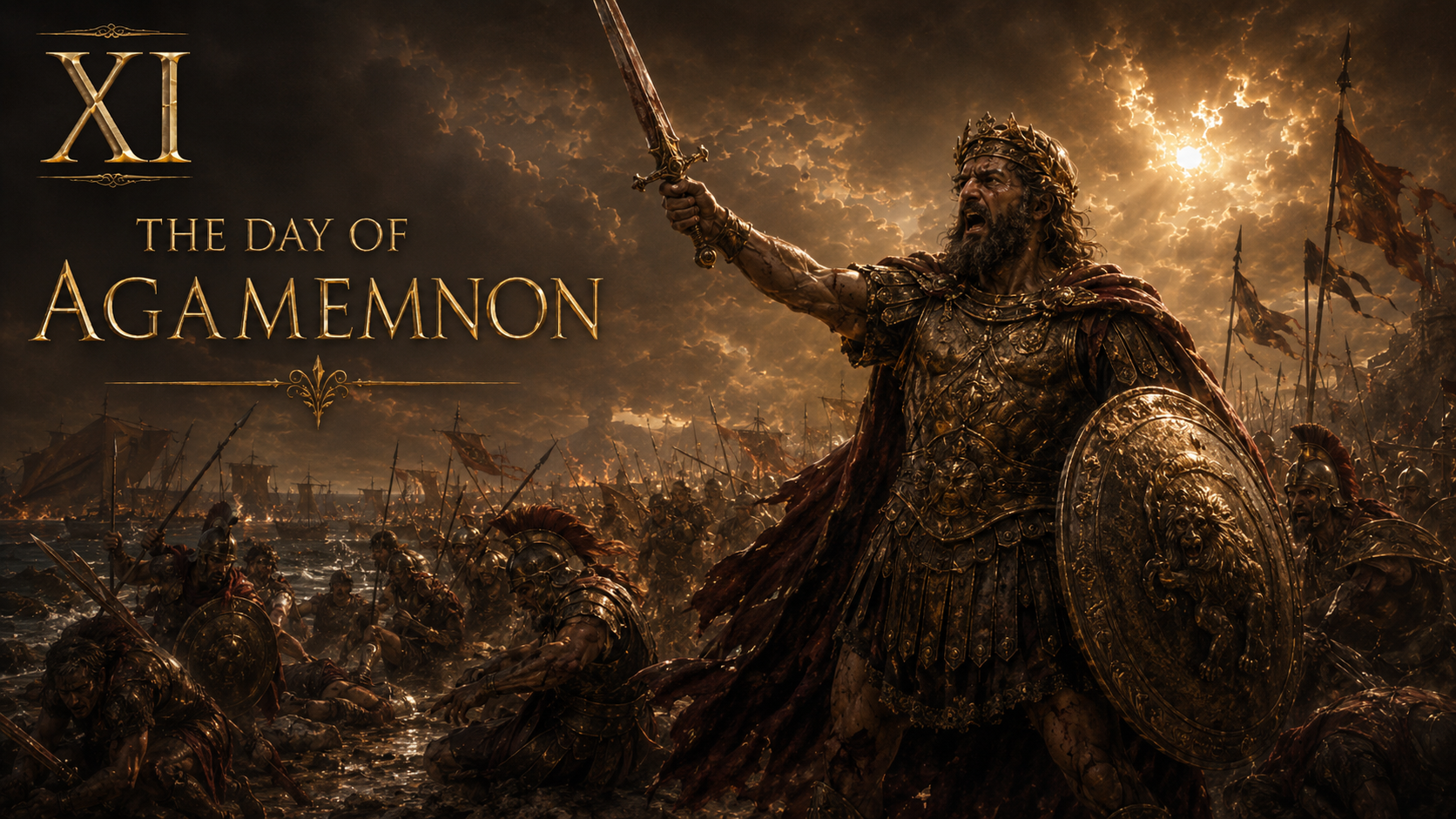
Book XI exposes the instability of heroic supremacy. Agamemnon’s brilliance dominates the morning, but one wound changes the movement of the whole army; strength passes from warrior to warrior until Patroclus is drawn toward the decision that will shape his fate.
Textual basis
Homer, Iliad, Book XI, lines 1–55: Zeus sends Strife at dawn, and Agamemnon arms for battle.
Reference edition used
Homer, Ilias. Griechisch–deutsch. Translated into German from the ancient Greek by Hans Rupé, 16th edition, Akademie Verlag, Berlin, 2013.
Deutsch
Das Lied verwandelt die Morgenröte, sonst ein Zeichen des Neubeginns, in die Stunde, in der die Gewalt erneut beginnt. Der Streit ist hier nicht nur ein Gefühl, sondern eine Macht, die gewöhnliche Männer ihre Namen vergessen und in die Maschinerie des Krieges eintreten lässt.
Der elfte Gesang zeigt die Unbeständigkeit heroischer Überlegenheit. Agamemnons Glanz beherrscht den Morgen, doch eine einzige Wunde verändert die Bewegung des ganzen Heeres; die Last wandert von Krieger zu Krieger, bis Patroklos in jene Entscheidung hineingezogen wird, die sein Schicksal bestimmen wird.
Textgrundlage
Homer, Ilias, 11. Gesang, Verse 1–55: Zeus bei Tagesanbruch Eris sendet und Agamemnon sich zur Schlacht rüstet.
Verwendete Referenzausgabe
Homer, Ilias. Griechisch–deutsch. Übertragen von Hans Rupé, 16. Auflage, Akademie Verlag, Berlin 2013.
Español
La canción convierte el amanecer, normalmente signo de renovación, en la hora en que la violencia comienza de nuevo. La discordia no es solo una emoción: se vuelve una fuerza que hace olvidar a hombres corrientes sus nombres y los introduce en la maquinaria de la guerra.
El canto XI muestra la inestabilidad de la supremacía heroica. El esplendor de Agamenón domina la mañana, pero una sola herida cambia el movimiento de todo el ejército; la carga pasa de guerrero en guerrero hasta que Patroclo es atraído hacia la decisión que marcará su destino.
Base textual
Homero, Ilíada, canto XI, versos 1–55: Zeus envía a la Discordia al amanecer y Agamenón se arma para la batalla.
Edición de referencia utilizada
Homer, Ilias. Griechisch–deutsch. Traducción alemana del griego antiguo de Hans Rupé, 16.ª edición, Akademie Verlag, Berlín, 2013.
Français
La chanson transforme l’aube, habituellement signe de renouveau, en l’heure où la violence recommence. La discorde n’est pas seulement une émotion : elle devient une force qui fait oublier leur nom aux hommes ordinaires et les fait entrer dans la machine de guerre.
Le chant XI révèle l’instabilité de la suprématie héroïque. L’éclat d’Agamemnon domine le matin, mais une seule blessure change le mouvement de toute l’armée ; le poids passe d’un guerrier à l’autre jusqu’à ce que Patrocle soit entraîné vers la décision qui fixera son destin.
Base textuelle
Homère, Iliade, chant XI, vers 1–55 : Zeus envoie Éris à l’aube et Agamemnon s’arme pour la bataille.
Édition de référence utilisée
Homer, Ilias. Griechisch–deutsch. Traduction allemande du grec ancien par Hans Rupé, 16e édition, Akademie Verlag, Berlin, 2013.