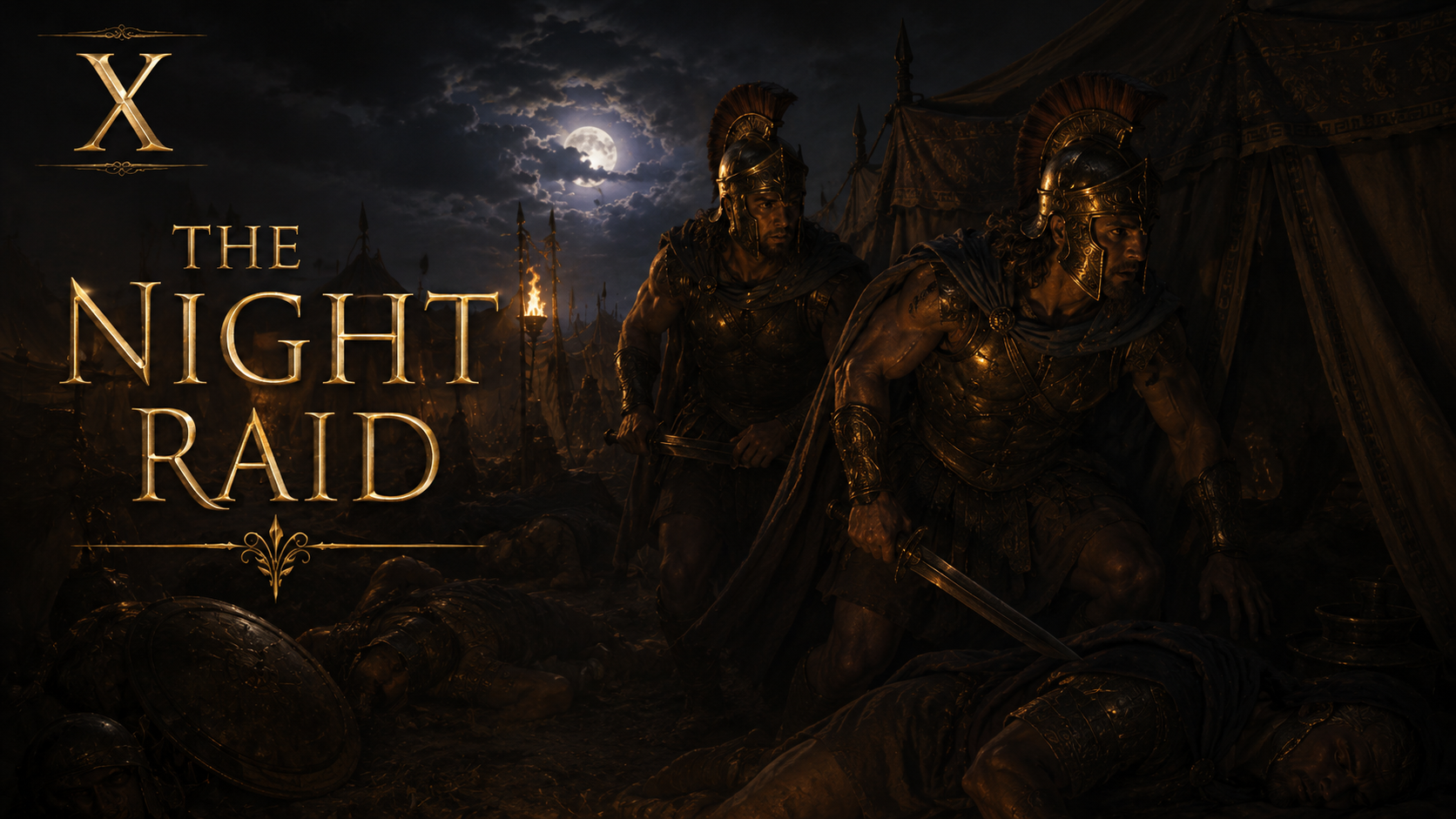
Lyrics
They crossed the line
where the watchfires died
with the black sea breathing
at their side
No farewell song
no lifted spear
only the night
and what men fear
One had a blade
that longed to burn
one had a mind
that knew each turn
And over both
through the moonlit sand
a grey-eyed silence
held its hand
Two shadows under Athena
moving where no banners fly
Two shadows under Athena
with the dark in every eye
No drums of glory
no golden cry
only the breath
of men who might die
Two shadows under Athena
two shadows under the sky
Odysseus moved
like thought made skin
he heard the dark
and listened in
Diomedes walked
with fire held low
a storm that knew
where not to show
They did not boast
they did not pray
they let the silence
lead the way
For night does not love
the loud or proud
it hides the quiet
beneath its shroud
Two shadows under Athena
moving where no banners fly
Two shadows under Athena
with the dark in every eye
No drums of glory
no golden cry
only the breath
of men who might die
Two shadows under Athena
two shadows under the sky
The plain was wide
the grass was thin
the Trojan fires
burned deep within
Each little flame
across the field
was one more secret
not yet revealed
A horse would stamp
a leather creak
a sleeping soldier
turn and speak
And every sound
could cut the thread
between the living
and the dead
Two shadows under Athena
moving where no banners fly
Two shadows under Athena
with the dark in every eye
No drums of glory
no golden cry
only the breath
of men who might die
Two shadows under Athena
two shadows under the sky
Then from the dark
a sign was cast
a bird of night
went sweeping past
They could not see
its wings in flight
but heard its cry
across the night
And Odysseus smiled
without a sound
as if old wisdom
touched the ground
For gods may speak
where men are blind
in broken air
and sharpened mind
Two shadows under Athena
moving where no banners fly
Two shadows under Athena
with the dark in every eye
No drums of glory
no golden cry
only the breath
of men who might die
Two shadows under Athena
two shadows under the sky
They were not clean
they were not bright
they were the work
that comes with night
The kind of work
no lyre can save
when courage walks
beside the grave
For every hero
carves a name
but not all roads
are roads of fame
Some roads are mud
and breath and bone
where even victory
walks alone
Two shadows under Athena
moving where no banners fly
Two shadows under Athena
with the dark in every eye
No drums of glory
no golden cry
only the breath
of men who might die
Two shadows under Athena
two shadows under the sky
So deeper still
the two men passed
beyond the Greek line
into the vast
Where Troy lay restless
half awake
and one wrong step
could make earth shake
The goddess watched
but did not sing
the night closed in
on everything
And somewhere near
with greed for gold
a running man
would soon be told
Two shadows under Athena
moving where no banners fly
Two shadows under Athena
with the dark in every eye
No drums of glory
no golden cry
only the breath
of men who might die
Two shadows under Athena
two shadows under the sky
Translations
Deutsch
[Strophe 1]
Sie überschritten die Linie,
wo die Wachfeuer starben,
mit dem Atem des schwarzen Meeres
an ihrer Seite.
Kein Abschiedslied,
kein erhobener Speer,
nur die Nacht
und was Menschen fürchten.
Einer trug eine Klinge,
die brennen wollte,
einer einen Geist,
der jede Wendung kannte.
Und über beiden
hielt durch den mondhellen Sand
ein grauäugiges Schweigen
seine Hand.
[Refrain]
Zwei Schatten unter Athena,
unterwegs, wo keine Banner fliegen.
Zwei Schatten unter Athena,
mit dem Dunkel in jedem Auge.
Keine Trommeln des Ruhms,
kein goldener Ruf,
nur der Atem
von Männern, die sterben könnten.
Zwei Schatten unter Athena,
zwei Schatten unter dem Himmel.
[Strophe 2]
Odysseus bewegte sich
wie ein Gedanke aus Haut;
er hörte das Dunkel
und lauschte hinein.
Diomedes ging
mit tief gehaltenem Feuer,
ein Sturm, der wusste,
wo er sich nicht zeigen durfte.
Sie prahlten nicht,
sie beteten nicht,
sie ließen das Schweigen
den Weg weisen.
Denn die Nacht liebt nicht
die Lauten oder Stolzen;
sie verbirgt die Stillen
unter ihrem Tuch.
[Refrain wiederholt]
[Strophe 3]
Die Ebene war weit,
das Gras war dünn,
die trojanischen Feuer
brannten tief darin.
Jede kleine Flamme
über dem Feld
war ein weiteres Geheimnis,
noch nicht enthüllt.
Ein Pferd stampfte,
Leder knarrte,
ein schlafender Soldat
drehte sich und sprach.
Und jedes Geräusch
konnte den Faden
zwischen Lebenden
und Toten durchtrennen.
[Refrain wiederholt]
[Strophe 4]
Da wurde aus dem Dunkel
ein Zeichen geworfen:
ein Vogel der Nacht
strich vorbei.
Sie konnten seine Flügel
im Flug nicht sehen,
doch hörten sie seinen Ruf
durch die Nacht.
Und Odysseus lächelte
ohne einen Laut,
als hätte alte Weisheit
den Boden berührt.
Denn Götter sprechen manchmal,
wo Menschen blind sind,
in gebrochener Luft
und geschärftem Geist.
[Refrain wiederholt]
[Strophe 5]
Sie waren nicht rein,
sie waren nicht hell;
sie waren die Arbeit,
die mit der Nacht kommt.
Jene Art von Arbeit,
die keine Leier retten kann,
wenn Mut
neben dem Grab geht.
Denn jeder Held
gräbt einen Namen,
doch nicht alle Wege
sind Wege des Ruhms.
Manche Wege sind Schlamm,
Atem und Knochen,
wo selbst der Sieg
allein geht.
[Refrain wiederholt]
[Strophe 6]
So gingen die zwei
noch tiefer,
jenseits der griechischen Linie
in die Weite.
Wo Troja unruhig lag,
halb wach,
und ein falscher Schritt
die Erde erschüttern konnte.
Die Göttin wachte,
doch sang sie nicht;
die Nacht schloss sich
um alles.
Und irgendwo nahe,
gierig nach Gold,
würde ein laufender Mann
bald seine Antwort erhalten.
[Refrain wiederholt]
Español
[Estrofa 1]
Cruzaron la línea
donde morían las hogueras,
con el mar negro respirando
a su lado.
Sin canción de despedida,
sin lanza levantada,
solo la noche
y lo que temen los hombres.
Uno llevaba una hoja
que ansiaba arder,
otro una mente
que conocía cada giro.
Y sobre ambos,
por la arena a la luz lunar,
un silencio de ojos grises
mantuvo su mano.
[Estribillo]
Dos sombras bajo Atenea,
avanzando donde no vuelan banderas.
Dos sombras bajo Atenea,
con oscuridad en cada ojo.
Sin tambores de gloria,
sin grito dorado,
solo el aliento
de hombres que podrían morir.
Dos sombras bajo Atenea,
dos sombras bajo el cielo.
[Estrofa 2]
Odiseo se movía
como pensamiento hecho piel;
oía la oscuridad
y escuchaba dentro.
Diomedes caminaba
con el fuego bajo,
una tormenta que sabía
dónde no mostrarse.
No se jactaron,
no rezaron,
dejaron que el silencio
guiara el camino.
Porque la noche no ama
a los ruidosos ni orgullosos;
oculta a los silenciosos
bajo su sudario.
[Estribillo repetido]
[Estrofa 3]
La llanura era ancha,
la hierba escasa,
los fuegos troyanos
ardían en su interior.
Cada pequeña llama
por el campo
era otro secreto
aún no revelado.
Un caballo golpeaba,
un cuero crujía,
un soldado dormido
se volvía y hablaba.
Y cada sonido
podía cortar el hilo
entre los vivos
y los muertos.
[Estribillo repetido]
[Estrofa 4]
Entonces desde la oscuridad
fue lanzada una señal:
un ave nocturna
pasó volando.
No pudieron ver
sus alas en vuelo,
pero oyeron su grito
por la noche.
Y Odiseo sonrió
sin un sonido,
como si la vieja sabiduría
tocara el suelo.
Porque los dioses hablan
donde los hombres están ciegos,
en aire quebrado
y mente afilada.
[Estribillo repetido]
[Estrofa 5]
No eran limpios,
no eran brillantes;
eran el trabajo
que llega con la noche.
El tipo de trabajo
que ninguna lira salva,
cuando el valor camina
junto a la tumba.
Todo héroe
graba un nombre,
pero no todos los caminos
son caminos de fama.
Algunos son barro,
aliento y hueso,
donde hasta la victoria
camina sola.
[Estribillo repetido]
[Estrofa 6]
Así pasaron aún más hondo
los dos hombres,
más allá de la línea griega,
hacia la inmensidad.
Allí Troya yacía inquieta,
medio despierta,
y un paso equivocado
podía sacudir la tierra.
La diosa observaba,
pero no cantaba;
la noche se cerró
sobre todas las cosas.
Y en algún lugar cercano,
codicioso de oro,
un hombre que corría
pronto recibiría respuesta.
[Estribillo repetido]
Français
[Couplet 1]
Ils franchirent la ligne
où mouraient les feux de garde,
la mer noire respirant
à leurs côtés.
Nul chant d’adieu,
nulle lance levée,
seulement la nuit
et ce que craignent les hommes.
L’un portait une lame
qui voulait brûler,
l’autre un esprit
qui connaissait chaque détour.
Et sur eux deux,
à travers le sable éclairé de lune,
un silence aux yeux gris
posa sa main.
[Refrain]
Deux ombres sous Athéna,
avançant là où ne vole aucune bannière.
Deux ombres sous Athéna,
l’obscurité dans chaque regard.
Nul tambour de gloire,
nul cri d’or,
seulement le souffle
d’hommes qui pourraient mourir.
Deux ombres sous Athéna,
deux ombres sous le ciel.
[Couplet 2]
Ulysse avançait
comme une pensée faite chair ;
il entendait l’obscurité
et l’écoutait.
Diomède marchait
le feu tenu bas,
tempête sachant
où ne pas se montrer.
Ils ne se vantèrent pas,
ils ne prièrent pas,
ils laissèrent le silence
ouvrir le chemin.
Car la nuit n’aime pas
les bruyants ni les fiers ;
elle cache les silencieux
sous son linceul.
[Refrain repris]
[Couplet 3]
La plaine était vaste,
l’herbe clairsemée,
les feux troyens
y brûlaient profondément.
Chaque petite flamme
à travers le champ
était un autre secret
pas encore révélé.
Un cheval frappait du pied,
un cuir grinçait,
un soldat endormi
se tournait et parlait.
Et chaque son
pouvait trancher le fil
entre les vivants
et les morts.
[Refrain repris]
[Couplet 4]
Alors de l’obscurité
fut lancé un signe :
un oiseau de nuit
passa en volant.
Ils ne purent voir
ses ailes en vol,
mais entendirent son cri
dans la nuit.
Et Ulysse sourit
sans un bruit,
comme si l’ancienne sagesse
avait touché le sol.
Car les dieux parlent parfois
là où les hommes sont aveugles,
dans l’air brisé
et l’esprit aiguisé.
[Refrain repris]
[Couplet 5]
Ils n’étaient pas propres,
ils n’étaient pas lumineux ;
ils étaient le travail
qui vient avec la nuit.
Ce genre de travail
qu’aucune lyre ne sauve,
quand le courage marche
auprès de la tombe.
Chaque héros
grave un nom,
mais toutes les routes
ne mènent pas à la gloire.
Certaines sont boue,
souffle et os,
là où même la victoire
marche seule.
[Refrain repris]
[Couplet 6]
Les deux hommes passèrent
plus profond encore,
au-delà de la ligne grecque,
dans l’immensité.
Là, Troie reposait inquiète,
à demi éveillée,
et un seul faux pas
pouvait secouer la terre.
La déesse veillait,
mais ne chantait pas ;
la nuit se referma
sur toute chose.
Et quelque part tout près,
avide d’or,
un homme qui courait
allait bientôt recevoir sa réponse.
[Refrain repris]
Reflection
English
Athena’s guidance is subtle: a cry in the dark, not immunity from danger. The song presents intelligence and force as complementary shadows, while refusing to clean the morally ambiguous work that night makes possible.
Book X moves through darkness, where courage depends on listening, disguise, memory, and judgment rather than open display. The night raid produces a tactical success, but its secrecy and ruthlessness leave moral unease beside the captured horses.
Textual basis
Homer, Iliad, Book X, lines 254–298: Diomedes and Odysseus arm themselves, pray to Athena, and receive the heron omen.
Reference edition used
Homer, Ilias. Griechisch–deutsch. Translated into German from the ancient Greek by Hans Rupé, 16th edition, Akademie Verlag, Berlin, 2013.
Deutsch
Athenas Führung ist leise: ein Ruf im Dunkeln, keine Befreiung von Gefahr. Das Lied zeigt Verstand und Kraft als einander ergänzende Schatten und weigert sich zugleich, die moralisch zweideutige Arbeit der Nacht zu beschönigen.
Der zehnte Gesang bewegt sich durch die Dunkelheit, in der Mut nicht von offener Schaustellung, sondern von Lauschen, Verstellung, Erinnerung und Urteilskraft abhängt. Der nächtliche Streifzug bringt einen taktischen Erfolg, doch seine Heimlichkeit und Härte lassen neben den erbeuteten Pferden moralisches Unbehagen zurück.
Textgrundlage
Homer, Ilias, 10. Gesang, Verse 254–298: Diomedes und Odysseus sich rüsten, zu Athene beten und das Reiherzeichen empfangen.
Verwendete Referenzausgabe
Homer, Ilias. Griechisch–deutsch. Übertragen von Hans Rupé, 16. Auflage, Akademie Verlag, Berlin 2013.
Español
La guía de Atenea es sutil: un grito en la oscuridad, no inmunidad ante el peligro. La canción presenta inteligencia y fuerza como sombras complementarias, sin limpiar el trabajo moralmente ambiguo que permite la noche.
El canto X avanza por la oscuridad, donde el valor depende de escuchar, ocultarse, recordar y juzgar más que de exhibirse abiertamente. La incursión nocturna logra un éxito táctico, pero su secreto y su crueldad dejan una inquietud moral junto a los caballos capturados.
Base textual
Homero, Ilíada, canto X, versos 254–298: Diomedes y Odiseo se arman, ruegan a Atenea y reciben el presagio de la garza.
Edición de referencia utilizada
Homer, Ilias. Griechisch–deutsch. Traducción alemana del griego antiguo de Hans Rupé, 16.ª edición, Akademie Verlag, Berlín, 2013.
Français
La conduite d’Athéna est discrète : un cri dans l’ombre, non une immunité au danger. La chanson unit intelligence et force comme deux ombres complémentaires, sans blanchir le travail moralement ambigu que rend possible la nuit.
Le chant X traverse l’obscurité, où le courage dépend de l’écoute, du déguisement, de la mémoire et du jugement plutôt que de l’éclat public. Le raid nocturne apporte un succès tactique, mais son secret et sa dureté laissent un malaise moral auprès des chevaux capturés.
Base textuelle
Homère, Iliade, chant X, vers 254–298 : Diomède et Ulysse s’arment, prient Athéna et reçoivent le présage du héron.
Édition de référence utilisée
Homer, Ilias. Griechisch–deutsch. Traduction allemande du grec ancien par Hans Rupé, 16e édition, Akademie Verlag, Berlin, 2013.