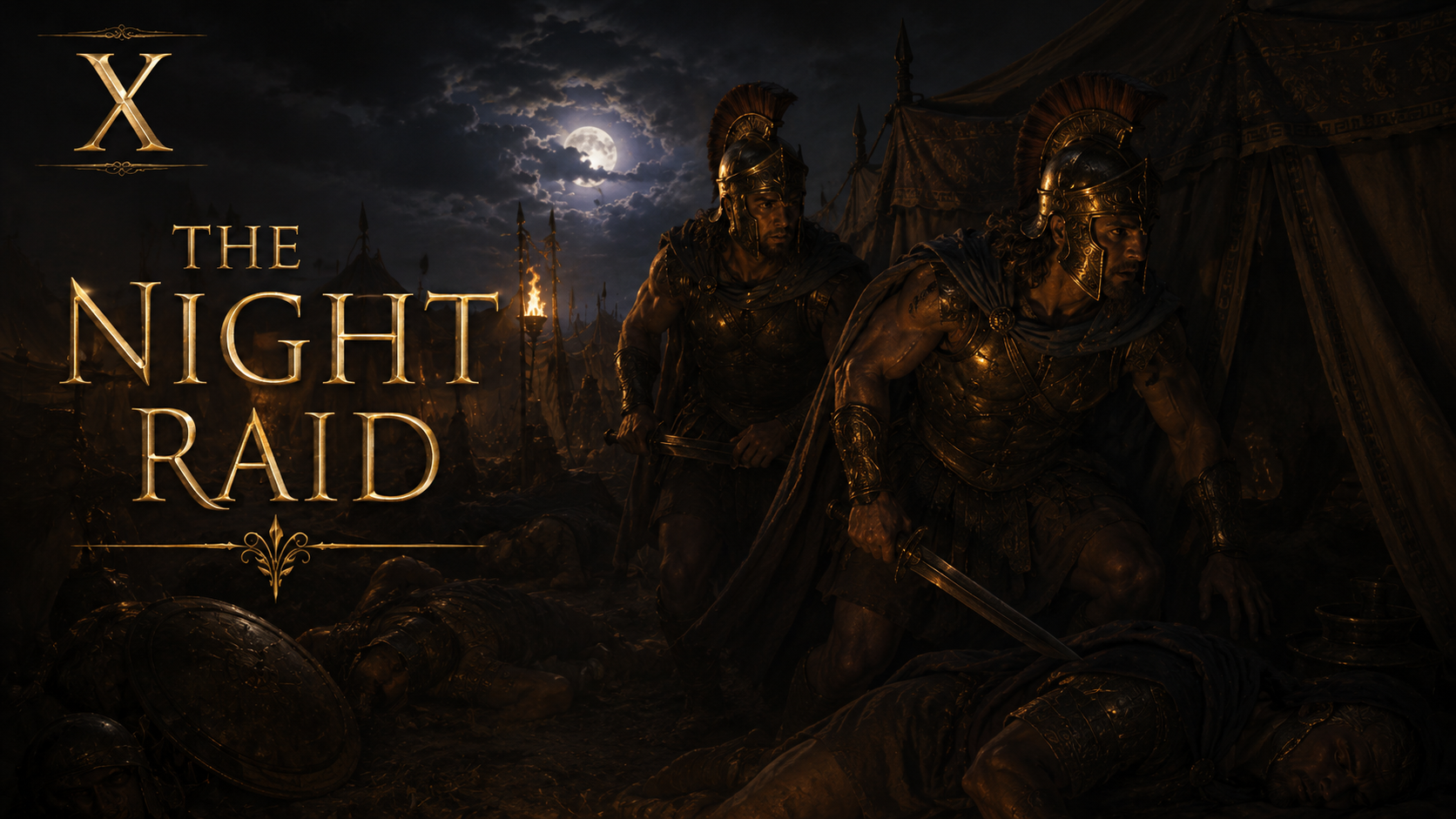
Lyrics
The old man spoke
and the circle grew still
with the sea behind
and Troy on the hill
No shield was lifted
no spear shone bright
only one hard question
cut through the night
Who will go out
where the watchfires burn
who will bring truth
before dawn returns
Who will walk
where no horns cry
with death in the grass
and Troy nearby
Who will walk into the night
who will step beyond the flame
Who will carry the dark alone
and come back carrying a name
No crowd will follow
no song will rise
only the stars
and the enemy’s eyes
Who will walk into the night
who will walk into the night
The young men listened
but no one moved
fear needs no voice
to tell the truth
For courage by daylight
can glitter like gold
but midnight asks
what the heart can hold
Then Diomedes
lifted his head
with fire in his blood
and no boast said
I will go out
where the danger lies
I will look Troy
straight in the eyes
But send me a man
whose mind runs deep
for the road is dark
and death does not sleep
A lone heart burns
but two hearts know
when to strike hard
and when to go
Who will walk into the night
who will step beyond the flame
Who will carry the dark alone
and come back carrying a name
No crowd will follow
no song will rise
only the stars
and the enemy’s eyes
Who will walk into the night
who will walk into the night
Many were worthy
many were strong
but one knew silence
and the shape of wrong
Odysseus came
with a hidden mind
seeing the road
that others leave behind
Not the loudest blade
not the brightest name
but a man who could move
where shadows came
Diomedes knew
before words were done
that night needs two
where daylight needs one
They took their weapons
without a cheer
no shining speech
to bury fear
Behind them slept
the army of Greece
in broken dreams
and borrowed peace
Before them waited
the breath of Troy
and the dark that swallows
both man and boy
Who will walk into the night
who will step beyond the flame
Who will carry the dark alone
and come back carrying a name
No crowd will follow
no song will rise
only the stars
and the enemy’s eyes
Who will walk into the night
who will walk into the night
So two men passed
where the watchline ends
not as brothers
not yet as friends
Side by side
with no need to speak
while the moon lay thin
and the sand was bleak
And before the blade
before the cry
the night looked back
through a goddess’ eye
Translations
Deutsch
[Strophe 1]
Der alte Mann sprach,
und der Kreis wurde still,
das Meer im Rücken,
Troja auf dem Hügel.
Kein Schild wurde gehoben,
kein Speer glänzte hell,
nur eine harte Frage
durchschnitt die Nacht.
Wer geht hinaus,
wo die Wachfeuer brennen?
Wer bringt Wahrheit zurück,
bevor die Morgenröte wiederkehrt?
Wer geht dort,
wo kein Horn ruft,
mit dem Tod im Gras
und Troja nahebei?
[Refrain]
Wer geht in die Nacht,
wer tritt jenseits der Flamme?
Wer trägt das Dunkel allein
und kehrt mit einem Namen zurück?
Keine Menge wird folgen,
kein Lied wird aufsteigen,
nur die Sterne
und die Augen des Feindes.
Wer geht in die Nacht?
Wer geht in die Nacht?
[Strophe 2]
Die jungen Männer hörten,
doch keiner bewegte sich;
Furcht braucht keine Stimme,
um die Wahrheit zu sagen.
Denn Mut bei Tageslicht
kann glänzen wie Gold,
doch Mitternacht fragt,
was das Herz halten kann.
Da hob Diomedes
seinen Kopf,
Feuer im Blut,
ohne Prahlerei.
Ich werde hinausgehen,
wo die Gefahr liegt;
ich werde Troja
gerade in die Augen sehen.
Doch schickt mir einen Mann,
dessen Geist tief läuft,
denn der Weg ist dunkel
und der Tod schläft nicht.
Ein einsames Herz brennt,
doch zwei Herzen wissen,
wann hart zuzuschlagen
und wann zu gehen ist.
[Refrain wiederholt]
[Strophe 3]
Viele waren würdig,
viele waren stark,
doch einer kannte das Schweigen
und die Gestalt des Unrechts.
Odysseus kam
mit verborgenem Geist,
er sah den Weg,
den andere übersehen.
Nicht die lauteste Klinge,
nicht der hellste Name,
sondern ein Mann, der gehen konnte,
wo Schatten kamen.
Diomedes wusste,
bevor die Worte endeten,
dass die Nacht zwei braucht,
wo der Tag einen braucht.
Sie nahmen ihre Waffen
ohne Jubel,
keine glänzende Rede,
um die Angst zu begraben.
Hinter ihnen schlief
das Heer der Griechen
in zerbrochenen Träumen
und geliehenem Frieden.
Vor ihnen warteten
der Atem Trojas
und das Dunkel, das
Mann und Knabe verschlingt.
[Refrain wiederholt]
[Strophe 4]
So gingen zwei Männer weiter,
wo die Wachlinie endet,
nicht als Brüder,
noch nicht als Freunde.
Seite an Seite,
ohne sprechen zu müssen,
während der Mond dünn lag
und der Sand trostlos war.
Und vor der Klinge,
vor dem Schrei,
blickte die Nacht zurück
durch das Auge einer Göttin.
Español
[Estrofa 1]
El anciano habló
y el círculo quedó inmóvil,
con el mar detrás
y Troya en la colina.
Ningún escudo se alzó,
ninguna lanza brilló,
solo una pregunta dura
cortó la noche.
¿Quién saldrá
donde arden las guardias?
¿Quién traerá la verdad
antes de que vuelva el alba?
¿Quién caminará
donde no gritan los cuernos,
con la muerte en la hierba
y Troya muy cerca?
[Estribillo]
¿Quién caminará en la noche,
quién irá más allá de la llama?
¿Quién llevará solo la oscuridad
y volverá trayendo un nombre?
No seguirá una multitud,
no se alzará ninguna canción,
solo las estrellas
y los ojos del enemigo.
¿Quién caminará en la noche?
¿Quién caminará en la noche?
[Estrofa 2]
Los jóvenes escucharon,
pero nadie se movió;
el miedo no necesita voz
para decir la verdad.
El valor a la luz del día
puede brillar como oro,
pero la medianoche pregunta
qué puede sostener el corazón.
Entonces Diomedes
levantó la cabeza,
con fuego en la sangre
y sin jactarse.
Yo saldré
donde vive el peligro;
miraré a Troya
directamente a los ojos.
Pero enviadme un hombre
cuya mente corra hondo,
pues el camino es oscuro
y la muerte no duerme.
Un corazón solitario arde,
pero dos corazones saben
cuándo golpear con fuerza
y cuándo retirarse.
[Estribillo repetido]
[Estrofa 3]
Muchos eran dignos,
muchos eran fuertes,
pero uno conocía el silencio
y la forma de lo torcido.
Odiseo llegó
con una mente oculta,
viendo el camino
que los otros dejan atrás.
No la hoja más ruidosa,
no el nombre más brillante,
sino un hombre capaz de moverse
por donde llegaban las sombras.
Diomedes supo,
antes de acabar las palabras,
que la noche necesita dos
donde el día necesita uno.
Tomaron sus armas
sin un grito,
sin discurso brillante
para enterrar el miedo.
Detrás dormía
el ejército griego
en sueños rotos
y paz prestada.
Delante aguardaban
el aliento de Troya
y la oscuridad que traga
tanto al hombre como al muchacho.
[Estribillo repetido]
[Estrofa 4]
Así pasaron dos hombres
por donde termina la guardia,
no como hermanos,
aún no como amigos.
Lado a lado,
sin necesidad de hablar,
mientras la luna yacía delgada
y la arena era desolada.
Y antes de la hoja,
antes del grito,
la noche devolvió la mirada
por el ojo de una diosa.
Français
[Couplet 1]
Le vieil homme parla,
et le cercle s’immobilisa,
la mer derrière eux,
Troie sur la colline.
Aucun bouclier ne se leva,
aucune lance ne brilla,
une seule question dure
trancha la nuit.
Qui sortira
là où brûlent les feux de garde ?
Qui ramènera la vérité
avant le retour de l’aube ?
Qui marchera
là où nul cor ne crie,
avec la mort dans l’herbe
et Troie tout près ?
[Refrain]
Qui marchera dans la nuit,
qui passera au-delà de la flamme ?
Qui portera seul l’obscurité
et reviendra portant un nom ?
Aucune foule ne suivra,
aucun chant ne s’élèvera,
seulement les étoiles
et les yeux de l’ennemi.
Qui marchera dans la nuit ?
Qui marchera dans la nuit ?
[Couplet 2]
Les jeunes hommes écoutèrent,
mais nul ne bougea ;
la peur n’a pas besoin de voix
pour dire la vérité.
Le courage en plein jour
peut briller comme l’or,
mais minuit demande
ce que peut porter le cœur.
Alors Diomède
leva la tête,
du feu dans le sang,
sans vantardise.
J’irai là
où se trouve le danger ;
je regarderai Troie
droit dans les yeux.
Mais donnez-moi un homme
dont l’esprit court profond,
car la route est noire
et la mort ne dort pas.
Un cœur solitaire brûle,
mais deux cœurs savent
quand frapper fort
et quand partir.
[Refrain repris]
[Couplet 3]
Beaucoup étaient dignes,
beaucoup étaient forts,
mais l’un connaissait le silence
et la forme de ce qui dévie.
Ulysse vint
avec un esprit caché,
voyant la route
que les autres laissent derrière.
Ni la lame la plus bruyante,
ni le nom le plus éclatant,
mais un homme capable d’avancer
là où venaient les ombres.
Diomède sut,
avant la fin des paroles,
que la nuit exige deux hommes
là où le jour n’en demande qu’un.
Ils prirent leurs armes
sans acclamation,
nul brillant discours
pour ensevelir la peur.
Derrière eux dormait
l’armée grecque,
dans des rêves brisés
et une paix empruntée.
Devant eux attendaient
le souffle de Troie
et l’ombre qui engloutit
l’homme comme le garçon.
[Refrain repris]
[Couplet 4]
Ainsi deux hommes passèrent
là où finit la ligne de garde,
non comme des frères,
pas encore comme des amis.
Côte à côte,
sans avoir besoin de parler,
tandis que la lune était mince
et le sable désolé.
Et avant la lame,
avant le cri,
la nuit regarda en retour
par l’œil d’une déesse.
Reflection
English
Night tests a different kind of courage from daylight battle. Diomedes’ willingness matters, but his request for Odysseus shows mature bravery: he chooses complementarity over solitary glory.
Book X moves through darkness, where courage depends on listening, disguise, memory, and judgment rather than open display. The night raid produces a tactical success, but its secrecy and ruthlessness leave moral unease beside the captured horses.
Textual basis
Homer, Iliad, Book X, lines 203–253: the Achaeans seek a volunteer, and Diomedes chooses Odysseus as his companion.
Reference edition used
Homer, Ilias. Griechisch–deutsch. Translated into German from the ancient Greek by Hans Rupé, 16th edition, Akademie Verlag, Berlin, 2013.
Deutsch
Die Nacht prüft einen anderen Mut als die Tagesschlacht. Diomedes’ Bereitschaft zählt, doch seine Bitte um Odysseus zeigt reife Tapferkeit: Er wählt Ergänzung statt einsamen Ruhm.
Der zehnte Gesang bewegt sich durch die Dunkelheit, in der Mut nicht von offener Schaustellung, sondern von Lauschen, Verstellung, Erinnerung und Urteilskraft abhängt. Der nächtliche Streifzug bringt einen taktischen Erfolg, doch seine Heimlichkeit und Härte lassen neben den erbeuteten Pferden moralisches Unbehagen zurück.
Textgrundlage
Homer, Ilias, 10. Gesang, Verse 203–253: die Achaier einen Freiwilligen suchen und Diomedes Odysseus als Begleiter wählt.
Verwendete Referenzausgabe
Homer, Ilias. Griechisch–deutsch. Übertragen von Hans Rupé, 16. Auflage, Akademie Verlag, Berlin 2013.
Español
La noche pone a prueba un valor distinto del combate diurno. Importa la disposición de Diomedes, pero pedir a Odiseo revela una valentía madura: elige complementarse antes que buscar gloria solitaria.
El canto X avanza por la oscuridad, donde el valor depende de escuchar, ocultarse, recordar y juzgar más que de exhibirse abiertamente. La incursión nocturna logra un éxito táctico, pero su secreto y su crueldad dejan una inquietud moral junto a los caballos capturados.
Base textual
Homero, Ilíada, canto X, versos 203–253: los aqueos buscan un voluntario y Diomedes elige a Odiseo como compañero.
Edición de referencia utilizada
Homer, Ilias. Griechisch–deutsch. Traducción alemana del griego antiguo de Hans Rupé, 16.ª edición, Akademie Verlag, Berlín, 2013.
Français
La nuit éprouve un courage différent de celui du combat diurne. La volonté de Diomède compte, mais sa demande d’Ulysse révèle une bravoure mûre : il choisit la complémentarité plutôt que la gloire solitaire.
Le chant X traverse l’obscurité, où le courage dépend de l’écoute, du déguisement, de la mémoire et du jugement plutôt que de l’éclat public. Le raid nocturne apporte un succès tactique, mais son secret et sa dureté laissent un malaise moral auprès des chevaux capturés.
Base textuelle
Homère, Iliade, chant X, vers 203–253 : les Achéens cherchent un volontaire et Diomède choisit Ulysse pour compagnon.
Édition de référence utilisée
Homer, Ilias. Griechisch–deutsch. Traduction allemande du grec ancien par Hans Rupé, 16e édition, Akademie Verlag, Berlin, 2013.