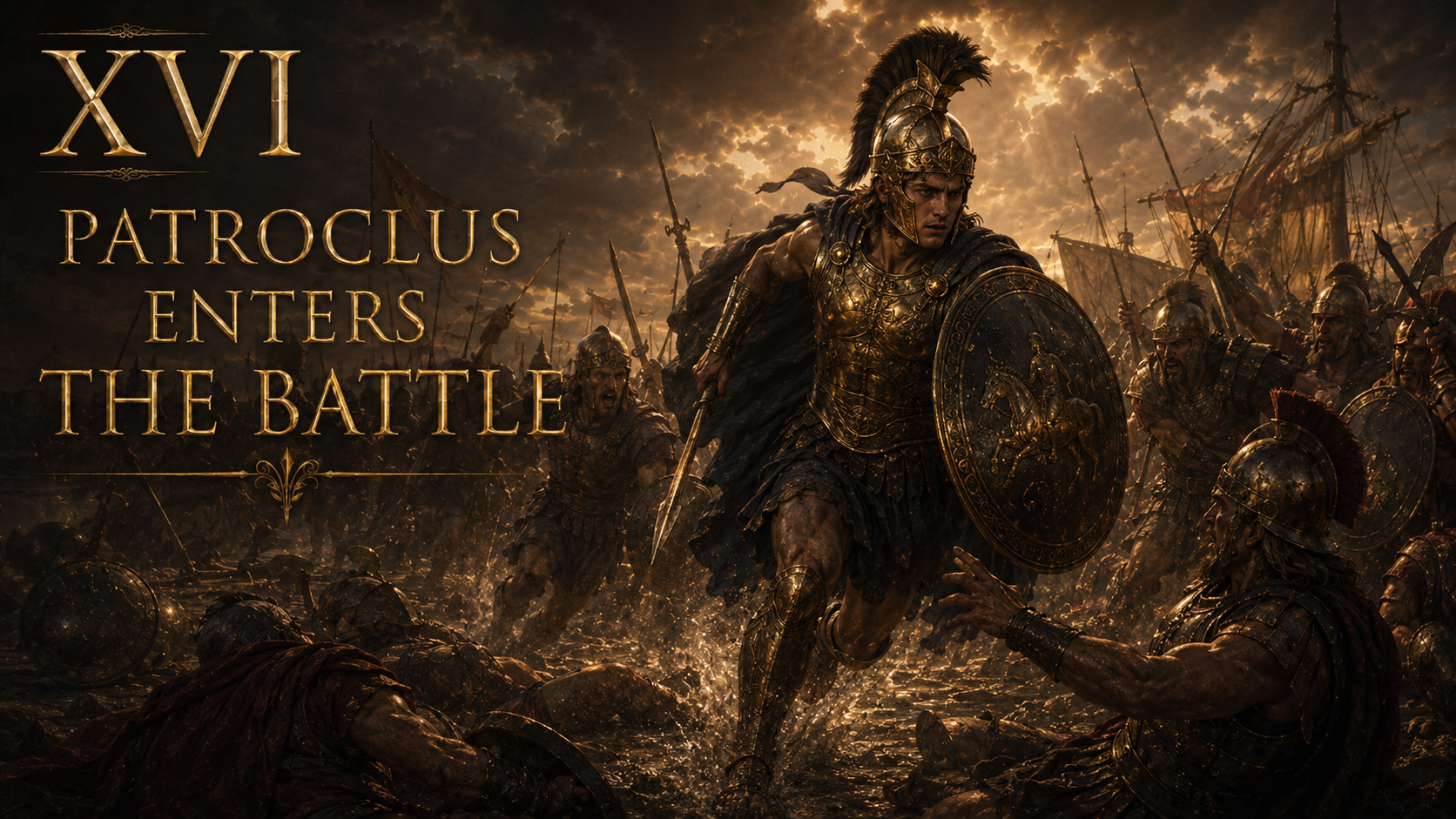
Lyrics
The dust had closed around him
The god had struck his pride
The first wound burned within him
And daylight stepped aside
The borrowed bronze hung heavy
The borrowed name grew thin
And all the roaring battle
Came circling back again
Then Hector came through thunder
With Troy behind his breath
A prince beneath the sunlight
Walking straight into death
Hector took the flame
From the man who carried fire
Hector took the flame
But he did not know the pyre
One brave heart fell silent
One bright road turned black
Hector took the flame
And called Achilles back
Patroclus stood there wounded
But still his spirit burned
He had saved the ships from ruin
Yet never had returned
He had crossed the line of warning
He had followed glory’s cry
He had worn another’s storm-light
Under an unforgiving sky
Now the field became a doorway
Now the plain became a stone
And the man inside the armor
Had to meet the end alone
Hector took the flame
From the man who carried fire
Hector took the flame
But he did not know the pyre
One brave heart fell silent
One bright road turned black
Hector took the flame
And called Achilles back
This was friendship turned to ashes
This was courage torn in two
This was love without protection
Doing what it had to do
And the spear went through the morning
And the dust received the cry
And the sea far off kept breathing
Under one more darkened sky
Hector took the flame
From the man who carried fire
Hector took the flame
But he did not know the pyre
One brave heart fell silent
One bright road turned black
Hector took the flame
And called Achilles back
Do not boast too high, son of Priam
Do not drink too deep of this day
There are footsteps by the water
There is wrath along the bay
When that knowledge finds Achilles
When that grief becomes his breath
The flame you think you captured
Will come back dressed as death
Hector took the flame
From the man who carried fire
Hector took the flame
But he did not know the pyre
One brave heart fell silent
One bright road turned black
Hector took the flame
And called Achilles back
Hector took the armor
Hector took the name
But he woke the greater fire
Hidden in the flame
Translations
English
The original English lyrics are shown in the Lyrics section above.
Deutsch
Staub schließt sich um Patroklos. Gottesschlag und erste Wunde haben den geliehenen Glanz verdünnt, als Hektor mit Troja im Atem auf ihn zutritt. Der tödliche Speer fällt in einen Kampf, der längst nicht mehr gleich ist.
Patroklos hat die Schiffe gerettet, aber die Warnungsgrenze überschritten. Nun wird die Ebene zur Tür und der Mensch in der Rüstung muss das Ende allein empfangen. Sein Mut und seine Freundschaft werden nicht ausgelöscht, nur weil die göttliche Ordnung ihn preisgibt.
Hektor nimmt die Flamme und glaubt, sie zu besitzen. Tatsächlich entzündet der Tod Patroklos’ erst das größere Feuer: Sobald Achilleus erfährt, was geschehen ist, kehrt der Glanz als Vergeltung zurück.
Español
El polvo se cierra alrededor de Patroclo. El golpe divino y la primera herida han debilitado el resplandor prestado cuando Héctor se acerca con Troya en su aliento. La lanza mortal entra en una lucha que ya no es igual.
Patroclo ha salvado las naves, pero cruzó el límite de la advertencia. Ahora la llanura se vuelve puerta y el hombre dentro de la armadura debe recibir solo el final. Su valor y su amistad no desaparecen porque el orden divino lo abandone.
Héctor toma la llama y cree poseerla. En realidad, la muerte de Patroclo enciende el fuego mayor: cuando Aquiles sepa lo ocurrido, el resplandor volverá como venganza.
Français
La poussière se referme autour de Patrocle. Le coup du dieu et la première blessure ont affaibli l’éclat emprunté lorsque Hector s’approche, portant Troie dans son souffle. La lance mortelle entre dans un combat qui n’est déjà plus égal.
Patrocle a sauvé les nefs, mais franchi la limite de l’avertissement. La plaine devient une porte et l’homme dans l’armure doit recevoir seul la fin. Son courage et son amitié ne sont pas effacés parce que l’ordre divin l’abandonne.
Hector prend la flamme et croit la posséder. En réalité, la mort de Patrocle allume le feu plus vaste : lorsque Achille apprendra ce qui s’est passé, l’éclat reviendra sous la forme de la vengeance.
English
Hector’s act is decisive but not self-sufficient. He arrives at the end of a sequence begun by Apollo and Euphorbus, then reads the result as personal triumph. The gap between what happens and the story a victor tells about it becomes one of the scene’s central moral tensions.
The “flame” Hector takes cannot be held as a trophy. Patroclus’ death transfers the centre of the epic back to Achilles and gives his withdrawal a devastating answer. What appears to be Troy’s brightest moment is therefore already darkened by the consequence it has awakened.
Textual basis
Homer, Iliad, Book XVI, lines 818–843: Hector meets the retreating, wounded Patroclus and delivers the final spear-thrust.
Reference edition used
Homer, Ilias. Griechisch–deutsch. Translated into German from the ancient Greek by Hans Rupé, 16th edition, Akademie Verlag, Berlin, 2013.
Deutsch
Hektors Tat ist entscheidend, aber nicht selbstgenügsam. Er kommt ans Ende einer Folge, die Apollon und Euphorbos begonnen haben, und deutet das Ergebnis als persönlichen Triumph. Der Abstand zwischen dem Geschehen und der Erzählung des Siegers wird zu einer zentralen moralischen Spannung der Szene.
Die „Flamme“, die Hektor nimmt, lässt sich nicht als Beute festhalten. Patroklos’ Tod verlagert das Zentrum des Epos zurück zu Achilleus und beantwortet dessen Rückzug auf verheerende Weise. Was wie Trojas hellster Augenblick aussieht, wird bereits von der Folge verdunkelt, die er geweckt hat.
Textgrundlage
Homer, Ilias, Gesang XVI, Verse 818–843: Hektor trifft auf den zurückweichenden, verwundeten Patroklos und führt den letzten Speerstoß.
Verwendete Referenzausgabe
Homer, Ilias. Griechisch–deutsch. Übertragen von Hans Rupé, 16. Auflage, Akademie Verlag, Berlin 2013.
Español
El acto de Héctor es decisivo, pero no autosuficiente. Llega al final de una secuencia iniciada por Apolo y Euforbo y lee el resultado como triunfo personal. La distancia entre lo ocurrido y el relato del vencedor se vuelve una de las tensiones morales centrales de la escena.
La “llama” que Héctor toma no puede conservarse como trofeo. La muerte de Patroclo devuelve el centro del poema a Aquiles y responde de forma devastadora a su retirada. Lo que parece el momento más luminoso de Troya ya está oscurecido por la consecuencia que ha despertado.
Base textual
Homer, Ilíada, canto XVI, versos 818–843: Héctor encuentra a Patroclo herido y en retirada y asesta el último golpe de lanza.
Edición de referencia utilizada
Homer, Ilias. Griechisch–deutsch. Traducción alemana del griego antiguo de Hans Rupé, 16.ª edición, Akademie Verlag, Berlín, 2013.
Français
L’acte d’Hector est décisif, mais non autonome. Il arrive au terme d’une suite commencée par Apollon et Euphorbe, puis lit le résultat comme un triomphe personnel. L’écart entre ce qui s’est produit et le récit du vainqueur devient l’une des tensions morales centrales de la scène.
La « flamme » prise par Hector ne peut être conservée comme trophée. La mort de Patrocle replace Achille au centre de l’épopée et donne à son retrait une réponse dévastatrice. Ce qui paraît être l’instant le plus lumineux de Troie est déjà obscurci par la conséquence qu’il a réveillée.
Base textuelle
Homer, Iliade, chant XVI, vers 818–843: Hector rencontre Patrocle blessé et en retrait, puis porte le dernier coup de lance.
Édition de référence utilisée
Homer, Ilias. Griechisch–deutsch. Traduction allemande du grec ancien par Hans Rupé, 16e édition, Akademie Verlag, Berlin, 2013.