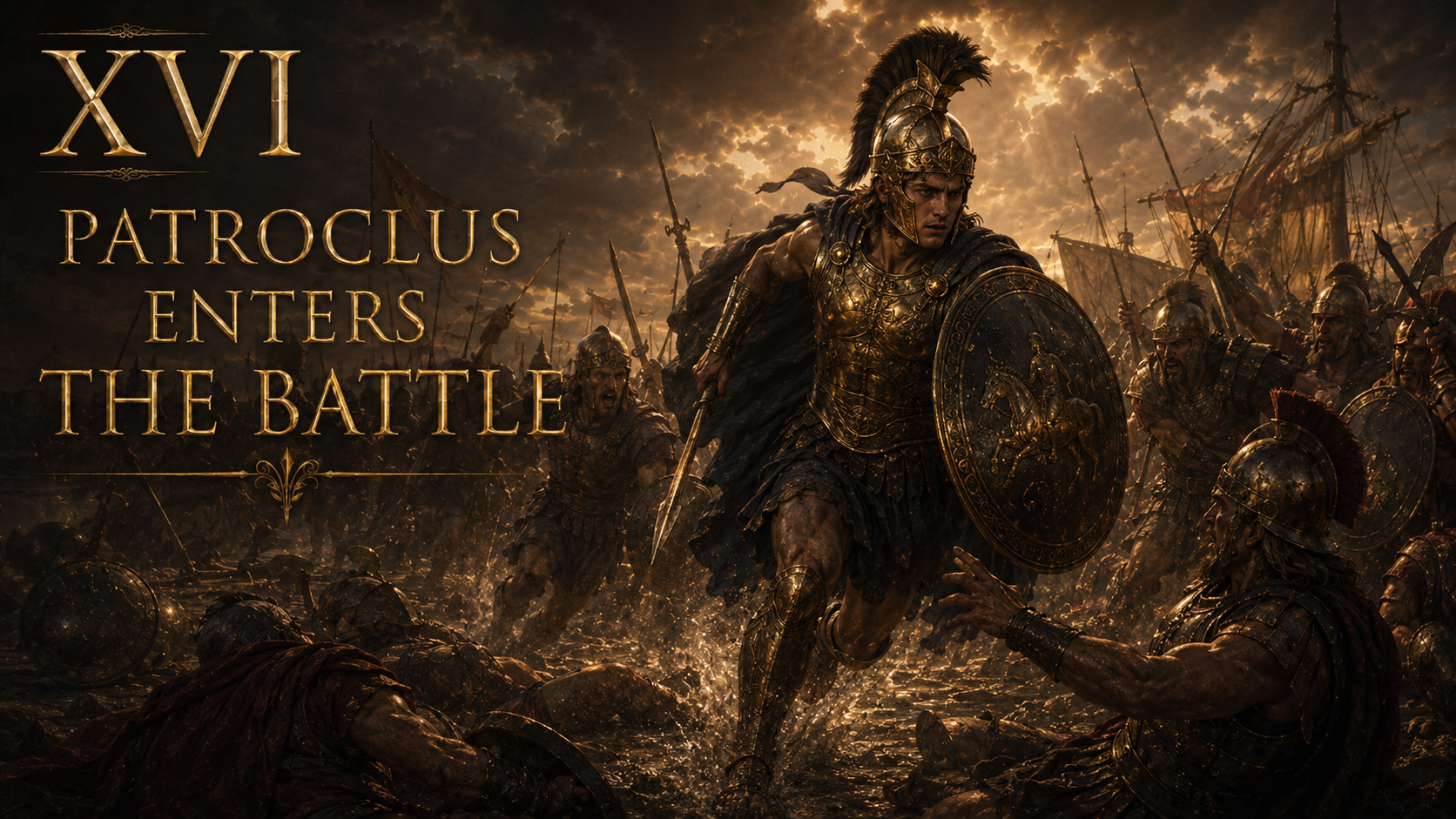
Lyrics
The ships are smoking by the shore
And men are falling in the sand
I hear their voices through the roar
Like broken oars in a drowning hand
You sit beside your wounded pride
With thunder folded in your chest
But out there brothers burn and cry
And mercy cannot wait for rest
Lend me your fire
Let me wear your thunder
Not for glory
Not for my name
Lend me your fire
Till the black ships breathe again
I will drive the darkness backward
I will carry your flame
I know the weight of what I ask
Your armor is no borrowed cloak
It holds the glare behind your mask
It smells of bronze and battle smoke
But if your heart will not return
Then let your shadow take the field
Let frightened Trojans see it burn
And make their rising courage yield
Lend me your fire
Let me wear your thunder
Not for glory
Not for my name
Lend me your fire
Till the black ships breathe again
I will drive the darkness backward
I will carry your flame
Tell me the border I must keep
Tell me the line I must not cross
I only go where comrades weep
I only count the living cost
I will not chase the city walls
I will not hunger for the crown
I only go where ruin calls
To pull our bleeding brothers out
But war has teeth beneath the dust
And gods bend close where bright men run
A borrowed blaze, a borrowed trust
May burn too near the falling sun
Lend me your fire
Let me wear your thunder
Not for glory
Not for my name
Lend me your fire
Till the black ships breathe again
I will drive the darkness backward
I will carry your flame
If I come back when smoke is gone
We’ll laugh beneath the evening sky
If I am lost before the dawn
Remember why I had to try
The sea is dark, the tents are red
The wounded call from every side
Give me the helm above your head
And let your wrath become my stride
Lend me your fire
Let me wear your thunder
Not for glory
Not for my name
Lend me your fire
Till the black ships breathe again
I will drive the darkness backward
I will carry your flame
I will carry your flame
Through the smoke and the crying
I will carry your flame
Where the bravest are dying
I will carry your flame
Though the road may turn colder
I will carry your flame
On a borrowed shoulder
Translations
English
The original English lyrics are shown in the Lyrics section above.
Deutsch
Die Schiffe rauchen am Ufer, Männer fallen im Sand, und ihre Stimmen dringen wie zerbrochene Ruder durch den Lärm. Patroklos sieht Achilleus neben seinem verwundeten Stolz sitzen und erinnert ihn daran, dass Barmherzigkeit nicht warten kann.
Er bittet darum, Achilleus’ Feuer und Donner zu tragen – nicht für Ruhm und nicht für den eigenen Namen, sondern bis die schwarzen Schiffe wieder atmen. Die Rüstung ist kein bloßer Mantel: Sie trägt den Glanz, den Geruch und die furchteinflößende Gestalt des Achilleus.
Patroklos verspricht, die Grenze einzuhalten und nicht bis zu Trojas Mauern zu jagen. Doch das Lied lässt bereits erkennen, dass Krieg und Götter den geliehenen Glanz in eine Gefahr verwandeln können. Sollte er nicht zurückkehren, soll Achilleus sich daran erinnern, warum er ging.
Español
Las naves humean junto a la orilla, los hombres caen en la arena y sus voces atraviesan el estruendo como remos rotos. Patroclo ve a Aquiles sentado junto a su orgullo herido y le recuerda que la compasión no puede esperar.
Le pide llevar su fuego y su trueno, no por gloria ni por un nombre propio, sino hasta que las naves negras vuelvan a respirar. La armadura no es una simple capa: contiene el resplandor, el humo y la figura temida de Aquiles.
Patroclo promete respetar el límite y no perseguir al enemigo hasta las murallas de Troya. Sin embargo, la canción anuncia que la guerra y los dioses pueden convertir el fulgor prestado en peligro. Si no regresa, Aquiles deberá recordar por qué partió.
Français
Les nefs fument au bord du rivage, les hommes tombent dans le sable et leurs voix traversent le fracas comme des rames brisées. Patrocle voit Achille assis auprès de son orgueil blessé et lui rappelle que la compassion ne peut attendre.
Il demande à porter son feu et son tonnerre, non pour la gloire ni pour son propre nom, mais jusqu’à ce que les nefs noires respirent de nouveau. L’armure n’est pas un simple manteau : elle porte l’éclat, la fumée et la silhouette redoutée d’Achille.
Patrocle promet de respecter la limite et de ne pas poursuivre l’ennemi jusqu’aux murs de Troie. Pourtant, le chant annonce déjà que la guerre et les dieux peuvent changer cette lumière empruntée en danger. S’il ne revient pas, Achille devra se souvenir de la raison de son départ.
English
Patroclus begins from compassion rather than ambition. He cannot endure the distance between Achilles’ private injury and the public suffering at the ships. His request therefore exposes the moral cost of withdrawal: even a justified grievance can become destructive when others must pay for it.
Yet the borrowed armour creates a fatal ambiguity. Patroclus wants to carry Achilles’ saving power without carrying his anger, but symbols have their own momentum. The disguise will rescue the fleet while also drawing Patroclus into a role larger and more dangerous than the mercy that first sent him out.
Textual basis
Homer, Iliad, Book XVI, lines 1–100: Patroclus weeps for the suffering Achaeans and asks Achilles for the Myrmidons and his armour.
Reference edition used
Homer, Ilias. Griechisch–deutsch. Translated into German from the ancient Greek by Hans Rupé, 16th edition, Akademie Verlag, Berlin, 2013.
Deutsch
Patroklos handelt zunächst aus Mitgefühl, nicht aus Ehrgeiz. Er erträgt den Abstand zwischen der persönlichen Kränkung des Achilleus und dem öffentlichen Leiden bei den Schiffen nicht länger. Seine Bitte zeigt damit den moralischen Preis des Rückzugs: Selbst berechtigter Zorn wird zerstörerisch, wenn andere ihn bezahlen müssen.
Die geliehene Rüstung erzeugt jedoch eine verhängnisvolle Mehrdeutigkeit. Patroklos möchte die rettende Kraft des Achilleus tragen, ohne dessen Zorn zu übernehmen. Doch Zeichen entwickeln eine eigene Dynamik: Die Verkleidung rettet die Flotte und zieht Patroklos zugleich in eine Rolle, die größer und gefährlicher ist als das Mitgefühl, das ihn hinausführt.
Textgrundlage
Homer, Ilias, Gesang XVI, Verse 1–100: Patroklos beweint das Leiden der Achaier und bittet Achilleus um die Myrmidonen und seine Rüstung.
Verwendete Referenzausgabe
Homer, Ilias. Griechisch–deutsch. Übertragen von Hans Rupé, 16. Auflage, Akademie Verlag, Berlin 2013.
Español
Patroclo parte de la compasión y no de la ambición. Ya no soporta la distancia entre la herida privada de Aquiles y el sufrimiento público junto a las naves. Su petición revela así el coste moral de la retirada: incluso un agravio justificado se vuelve destructivo cuando otros deben pagarlo.
La armadura prestada, sin embargo, crea una ambigüedad fatal. Patroclo quiere llevar el poder salvador de Aquiles sin adoptar su ira, pero los símbolos adquieren su propio impulso. El disfraz salvará la flota y, al mismo tiempo, arrastrará a Patroclo hacia un papel mayor y más peligroso que la misericordia que lo puso en camino.
Base textual
Homer, Ilíada, canto XVI, versos 1–100: Patroclo llora por el sufrimiento de los aqueos y pide a Aquiles los mirmidones y su armadura.
Edición de referencia utilizada
Homer, Ilias. Griechisch–deutsch. Traducción alemana del griego antiguo de Hans Rupé, 16.ª edición, Akademie Verlag, Berlín, 2013.
Français
Patrocle agit d’abord par compassion, non par ambition. Il ne supporte plus la distance entre la blessure privée d’Achille et la souffrance publique près des nefs. Sa demande révèle ainsi le prix moral du retrait : même un grief légitime devient destructeur lorsque d’autres doivent le payer.
L’armure empruntée crée pourtant une ambiguïté fatale. Patrocle veut porter la puissance salvatrice d’Achille sans reprendre sa colère, mais les symboles acquièrent leur propre élan. Le déguisement sauvera la flotte tout en entraînant Patrocle dans un rôle plus vaste et plus dangereux que la pitié qui l’a d’abord envoyé au combat.
Base textuelle
Homer, Iliade, chant XVI, vers 1–100: Patrocle pleure la souffrance des Achéens et demande à Achille ses Myrmidons et son armure.
Édition de référence utilisée
Homer, Ilias. Griechisch–deutsch. Traduction allemande du grec ancien par Hans Rupé, 16e édition, Akademie Verlag, Berlin, 2013.